
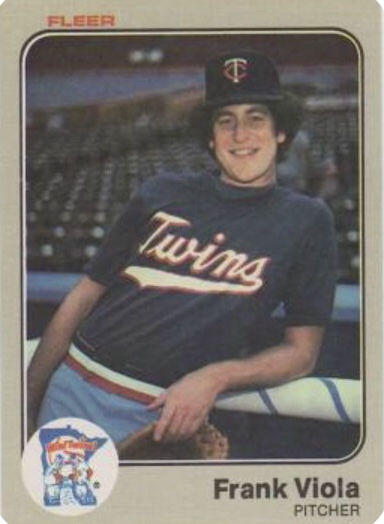

Value: $50.00 – Grade: 9
Metrodome Streak: https://youtu.be/Q3Px55ZhVWE
Frank John Viola Jr. (born in Hempstead, NY on April 19, 1960) is an American former starting pitcher in Major League Baseball who played for the Minnesota Twins (1982–1989), New York Mets (1989–1991), Boston Red Sox (1992–1994), Cincinnati Reds (1995), and Toronto Blue Jays (1996). A three-time All-Star, he was named World Series MVP with the Twins in 1987 and won the AL Cy Young Award in 1988. He is the pitching coach of the High Point Rockers. He batted and threw left-handed, and he was nicknamed “Sweet Music” – a nickname he picked up after a Minnesota sports writer declared that when Viola pitched, there was “Sweet Music” in the Hubert H. Humphrey Metrodome. The nickname was a play on the fact that his last name is also a name of a musical instrument, although pronounced differently. A fan began displaying a banner bearing the phrase in the outfield’s upper deck whenever Viola pitched. Twins fans considered the banner to be a good luck charm. The banner is now the property of the Minnesota Historical Society. It was again displayed when Viola was inducted into the Twins Hall of Fame. He was honored as a member of the Twins’ “All Dome” team in 2009. Viola was born and grew up in East Meadow, New York, with his brother John and sister Nancy, and he went on to attend and play baseball for East Meadow High School before playing at the collegiate level for St. John’s University. On May 21, 1981, Viola faced future Mets teammate Ron Darling, then playing for Yale University. The game, often considered to be the best in college baseball history, saw Darling pitch 11 innings of no-hit ball before surrendering his only hit, a leadoff single in the 12th, leading to the game’s only run. Viola himself threw 11 innings of shutout ball. Viola was drafted following his senior year in the 16th round of the 1979 Major League Baseball draft by the Kansas City Royals, but he did not sign. Viola signed with the Minnesota Twins after the team drafted him in the second round of the 1981 Major League Baseball draft. After spending less than a full season in the minor leagues, Viola made his major league debut on June 6, 1982. Although his statistics were fairly disappointing—he finished 11–25 with a 5.37 ERA in the 1982 and 1983 seasons—Viola became a permanent fixture of the Twins’ starting staff for the next 7 seasons, picking up 112 of his 176 career wins. Viola helped pitch the Twins to their second World Series appearance and first World Series win in 1987; he finished the season with a 17–10 record, a 2.90 ERA, and 197 strikeouts in 251+2⁄3innings. Viola would then sparkle in the post-season, going a combined 3–1 with 25 strikeouts in 31+1⁄3 innings despite a 4.31 ERA. Following the Twins’ Game 7 series–clinching win—a game which Viola won 4–2—he was named the 1987 World Series Most Valuable Player. Most baseball enthusiasts agree that Viola’s best year was 1988, his last full year with the Twins. That year, he threw his signature circle change with skill, compiling an impressive 24–7 record with 7 complete games and 2 shutouts in 255 innings pitched with a career-low ERA of 2.64. He also gave up only 20 home runs and 54 walks. Viola led the league in wins and would go on to win the AL Cy Young Award in a landslide, finishing with 27 of the 28 first-place votes and beating out second-place Dennis Eckersley by 86 total votes.
 High Quality Baseball Cards