
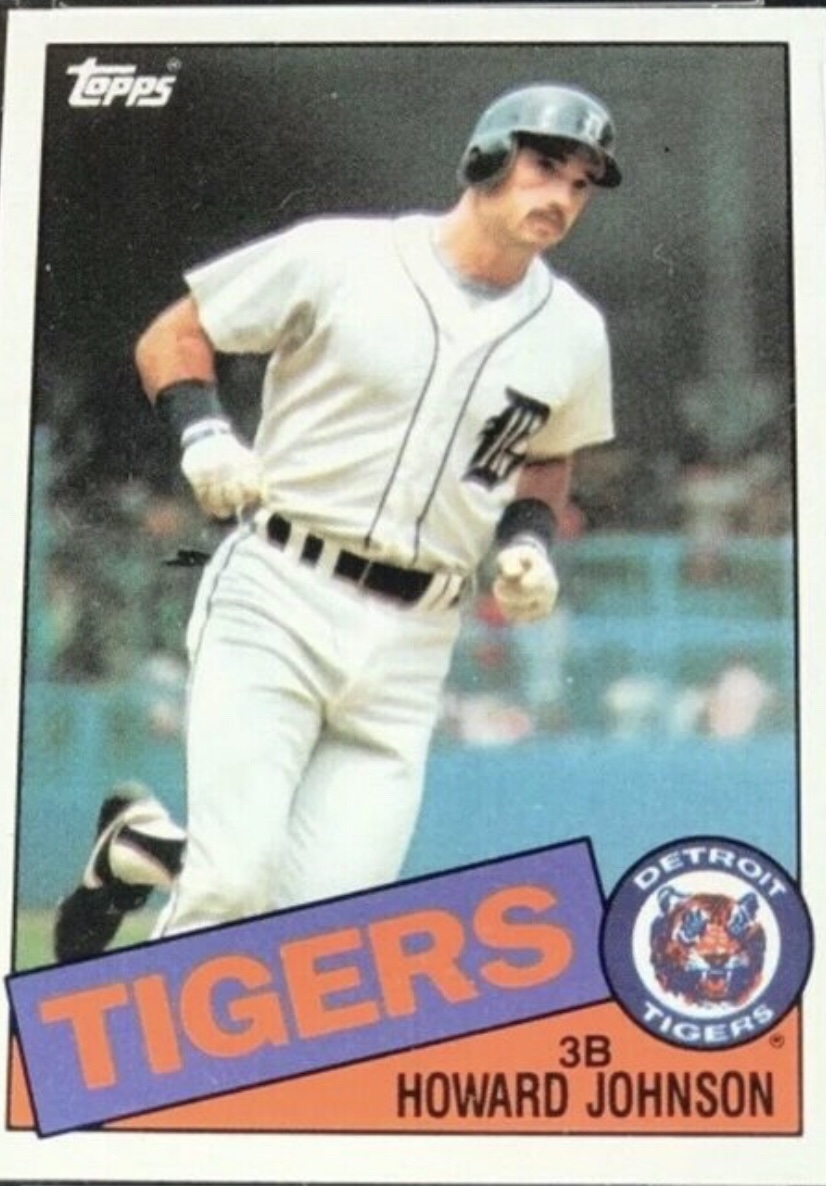
1987 Highlights: https://youtu.be/BbxSDXNwDa8
Howard Michael Johnson (born in Clearwater, FL on November 29, 1960), nicknamed HoJo (the nickname of the otherwise unrelated Howard Johnson’s company), is an American former professional baseball third baseman. He played for the Detroit Tigers, New York Mets, Colorado Rockies, and Chicago Cubs of the Major League Baseball (MLB) from 1982 to 1995. He is third on the Mets’ all-time lists for home runs, runs batted in, doubles, and stolen bases. He also played for the Rockland Boulders of the Canadian-American Association of Professional Baseball. On July 13, 2007, he was promoted from his position as the Mets’ first base coach to their hitting coach which he held until the end of the 2010 season. From 2014 to June 2015, he was the hitting coach of the Seattle Mariners after starting 2013 as the batting instructor for the Tacoma Rainiers, the Mariners’ Triple-A affiliate. In the minor leagues, the Tigers soon converted Johnson from a pitcher to an infielder, and in 1981, he hit 22 home runs for the AA Birmingham Barons. He was promoted to Detroit to start 1982, but was hitting only .188 in early May when he was sent back to AAA. He was back in the majors in mid-August and posted fantastic numbers for the rest of the season, including a .405 average in September that raised his final average to .316. He started 1983 with the big club but was sent down again in late May with a .212 averagIn 1984, Johnson was back with the Tigers and was made the left side of a platoon with Tom Brookens. Johnson started fairly well but had a poor second half. He finished the regular season with a .248 batting average, 50 runs batted in (RBI) and 12 homers in 355 at bats. The Tigers led the division for the entire campaign but Johnson sat the bench for the entire 1984 ALCS while Brookens, Marty Castillo and Darrell Evans split time at third. Johnson wound up pinch-hitting only once in the 1984 World Series, reaching on an error by second baseman Alan Wiggins as the Tigers eased through the postseason en route to the world championship. Johnson was traded from the Tigers to the New York Mets for Walt Terrell at the Winter Meetings on December 7, 1984. The move put three players at third base for the Mets but, three days later, they sent Hubie Brooks to the Montreal Expos as part of a trade for catcher Gary Carter. Johnson’s inability to hit well from the right side resulted in him being platooned by the Mets in 1985, this time with Ray Knight. Both started terribly and neither reached .200 until early July. Johnson hit below average all season, while Knight was even worse. The Mets, as they had in 1984, narrowly missed the postseason in 1985. 1986 was the year of the Mets and both Johnson and Knight started very well. The Mets’ problems shifted from third base to shortstop as Rafael Santana struggled to keep his average above .150 most of the season. Johnson was a capable shortstop defensively and picked up extra playing time moving between short and third but his hitting started declining in May. Between his mediocre hitting, continued lack of power, and an injury that wiped out three weeks in June, Johnson played in only 88 games in the regular season. When he returned from the June injury, Johnson went on a home run tear including two in his first game back and, within six weeks, his slugging percentage jumped from .376 to .510. One of Johnson’s home runs occurred in a legendary game on July 22, 1986, against the Cincinnati Reds. When a 10th-inning bench-clearing fight ended, three Mets players were out of the game and they were forced to spend the rest of the game with a pitcher in the outfield and two pitchers in the batting lineup. When one of the pitchers, Jesse Orosco, drew a walk in the 14th inning, Johnson followed with a three-run home run that led to a Mets win. Johnson faded down the stretch and was virtually shut out of the postseason, going 0-for-7 in four games. His only start was Game 2 of the 1986 World Series, when he went 0-for-4 in a crucial Mets loss that put them in an 0–2 hole. His only other at bat in the series was in Game 6, when he struck out in the ninth inning. Nevertheless, at age 25, Johnson already had his second World Series ring. Ray Knight was allowed to become a free agent after the 1986 World Series. Johnson, given sole ownership of the third base position, began a three-month power surge in mid-May. In 10 games, he hit five home runs, including a pair of three-run shots, with 13 RBI. In an 11-game span a month later, he hit another six home runs with 10 RBI. In seven games around the all-star break, he hit another six home runs and seven RBIs, raising his slugging percentage over .520. With his 22nd home run of the season in mid-July, the previously light-hitting Johnson took over the team home run lead from Darryl Strawberrywhile hitting from the seventh spot in the batting order. He ended July with six RBIs in seven games along with a four-hit game, and then started August with a grand slam. In a 13-game span in late July and early August, he had at least one RBI in all but one game and amassed 17 RBIs overall. Three games in mid-August brought another three home runs and seven RBIs, but the power tear was about over for his breakout season. Johnson’s power surge was complemented by a surge in speed. Although he had 31 stolen bases in five previous seasons, on September 11, 1987, Johnson stole his 30th base to join the 30–30 clubfor the first time. Johnson became the first switch-hitter to join the club, and he and Strawberry became the only teammates to achieve 30–30 status in the same season. Another grand slam in September brought Johnson’s home run total to 36, just four shy of his entire career before 1987. Unfortunately for the Mets, as Johnson’s power faded, so did their run at the postseason and the defending champions missed the playoffs. The entire league took notice of Johnson’s unexpected rise in 1987 and he received 42 points in the voting for National League MVP. His home run and RBI totals were second only to Strawberry on the team and his home runs were seventh-best in the entire majors. His right-handed hitting was substantially better than his left-handed hitting with numbers better in almost every category including a batting average 36 points higher and slugging 74 points higher. His 36 home runs overall were the most in National League history by a switch-hitter, breaking Ripper Collins’ 53-year-old record.
 High Quality Baseball Cards