

Hall of Fame Biography: https://youtu.be/gIZpWB256e4
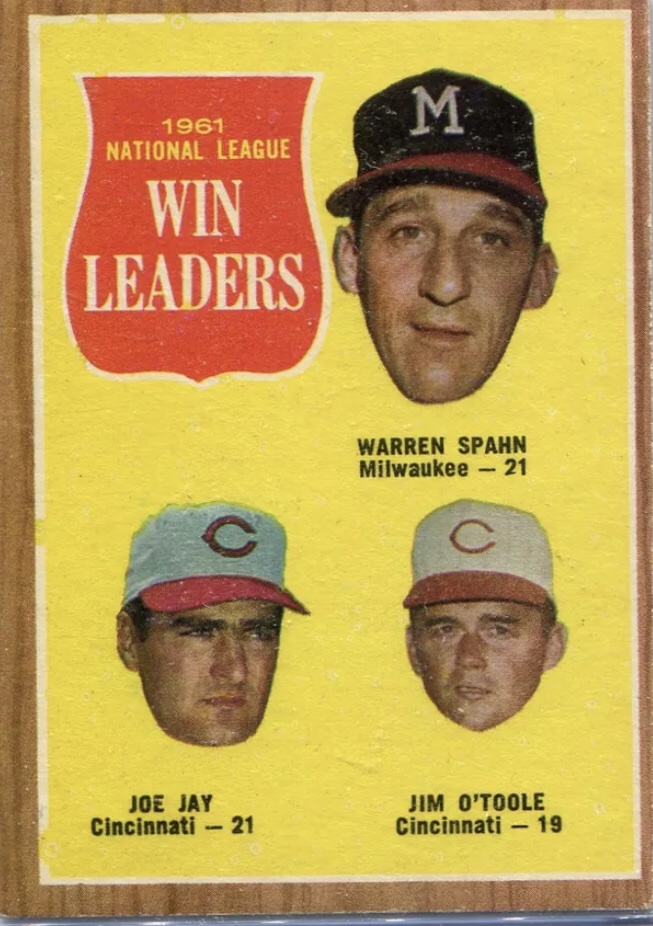
Warren Edward Spahn (Born in Buffalo, NY on April 23, 1921 – November 24, 2003) was an American professional baseball player. He played in Major League Baseball as a left-handed pitcher in 1942 and then from 1946 until 1965, most notably for the Boston Braves, who became the Milwaukee Braves after the team moved west before the 1953 season. His baseball career was interrupted by his military service in the United States Army during the Second World War. Born and raised in Buffalo, New York, Spahn attended South Park High School. With 363 victories over the span of his 21-year baseball playing career, Spahn holds the major league record for most career wins by a left-handed pitcher, and the most by a pitcher who played his entire career in the post-1920 live-ball era.[3] He was a 17-time All-Star player who won 20 games or more in 13 seasons, including a 23–7 record when he was age 42. Spahn won the 1957 Cy Young Award and was a three-time runner-up during the period when only one award was given for both leagues. At the time of his retirement in 1965, Spahn held the Major League Baseball record for career strikeouts by a left-handed pitcher. He was elected to the Baseball Hall of Fame in his first year of eligibility in 1973 with 82.89% of the vote. The Warren Spahn Award, given annually to the major leagues’ best left-handed pitcher, is named in his honor. Regarded as a “thinking man’s” pitcher who liked to outwit batters, Spahn once described his approach on the mound: “Hitting is timing. Pitching is upsetting timing.” Spahn’s major league career began in 1942 with the Braves and he spent all but one year with that franchise, first in Boston and then in Milwaukee. He finished his career in 1965 with the New York Mets and the San Francisco Giants. With 363 wins, Spahn is the sixth most winning pitcher in history, trailing only Cy Young (511), Walter Johnson (417), Grover Cleveland Alexander (373), Christy Mathewson (373), and Pud Galvin (364) on MLB’s all-time list. He led the league in wins eight times (1949–50, 1953, 1957–1961, each season with 20+ wins) and won at least 20 games an additional five times (1947, 1951, 1954, 1956, 1963). Spahn also threw two no-hitters (in 1960 and 1961, at ages 39 and 40), won 3 ERA titles (1947, 1953, and 1961), and four strikeout crowns (1949–1952). He appeared in 14 All-Star Games, the most of any pitcher in the 20th century. He won the NL Player of the Month Award in August 1960 (6–0, 2.30 ERA, 32 SO) and August 1961 (6–0, 1.00 ERA, 26 SO). Spahn acquired the nickname “Hooks”, not so much because of his pitching, but due to the prominent shape of his nose. He had once been hit in the face by a thrown ball that he was not expecting, and his broken nose settled into a hook-like shape. In Spahn’s final season, during his stint with the Mets, Yogi Berra came out of retirement briefly and caught 4 games, one of them with Spahn pitching. Yogi later told reporters, “I don’t think we’re the oldest battery, but we’re certainly the ugliest.” Spahn was known for a very high leg kick in his delivery, as was his later Giants teammate Juan Marichal. Photo sequences show that this high kick served a specific purpose. As a left-hander, Spahn was able not only to watch any runner on first base, but also to avoid telegraphing whether he was delivering to the plate or to first base, thereby forcing the runner to stay close to the bag. As his fastball waned, Spahn adapted, and relied more on location, changing speeds and a good screwball. He led or shared the lead in the NL in wins in 1957–1961 (age 36–40). Spahn was also a good hitter, hitting at least one home run in 17 straight seasons, and finishing with an NL career record for pitchers, with 35 home runs. Wes Ferrell, who spent most of his time in the American League, holds the overall record for pitchers, with 37. Spahn posted a .194 batting average (363-for-1872) with 141 runs, 57 doubles, 6 triples, 94 bases on balls and 189 RBI. He also drove in 10 or more runs nine times, with a career-high 18 in 1951. In 1958 he batted a strong .333 (36-for-108). In eight World Series games, he batted .200 (4-for-20) with 4 RBI and 1 walk.
Society for American Baseball Research: https://sabr.org/bioproj/person/joey-jay/
Joseph Richard Jay (born in Middletown, CT on August 15, 1935) is an American former professional baseballstarting pitcher, who played in Major League Baseball (MLB) from 1953 through 1966, Jay played for the Milwaukee / Atlanta Braves(1953–1955, 1957–1960, 1966), and Cincinnati Reds (1961–1966). He was a switch-hitter and threw right-handed. In addition to being the first Little League player to advance to the major leagues, Jay was one of the first “bonus baby” players in the major leagues. This resulted when he signed a significant contract ($20,000) with the Braves, which forced the Braves to keep Jay on their major league roster for two seasons because of the contract’s amount. On September 20, 1953, at the age of 17, making his first career start (having pitched only one game in relief previous), he pitched a seven-inning complete game shutout (the game was shortened due to rain), but generally was unremarkable in his two years with the team. Following the end of his two years, he was sent to the minors to gain experience on a staff that already was loaded with Hall of Famer Warren Spahn, Bob Buhl and Lew Burdette. Jay went 7–5 with an ERA of 2.14 in 18 games for the Braves in his best season (1958), becoming the first pitcher (fourth player overall) to win the NL Player of the Month awardin July (going 5-2 in 7 starts, posting an ERA of 1.39, and earning 46 SO in 58.1 IP) but a broken finger kept him out of the World Series. The Braves traded Jay to the Cincinnati Redsafter the 1960 season for infielder Roy McMillan. Braves General Manager at the time, John McHale, reportedly made the deal based on the feeling Carl Willey could do a better job for Milwaukee than Jay. Jay took full advantage of the trade, as he became a key figure in the Reds’ stunning revival in 1961. Jay won 21 games (the first pitcher to win 20 since Ewell Blackwell in 1947), tied for the league lead in wins and shutouts, and won his second NL Player of the Month award in May (winning all six starts including a 4 May one-hitter against the Phillies, a 2.72 ERA, and 38 SO in 51.2 IP) as the Reds surged to their first National League pennant since 1940. However, the Reds faced a powerful New York Yankees club which won 109 games and featured Roger Maris, Mickey Mantle and Whitey Ford, as the Reds lost in five games. However, the lone Reds win occurred in Game 2, a 6-2 victory as Jay threw a complete-game four-hitter at Yankee Stadium, being Jay’s single-game career highlight. On May 1, 1962, at the Polo Grounds, off New York Mets pitcher Sherman Jones, Jay hit a three-run HR (base runners were Wally Post and Leo Cárdenas), in the 6th inning, for his first MLB home run. At Crosley Field, on May 28, 1962, Jay hit his only other career home run, off Houston Colt .45s pitcher Bobby Tiefenauer, in the 5th inning, a two-run blast (Don Zimmer was on base). Jay also won 21 games in 1962 as the Reds won 98 games to finish in third-place behind the Giants and Dodgers. Jay’s heavy workload in 1961 and 1962 took a toll the following year where he struggled to a 7–18 record. Jay posted an (11-11) mark in 1964 as the Reds finished a single game behind the eventual World Series champion St. Louis Cardinals.
Slideshow: https://youtu.be/WdZtnbbiEaI
James Jerome O’Toole (Born in Chicago, IL on January 10, 1937 – December 26, 2015) was an American professional baseball pitcher. He played in Major League Baseball (MLB) for the Cincinnati Reds and Chicago White Sox during his 10-year career. From 1961–64, he won 19, 16, 17 and 17 games for the Cincinnati Reds, from 1961 to 1963 respectively 3rd, tied for 8th, and tied for 10th in the National League. He played a crucial role in Cincinnati’s 1961 National League championship, when he won 19 of 28 decisions, with an earned run average of 3.10, second in the National League behind Warren Spahn. He was named Player of the Month for September with a 5–0 record, 2.53 ERA, and 37 strikeouts. He finished 10th in MVP voting. Though pitching effectively in the 1961 World Series, with an earned run average of 3.00, O’Toole lost his two decisions to Whitey Ford in games 1 and 4, as the New York Yankeesbested the Reds in five games. In 1963, he was the starting pitcher of the National League in the Major League Baseball All-Star Game (his only appearance at the Summer Classic), pitching 2 innings and allowing 1 earned run, not involved in the decision. O’Toole later said that being selected as the starting pitcher by San Francisco Giants manager Alvin Dark was one of the proudest moments of his career. In 1964, he continued as an elite pitcher, with a career-best earned run average of 2.66, 6th in the National League, and a win-lost percentage of .708, third in the National League behind Sandy Koufax and Juan Marichal, two members of the National Baseball Hall of Fame and Museum. O’Toole played in Cincinnati until his final season, 1967, spent with his hometown team, the Chicago White Sox, but was ineffective due to arm troubles. O’Toole tried to return with a 1969 expansion team, the Seattle Pilots, but was cut in spring training before the season began.
 High Quality Baseball Cards