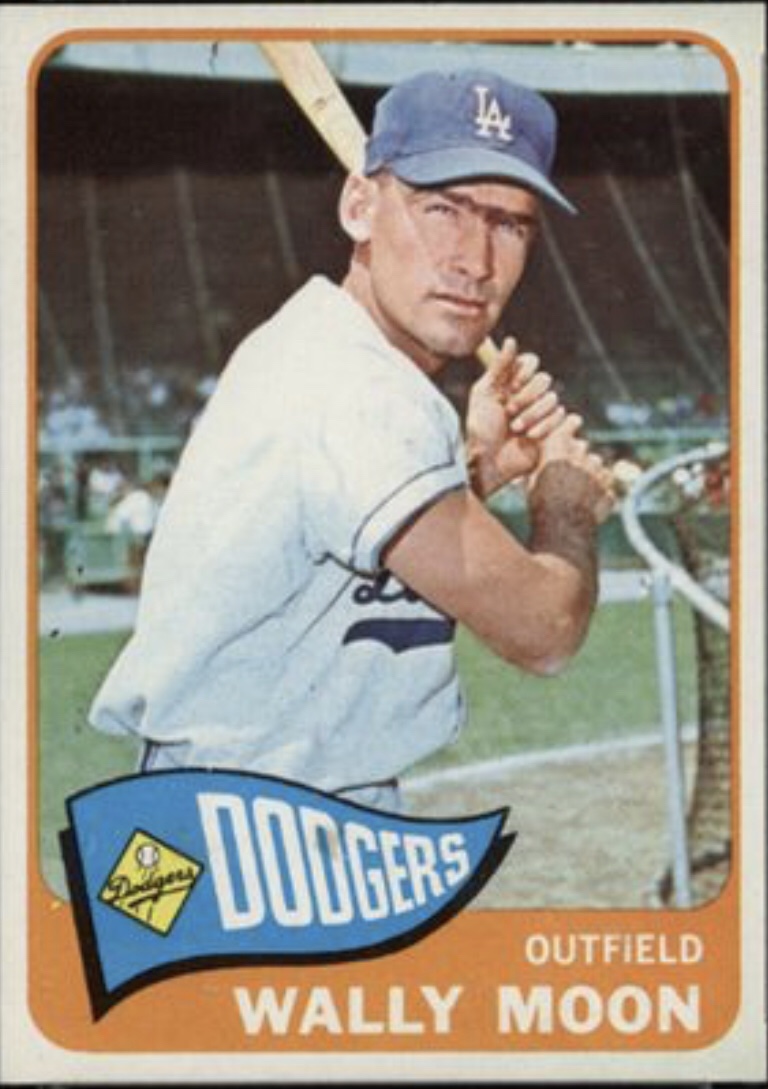
Wally Moon. (1965). $50

1965 Topps #247 – Value: $50.00 – Grade: 8

Interview: https://youtu.be/jacsCWTd5Ng

Wallace Wade “Wally” Moon (Born in Bay, AK on April 3, 1930 – February 9, 2018) had the distinct honor of replacing Hall of Fame right fielder Enos Slaughter on the St. Louis Cardinals roster in 1954, to which he then proceeded to easily win the MLB and Sporting News Rookie of the Year Awards over future Hall of Famers Ernie Banks, Hank Aaron and All-Star Gene Conley. Despite being instructed to attend the Cardinals minor league training camp, Wally showed up at spring training in St. Petersburg threatening to try out for the big club or quit baseball. He filled Slaughter’s spot, who was traded to the New York Yankees, impressively as he batted .304 with 12 home runs and 76 RBI. He averaged .298 with 151 hits and 70 RBI in his first seven seasons in the Majors. Moon played 12 seasons with the Cardinals (1954-1958) and the Los Angeles Dodgers (1959-1965) with his best season coming in 1961 when he batted .328 with 152 hits and 88 RBI while leading the league in on-base percentage (.434). Wally earned three National League All-Star selections, won the 1960 NL Gold Glove and won the 1959 and 1965 World Series titles with the Dodgers. Moon posted a .980 career fielding percentage with 3,133 putouts, 174 assists, 133 double plays and 68 errors in 3,375 chances. Wally Moon finished his career after amassing 1,399 hits including 212 doubles and 142 home runs, scoring 737 runs and driving in 661 RBI over the course of 12 years. He is often recognized by his relatively thick “uni-brow”, prevalent on his numerous trading cards.
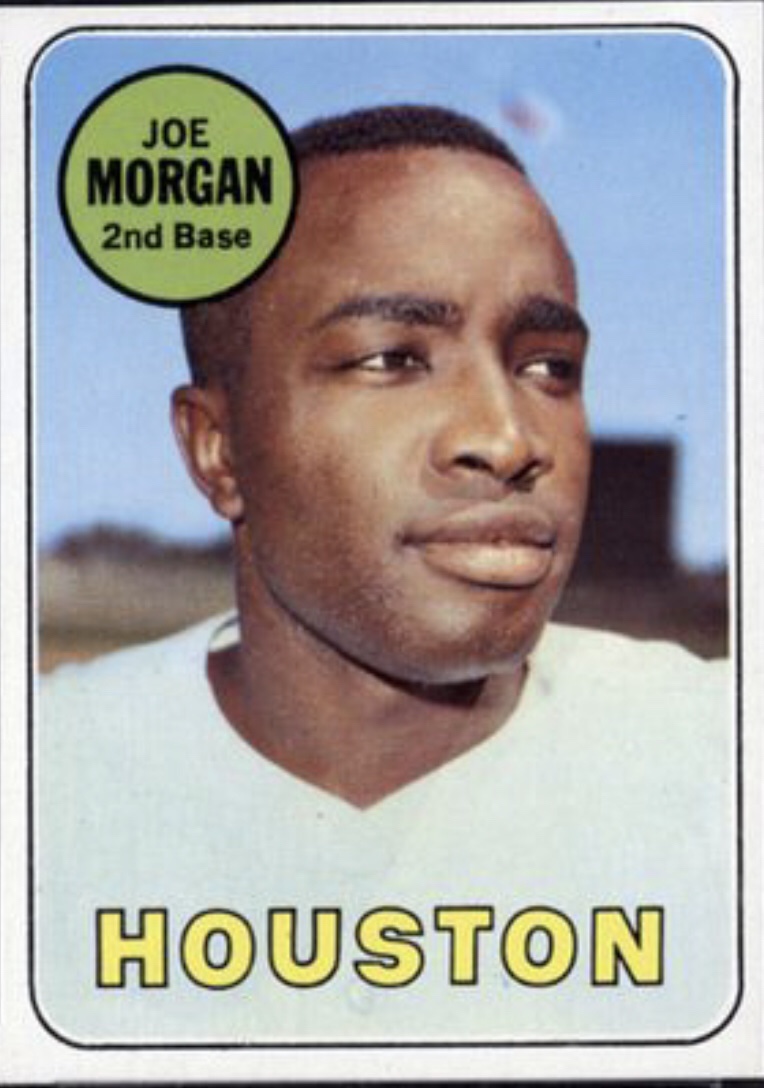
Joe Morgan. (1969). $343

1969 Topps #35 – Value: $50.00 – Grade: Mint

Career Highlights: https://youtu.be/1Ba9o1-hUO8

#60 of the Top 100 Players

Joe Leonard Morgan (Born in Bonham, TX on September 19, 1943-October 11, 2020) is the only second baseman in baseball history to win back-to-back Most Valuable Player award when he accomplished it in 1975 and 1976. Joe Morgan was a threat in every facet of the game, with excellent defensive skills, blazing speed and surprising power for a relatively small player. Morgan ranks third all-time in walks behind Babe Ruth and Ted Williams. Signed as a free agent by the Houston Colt .45s and spending nine years with the Colts/Astros (1963, 1964-1971, 1980), Morgan fell out of favor with the Astros management and was sent to Cincinnati, where he spent eight seasons (1972-1979) in one of the most lop-sided trades in history. Morgan made an immediate impact on the Big Red Machine line-up, hitting .292, scoring 122 runs and walking 115 times (both league leads) and helping the Reds to the 1972 National League pennant. The ten-time All-Star helped the Reds win the World Series in 1975 and 1976 and was the league’s MVP both seasons. Joe also won five Gold Gloves. Joe Morgan retired with 2,517 hits, 1,650 runs scored, 1,133 RBI, 689 stolen bases and a career .271 batting average. Joe Leonard Morgan was elected to the National Baseball Hall of Fame in 1990.

Marquis Grissom. (‘90 RC) $33

1990 Fleer #347 – Rookie Card
Value: $32.75 – Grade: 10

Montreal Expo: https://youtu.be/DigfMrQGoDk

Marquis Deon Grissom (born in Atlanta, GA on April 17, 1967) is an American former professional baseball center fielder. He played in Major League Baseball (MLB) for the Montreal Expos, Atlanta Braves, Cleveland Indians, Milwaukee Brewers, Los Angeles Dodgers, and San Francisco Giants between 1989 and 2000. In 1988, the Montreal Expos selected Grissom with the 76th overall pick in the amateur draft, as part of that draft’s third round. He had been considered a prospect as both a pitcher and an outfielder, but the Expos decided to have him abandon the mound and work solely as a position player. He made his professional debut with the Jamestown Expos of the New York–Penn League that fall and advanced quickly through the system, first appearing in the majors on August 22, 1989. He showed steady improvement for the next few seasons, gradually developing into a star as Montreal’s leadoff hitterand center fielder. He led the National League in stolen bases in 1991 and 1992, was a member of the NL All-Star team in 1993 and 1994, and won four consecutive Gold Gloves, the first coming in 1993. Against the Los Angeles Dodgers on July 28, 1991, Grissom caught Chris Gwynn’s fly ball for the final out of Dennis Martínez’s perfect game. The Expos enjoyed success on the field, but a strike ended the 1994 season before the playoffs, and after baseball resumed the team was forced to trade many of their stars for financial reasons. In April 1995, the Expos traded Grissom to the Atlanta Braves, in exchange for pitcher Esteban Yan and outfielders Roberto Kelly and Tony Tarasco. The Braves were just beginning a run of dominance in the NL East, and in his first season in Atlanta, they won the World Series with Marquis (the only player on that Atlanta Braves team who actually was born and raised in Atlanta) securing the final out by catching a fly ball by Carlos Baerga. They returned to the fall classic the next season, but failed to defend their title against the New York Yankees. Teams’ financial motivations continued to affect the course of Grissom’s career, and in March 1997, he was involved in a blockbuster trade with the Cleveland Indians. Hoping to save money that had been committed to long-term contracts, Atlanta traded Grissom and two-time All-Star David Justiceto the Indians, receiving in return three-time All-Star Kenny Lofton and setup man Alan Embree. The deal worked out well for Cleveland, as the team went all the way to the World Series, ultimately losing to the Florida Marlins in seven games. Grissom performed exceptionally well in that postseason, winning the MVP award in the ALCS, and completing a 15-game World Series consecutive game hitting streak spanning 3 World Series, the 2nd longest of all time next to Hank Bauer of the New York Yankees.

Jack Morris. (1978 RC). $1,275

1980 Topps #371 – Value: $25.00 – Grade: 9

Hall of Famer: https://youtu.be/hBC5HIS5kKg

John Scott Morris (born in St. Paul, MN on May 16, 1955) is an American former professional baseball starting pitcher. He played in Major League Baseball (MLB) between 1977 and 1994, mainly for the Detroit Tigers. Morris won 254 games throughout his career. Armed with a fastball, a slider, and a forkball, Morris was a five-time All-Star(1981, 1984, 1985, 1987, and 1991), and played on four World Series Championship teams (1984 Tigers, 1991 Minnesota Twins, and 1992–1993 Toronto Blue Jays). He went 3–0 in the 1984 postseason with two complete-game victories in the 1984 World Series, and 4–0 in the 1991 postseason with a ten-inning complete-game victory in Game 7 of the 1991 World Series. Morris won the Babe Ruth Awardin both 1984 and 1991, and was named World Series MVP in 1991. While he gave up the most hits, most earned runs, and most home runs of any pitcher in the 1980s, he also started the most games, pitched the most innings, and had the most wins of any pitcher in that decade. He is one of eight players in MLB history to have won back-to back World Series championships on different teams, the other seven being Ben Zobrist, Jake Peavy, Bill Skowron, Clem Labine, Don Gullett, Ryan Theriot, and Joc Pederson.

MV Plyrs(Fox/Banks)(‘75) $100

1959 Topps #197 – Value: $100.00 – Grade: 4

A Tribute: https://youtu.be/mKP2jZor6Gk

Ernest Banks (Born in Dallas, TX on January 31, 1931 – January 23, 2015), nicknamed “Mr. Cub” and “Mr. Sunshine”, was an American professional baseball player who starred in Major League Baseball (MLB) as a shortstop and first baseman for the Chicago Cubs between 1953 and 1971. He was inducted into the National Baseball Hall of Fame in 1977, and was named to the Major League Baseball All-Century Team in 1999.

Joins Cooperstown Elite: https://youtu.be/Kkqz2Jkg9T0

Nellie Fox (born in St. Thomas, PA in 1927) is what you’d call a manager’s ballplayer. He does his job expertly and he does it every day. He’s the type of player you can count on. He’s an old pro. A great many times, he is hurting pretty badly from the dumpings he’s taken on the field, but he’s always ready to play.” – Al Lopez. Jacob Nelson Fox, or Nellie as he would come to be known, was born in St. Thomas, Pa., on Christmas Day in 1927. Less than 20 years later, he would make his debut in the Major Leagues at the ripe age of 19 for the Philadelphia Athletics. Trade winds carried him to the Chicago White Sox after the 1949 season, and here truly begins the story of Nellie Fox. In 1951, after his debut season for the Sox in which he hit only .247, Nellie began an 11-season stretch of All-Star selections, playing in a total of 1,691 games. This period also included a 798 consecutive game streak, the 11th longest of its kind in major league history. Over these years, Fox batted .299 and had 561 walks while striking out only 146 times. This would come to be one of Nellie’s defining traits: A refusal to give in at the plate. Fox ranks as one of the toughest outs in Major League Baseball history, recording only 216 strikeouts in more than 10,000 plate appearances. In addition to his eye at the plate, Nellie was also one of the best defenders to ever play second base. The Gold Glove Awards were first handed out in 1957 and Fox was the inaugural American League second base recipient. Long lauded for his defensive prowess, Fox would go on to win two more Gold Glove Awards in 1959 and 1960. Fox had arguably the best year of his career in 1959, a season in which he hit .306 and captured the American League MVP award, narrowly edging out his double play partner, Luis Aparicio. This would be the only year Fox tasted the postseason and while the White Sox would lose to the Los Angeles Dodgers in the World Series, Nellie rose to the occasion – leading the Sox with a .375 batting average. Fox passed away on Dec. 1, 1975. He was elected to the Hall of Fame in 1997.

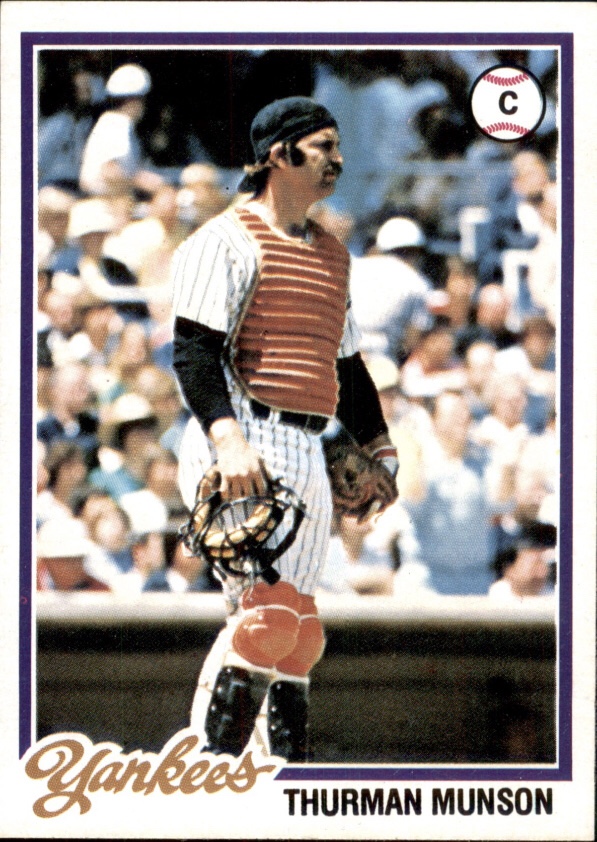
Thurman Munson. (1978). $15

1978 Topps #60 – Value: $15.00 – Grade: 5

A Tribute: https://youtu.be/oPq47Iab-Qw

Thurman Lee Munson (Born in Akron, OH on June 7, 1947 – August 2, 1979) was an American professional baseball catcher who played 11 seasons in Major League Baseball (MLB) with the New York Yankees, from 1969 until his death in 1979. A seven-time All-Star, Munson had a career batting averageof .292 with 113 home runs and 701 runs batted in (RBIs). Known for his outstanding fielding, he won the Gold Glove Award in three consecutive years (1973–75). Born in Akron, Ohio, Munson was selected as the fourth pick of the 1968 MLB draft and was named as the catcher on the 1968 College Baseball All-American Team. Munson hit over .300 in his two seasons in the minor leagues, establishing himself as a top prospect. He became the Yankees’ starting catcher late in the 1969 season, and after his first complete season in 1970, in which he batted .302, he was voted American League (AL) Rookie of the Year. Considered the “heart and soul” of the Yankees, Munson was named captain of the Yankees in 1976, the team’s first since Lou Gehrig. That same year, he won the AL Most Valuable Player (MVP) Award, making him the only Yankee to win the Rookie of the Year and MVP Awards. As captain, Munson helped lead the Yankees to three consecutive World Series appearances from 1976 to 1978, winning championships in the latter two years. He is the first player in baseball history to be named a College Baseball All-American and then in MLB win a Rookie of the Year Award, MVP Award, Gold Glove Award, and World Series championship. He is also the only catcher in MLB postseason history to record at least a .300+ batting average (.357), 20 RBIs (22), and 20 defensive caught stealings(24). During an off day on August 2, 1979, during the Yankees 1979 season, Munson died at age 32 while practicing landing his Cessna Citation I/SPaircraft at Akron–Canton Airport. He suffered a broken neck as result of the crash, and his cause of death was asphyxiation. The Yankees honored him by immediately retiringhis uniform 15, and dedicating a plaque to him in Monument Park.

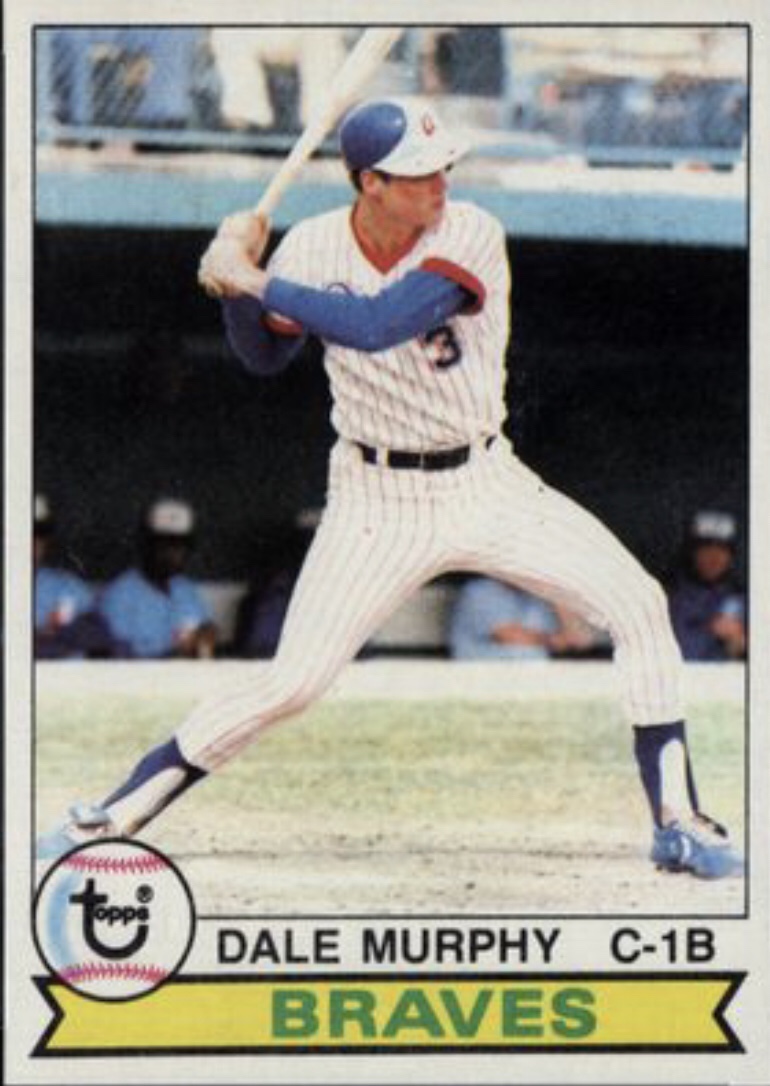
Dale Murphy. (1979). $525

1979 Topps #39 – Value: $250.00 – Grade: 9

Dale Murphy Night (June 4, 1991): https://youtu.be/8VEvyh4RH3c

Dale Bryan Murphy (Born in Portland, OR on March 12, 1956-) became the youngest National League player to win back-to-back Most Valuable Player Awards after leading the NL in RBI in 1982 and 1983. He also earned his first of four Silver Sluggers Awards and first of five NL Gold Gloves. The Atlanta Braves took Dale with the fifth overall pick of the 1975 MLB June Amateur Draft and he debuted as a catcher two seasons later. After being moved to the outfield in 1980, Murphy developed into one of the premier outfielders with an exceptional glove and above average bat. Extremely durable, Dale missed only 27 games from 1982 to 1990. He led the NL in games played four times, home runs, RBI and slugging percentage twice and once in plate appearances, runs, walks and on-base percentage. Murphy played 18 years in the Majors with the Braves (1976-1990), the Philadelphia Phillies (1990-1992) and the Colorado Rockies (1993). The seven-time All-Star earned the 1985 Lou Gehrig Memorial Award as “the player who best exemplifies the character and integrity (of Gehrig) both on and off the field” and then was named the 1988 Roberto Clemente Award as “the player who best exemplifies the game of baseball, sportsmanship, community involvement and individual’s contribution to the team.” Dale Murphy finished his career with a .265 career batting average, 2,111 hits including 350 doubles and 398 home runs, 1,197 runs scored, 161 stolen bases and 1,266 RBI. He also posted a .982 fielding percentage over his 18-year career.

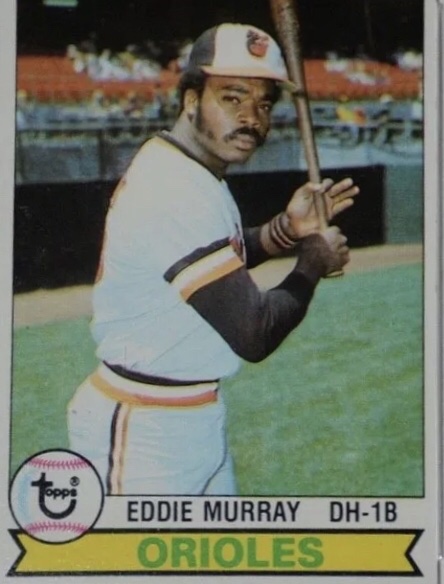
Eddie Murray. (1979). $500

1979 Topps #640 – Value: $300.00 – Grade: Mint

Hall of Fame Biography: https://youtu.be/m7aAnmvgfSo

#77 of the Top 100 Players

Eddie Clarence Murray (born in Los Angeles, CA on February 24, 1956), nicknamed “Steady Eddie,” is a former Major League Baseball (MLB) first baseman and designated hitter. Spending most of his MLB career with the Baltimore Orioles, he ranks fourth in team history in both games played and hits. Though Murray never won a Most Valuable Player (MVP) Award, he finished in the top ten in MVP voting several times. After his playing career, Murray coached for the Orioles, Cleveland Indians and Los Angeles Dodgers. Murray was selected by the Baltimore Orioles in the third round of the 1973 amateur draft and had several successful seasons in the minor leagues. He debuted at the major league level on April 7, 1977, and played in 160 games for the Orioles in his first season. In 160 games, he hit for .283 while contributing 88 RBIs, 27 home runs, 29 doubles, and 173 hits while also striking out 104 times during the season. This was the only season in which he struck out over 100 times. He won the American League Rookie of the Year award. In his next season, he played in 161 games while raising his totals, hitting for .285 along with having 95 RBIs, 27 home runs, 32 doubles, 174 hits along with being named to his first All-Star Game and finishing 8th in the MVP balloting. In the 1979 season, he hit .295 along with driving in 99 runs, 25 home runs, 30 doubles and 179 hits in 159 games. Though he was not named to the All-Star Game, he finished 11th in the MVP balloting. He participated in his first postseason. In the 1979 American League Championship Series, he hit 5-for-12 for a .417 batting average along with one home run and 5 RBIs as they beat the California Angels in four games. In the 1979 World Series, he hit 4-for-26 for a .154 average with one home run and 2 RBIs but also four strikeouts as the Orioles lost to the Pittsburgh Pirates in seven games. With the Orioles from 1977 until 1988, Murray averaged 28 home runs and 99 RBI and was a perennial candidate for the MVP award, twice finishing second in the voting. Murray’s close-knit friendship with fellow Oriole Cal Ripken, Jr. was highly publicized in Baltimore at the time. In fact, Ripken has credited Murray with teaching him his work ethic.

Stan Musial. (1988). $590

1988 Topps #665 – Value: $590.00 – Grade: 9

Career Highlights: https://youtu.be/AsM75dmRUTI

#10 of the Top 100 Players

Stanley Frank Musial (born in Donora, PA, on November 21, 1920 – January 19, 2013), nicknamed Stan the Man, was an American baseball outfielder and first baseman. He spent 22 seasons in Major League Baseball (MLB), playing for the St. Louis Cardinals, from 1941 to 1944 and from 1946 to 1963. Widely considered to be one of the greatest and most consistent hitters in baseball history, Musial was a first-ballot inductee into the Baseball Hall of Fame in 1969. He batted .331 over the course of his career and set National League (NL) records for career hits(3,630), runs batted in (1,951), games played (3,026), at bats (10,972), runs scored (1,949) and doubles (725). His 475 career home runs then ranked second in NL history behind Mel Ott’s total of 511. A seven-time batting champion, he was named the National League’s (NL) Most Valuable Player (MVP) three times and was a member of three World Series championship teams. He also shares the major league record for the most All-Star Games played (24) with Hank Aaron and Willie Mays. Musial was born in Donora, Pennsylvania, where he frequently played baseball informally or in organized settings, and eventually played on the baseball team at Donora High School. Signed to a professional contract by the St. Louis Cardinals as a pitcher in 1938, Musial was converted into an outfielder and made his major league debut in 1941. Noted for his unique batting stance, he quickly established himself as a consistent and productive hitter. In his first full season, 1942, the Cardinals won the World Series. The following year, he led the NL in six different offensive categories and earned his first MVP award. He was also named to the NL All-Star squad for the first time; he appeared in every All-Star game in every subsequent season he played. Musial won his second World Series championship in 1944, then missed the entire 1945 season while serving in the Navy. After completing his military service during the war, Musial returned to baseball in 1946 and resumed his consistent hitting. That year he earned his second MVP award and third World Series title. His third MVP award came in 1948, when he finished one home run short of winning baseball’s Triple Crown. After struggling offensively in 1959, Musial used a personal trainer to help maintain his productivity until he decided to retire in 1963. At the time of his retirement, he held or shared 17 major league records, 29 National League records, and nine All-Star Game records. In addition to overseeing personal businesses, including a restaurant, both before and after his playing career, Musial served as the Cardinals’ general manager in 1967, winning the pennant and World Series, then resigning that position. Musial was selected for the Major League Baseball All-Century Team in 1999. In February 2011, President Barack Obama presented Musial with the Presidential Medal of Freedom, the highest civilian award that can be bestowed on a person by the United States government.

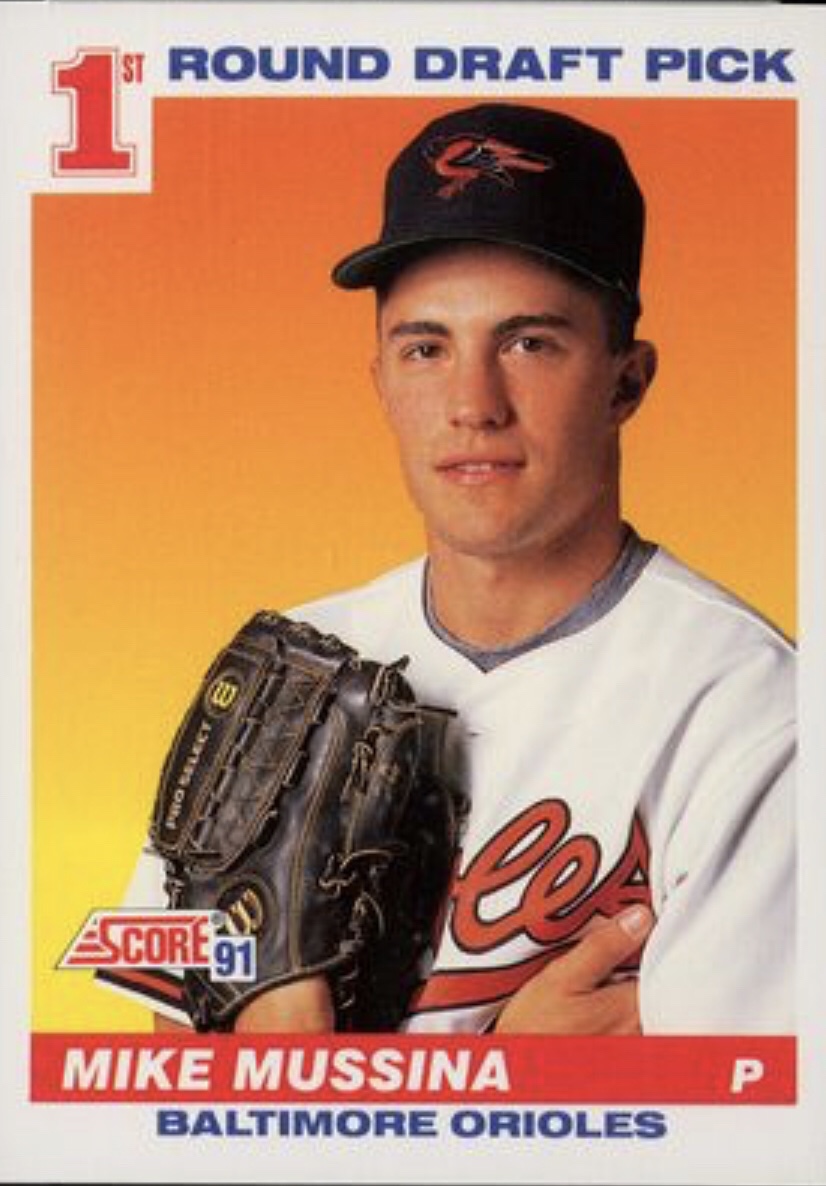
Mike Mussina. (1991 RC). $25

1991 Score #383 – Rookie Card
Value: $25.00 – Grade: 9

Hall of Fame Introduction: https://youtu.be/LVwR7mTU3qE

Michael Cole Mussina (Born in Williamsport, PA on December 8, 1968-) was one of the most successful pitchers in Major League history who struggled on the cusp of greatness, with postseason success despite little run support and a handful of near no-hitters or perfect games due to his masterful pitching. The Baltimore Orioles drafted Mike in the 1987 MLB Draft, but he chose to attend college, then took him again with the 20th overall pick of the 1990 MLB Draft out of Stanford University where he earned an economics degree in 3-1/2 years. After only one season of minor league ball, Mussina was plugged into the Orioles starting rotation and posted an impressive 2.88 ERA in his first 12 starts. Mike led the American League in winning percentage in his second campaign as he went 18-5 for a .783 winning percentage. Mike was dominant throughout his career using both power and control to send batters down and during his 18-year career, his rookie year, when he posted record of 4-5, is the only year he did not win 10 or more games. Mussina led the AL once in winning percentage (1992), wins and shutouts (1995), starts (1996) and innings pitched (2000). He spent his entire career in the American League with the Orioles (1991-2000) and the New York Yankees (2001-2008). Mike was a perennial Cy Young candidate finishing in the top six nine times. He won seven Gold Gloves and was a five-time AL All-Star. Mussina did produce clutch playoff performances in his nine year of postseason play, but he was unable to capture a World Series title as the Yankees hoisted the trophy the year before he joined them and the year after he left. Mike Mussina finished his career with a 270-153 record, 57 complete games, 23 shutouts, 2,813 strikeouts and a 3.68 career ERA in 537 games and 536 starts. On the mound he also posted a .980 fielding percentage earning him those five AL Gold Gloves. Mike Mussina is a member of the Baseball Hall of Fame’s Class of 2019.