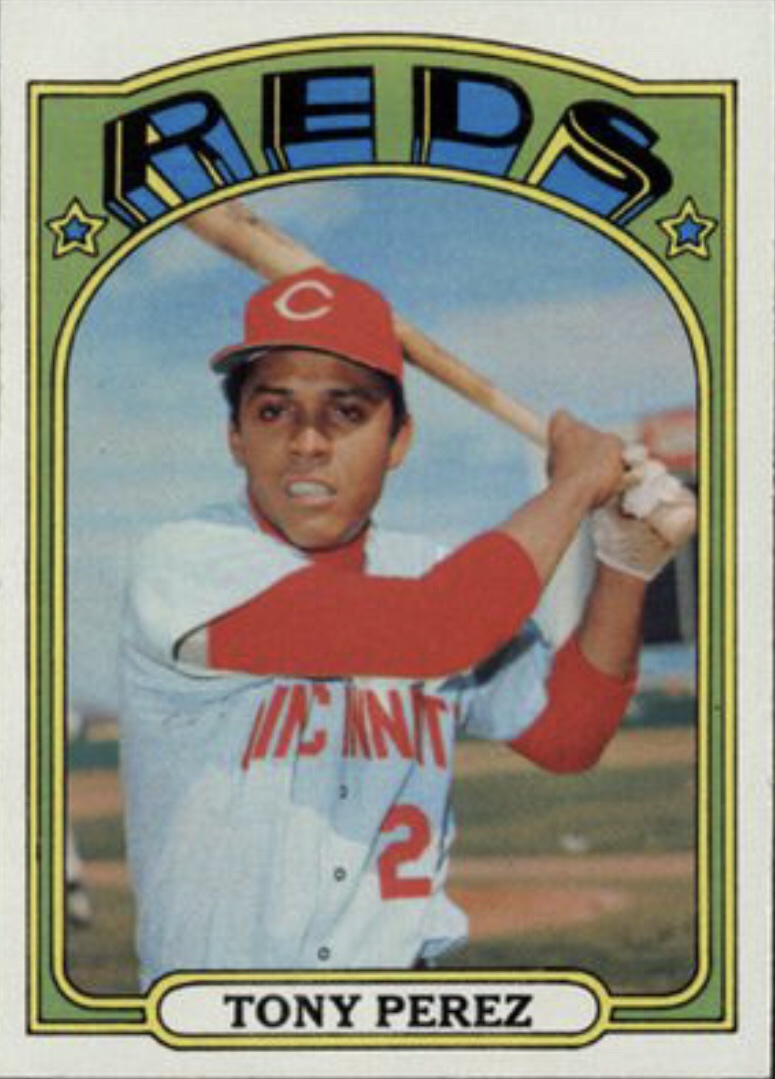
Atanasio “Tony” Perez Rigal (Born in Ciego de Avila, Cuba on May 14, 1942-) was the run-producing corner infielder for the Cincinnati Reds’ Big Red Machine that went to four World Series in a 7 year span (1970-1976), winning back-to-back titles in 1975 and 1976. Perez played 23 seasons for the Reds (1964-1976, 1984-1986), Expos (1977-1979), Red Sox (1980-1982) and Phillies (1983). After winning the Pacific Coast League MVP Award, Perez was promoted to the promoted to the Reds club for the stretch run in 1964. A seven-time All-Star selection, Perez is often remembered for his 15th inning home run in the 1967 All-Star game off Catfish Hunter to win the game, thereby garnering the game’s Most Valuable Player Award. Tony topped the 100-RBI mark for seven times in his career, and averaged 96 over the course of his 23 seasons in the big leagues. Tony Perez retired with 2,732 hits, 1,272 runs, 1,652 RBI, 379 home runs and a .279 career batting average. Atanasio “Tony” Perez Rigel was elected to the National Baseball Hall of Fame in 2000.
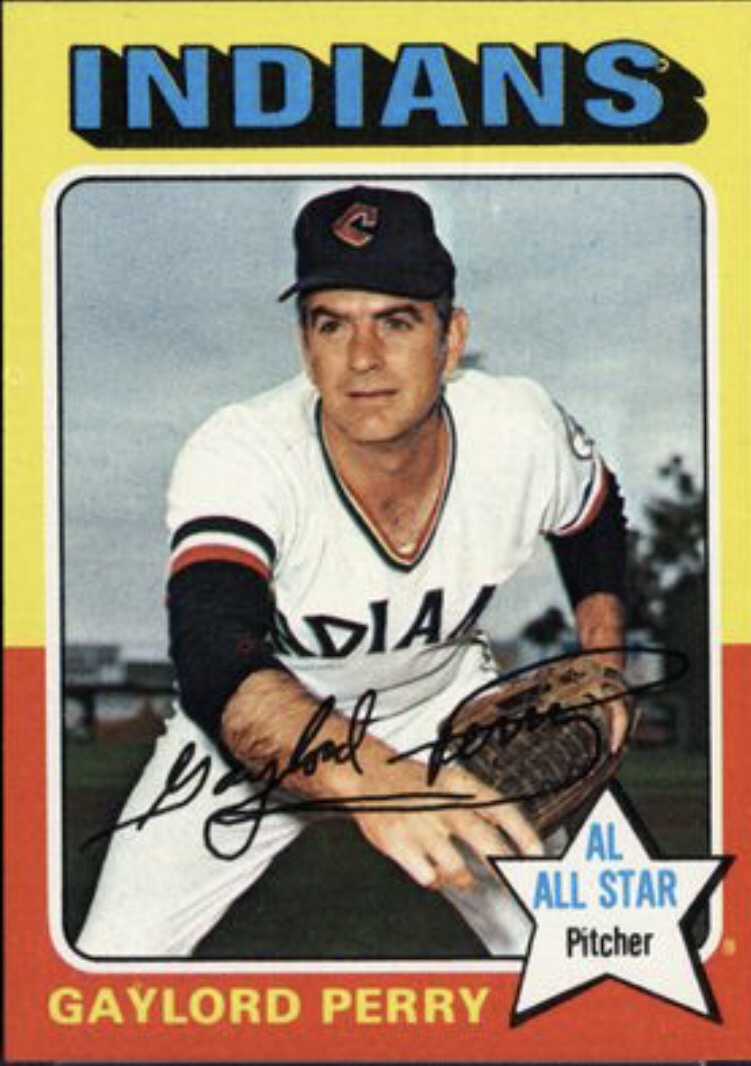
Gaylord Jackson Perry (Born in Williamston, NC on September 15, 1938-) was the first pitcher to win the CY Young Award in both leagues when he won it in Cleveland in 1972 and again in San Diego in 1978. As is the case with most pitchers, Gaylord was less than adept at the plate, so much so manager Al Dark quipped in 1963, “They’ll put a man on the moon before he hits a home runs.” One hour after the 1969 Apollo 11 moon landing, Perry hit his first ever home run. In 1968, Gaylord no-hit the St. Louis Cardinals and fireballer Bob Gibson. The well-traveled Perry spent time with eight separate teams during his 22-year career (1962-1983) including the Giants, Indians, Rangers, Padres, Yankees, Braves, Mariners and Royals. In 1982, the five-time All-Star won his 300 game with the Mariners and the following year surpassed Hall of Famer Walter Johnson’s 3,508 strikeout mark with the Royals, becoming the third man in the same year to do so with fellow Hall of Famers Nolan Ryan and Steve Carlton. Despite only pitching one game in the postseason in 1971 with the Giants, Perry did his job effectively, winning 10 or more games in 17 seasons during his 22-year career. Gaylord finished his career with a 314-265 record, 3,534 strikeouts and a 3.10 earned run average. Gaylord Jackson Perry was elected to the National Baseball Hall of Fame in 1991.
Michael Joseph Piazza (born in Norristown, PA on September 4, 1968) is an American former professional baseball catcher who played 16 seasons in Major League Baseball (MLB), from 1992 to 2007, and currently the manager of the Italy national baseball team. He played most notably for the New York Mets and Los Angeles Dodgers, while also having brief stints with the Florida Marlins, San Diego Padres, and Oakland Athletics. A 12-time All-Star and 10-time Silver Slugger Award winner at catcher, Piazza produced strong offensive numbers at his position; in his career, he recorded 427 home runs—a record 396 of which were hit as catcher—along with a .308 batting average and 1,335 runs batted in (RBI). Piazza was drafted by the Dodgers in the 1988 MLB draft as a favor from Tommy Lasorda to Piazza’s father. He was the last player selected and signed in his draft class to play in the Major Leagues. Initially a first baseman, Piazza converted to catcher in the minor leagues at Lasorda’s suggestion to improve his chances of being promoted. He made his major league debut in 1992 and the following year was named the National League (NL) Rookie of the Year and was an All-Star for the first of 10 consecutive seasons. Piazza immediately impressed with his ability to hit for power and average. His best year as a Dodger came in 1997 when he batted .362, hit 40 home runs, and had 124 RBI, leading to a runner-up finish in voting for the NL Most Valuable Player Award. In 1998, he was traded to the Marlins and then a week later to the Mets, with whom he spent most of the remainder of his career. He helped the Mets reach the 2000 World Series, the only World Series appearance of his career. After the 2005 season, Piazza left the Mets to play one season each for the Padres and Athletics before retiring after the 2007 season. Piazza is regarded as one of the best offensive catchers in baseball history. He had at least one RBI in 15 straight games for the Mets in 2000, the second-longest RBI streak ever. In 2013, the Mets inducted Piazza into the New York Mets Hall of Fame. In 2016, Piazza was elected to the Baseball Hall of Fame, receiving 82.95% of the vote.
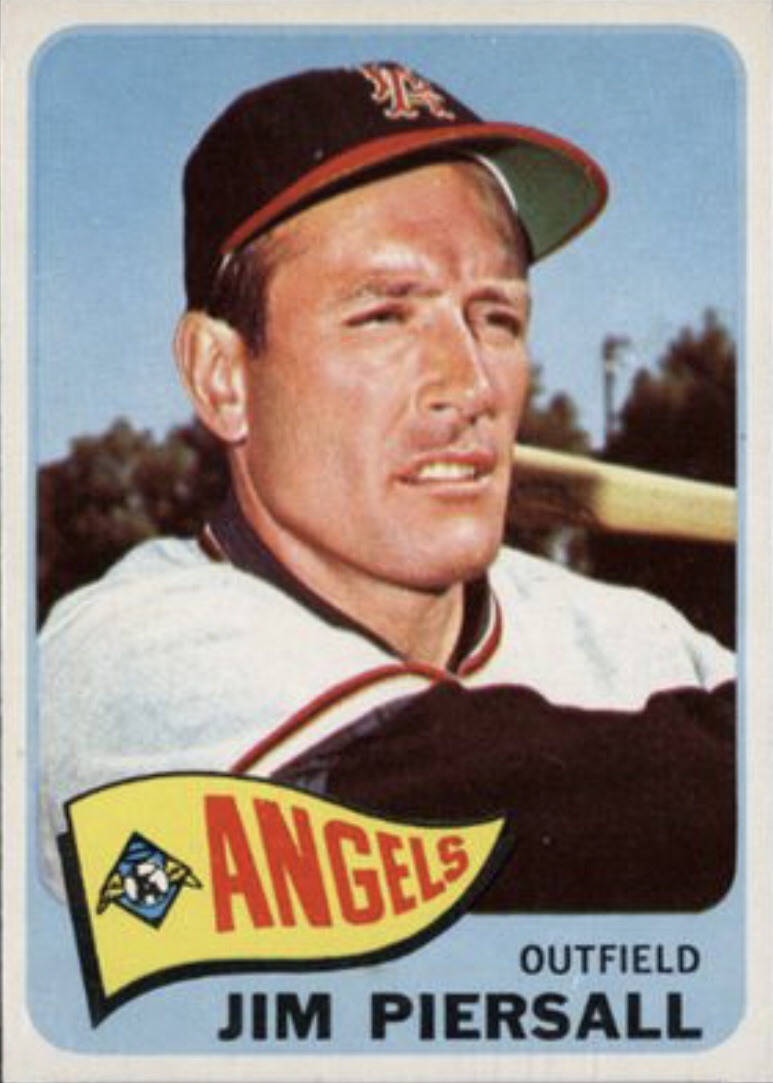
James Anthony “Jimmy” Piersall (Born in Waterbury, CN on November 14, 1929 – June 3, 2017) struggled with personal demons throughout his career and received treatment for “nervous exhaustion” after confrontations with his teammates, opponents, umpires and management due to his erratic behavior. Piersall played centerfield 17 seasons in the Majors with the Boston red Sox (1950, 1952-1958), the Cleveland Indians (1959-1961) the Washington Senators (1962-1963), the New York Mets (1963) and the Los Angeles/California Angels (1963-1964/1965-1967). Jimmy held the dubious distinction of replacing longtime centerfielder Dom DiMaggio, and earned two Gold Gloves in 1958 with Boston and in 1961 with Cleveland. Piersall tended to play shallow in centerfield helping him post a career .990 fielding percentage with 3,851 putouts in 3,985 chances. He enjoyed his most successful season in 1956 as he batted .293 with 176 hits including a league leading 40 doubles, 14 home runs and 87 RBI in an American League leading 155 games. He was named to the 1954 and 1956 MLB All-Star Games. Jimmy Piersall finished his career in 1967 as a California Angel having batted .272 with 1,604 hits including 256 doubles and 104 home runs, scoring 811 runs and driving in 591 RBI while stealing 115 bases. Jimmy is often remembered for his struggles with mental issues and the book Fear Strikes Out: The Jimmy Piersall Story, Jimmy’s personal notes and memoire, which was made into a motion picture in 1957. After retiring from playing, he spent time in the broadcast booth with the Texas Rangers and the Chicago White Sox.
Louis Victor Piniella (born in Tampa, FL on August 28, 1943) is a former professional baseball player and manager. An outfielder, he played 16 seasons in Major League Baseball (MLB) with the Baltimore Orioles, Cleveland Indians, Kansas City Royalsand New York Yankees. During his playing career, he was named AL Rookie of the Year in 1969 and captured two World Series. Piniella played for the Royals for their first five seasons (1969–1973) and was the American League’s Rookie of the Year in 1969 and was named to the 1972 All-Star Game. He was the first batter in Royals history; on April 8 of their first season in 1969, he led off the bottom of the first inning against left-hander Tom Hall of the Minnesota Twins. Piniella doubled to left field, then scored on an RBI single by Jerry Adair. After the 1973 season, Piniella was traded by the Royals with Ken Wright to the New York Yankees for Lindy McDaniel. Baseball author Bill James called the trade the only clinker the Royals made during the 1970s. He played with the Yankees for 11 seasons, during which the Yankees won five AL East titles (1976–78, 1980, and 1981), four AL pennants (1976–78, and 1981), and two World Series championships (1977–78). In 1975, he missed part of the year with an inner ear infection. From mid-1977 through the end of 1980, he was the Yankees’ regular outfielder/DH. In his career, Piniella made one All-Star team and compiled 1,705 lifetime hits despite not playing full-time for just under half of his career. He received 2 votes for the Hall of Fame as a player in 1990.
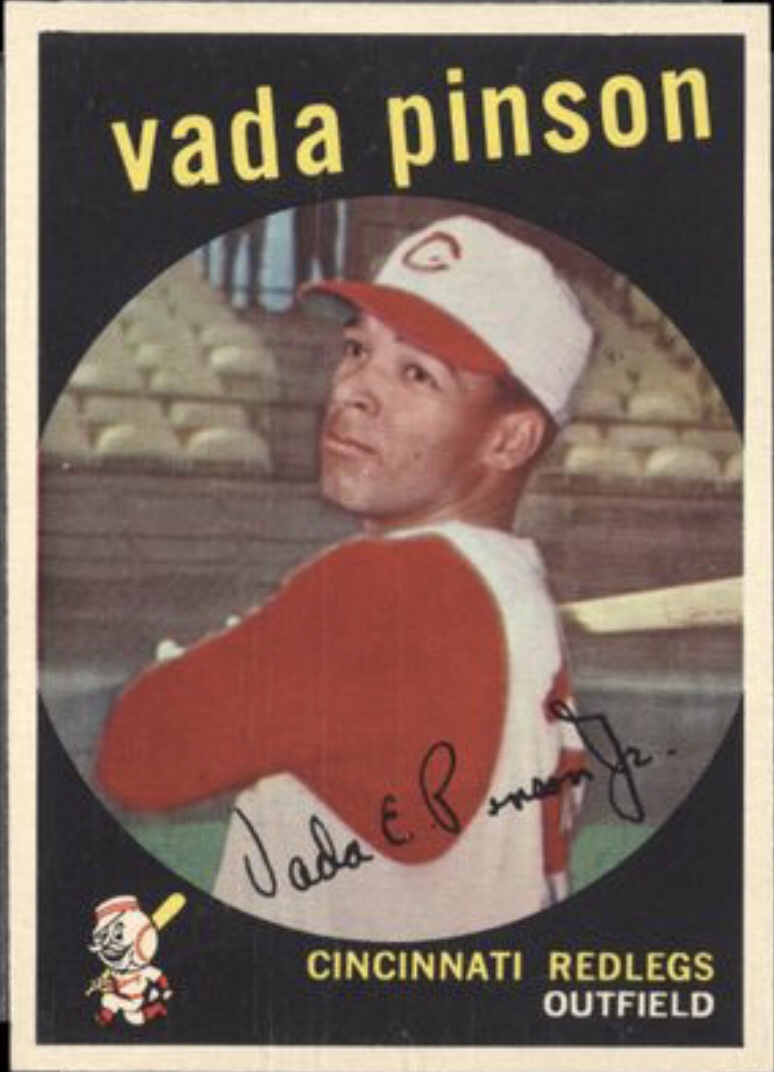
Vada Edward Pinson, Jr. (born in Memphis, TN on August 11, 1938 – October 21, 1995) burst into Major League Baseball straight out of high school with the Cincinnati Reds, and then led the National league in hits (131), doubles (47), at-bats (648) and plate appearances (706) in his second season. Unfortunately, because he had six at-bats (96) more than the minimum in 1958, he was ineligible for Rookie of the Year honors during his impressive “sophomore” year. Early on in Cincinnati, Vada played alongside Hall of Famer Frank Robinson and later Tony Perez and Pete Rose battling for power supremacy. He played the outfield for 18 seasons in Cincinnati (1958-1969), the St. Louis Cardinals (1969), the Cleveland Indians (1970-1971, the California Angels (1972-1973) and the Kansas City Royals (1974-1975). Always the offensive threat, Pinson led the National League twice in hits, doubles, and triples and once in runs scored. From his second to his second to last year, Vada had 110 hits or more each season and had yen years with 150 or more including four over 200 hits. Pinson also starred in the field as he posted a .981 fielding percentage with 5,097 putouts in 5,370 chances. He was named to four All-Star Games, appeared in the 1961 World Series loss to the New York Yankees and won a Gold Glove in 1961. Vada Pinson finished his playing career with a .286 career batting average, 2,757 hits including 485 doubles and 285 home runs, 305 stolen bases and 1,170 RBI. After his playing days ended, Pinson coached from 1977-1994 with the Seattle Mariners, Chicago White Sox, Detroit Tigers, and Florida Marlins.
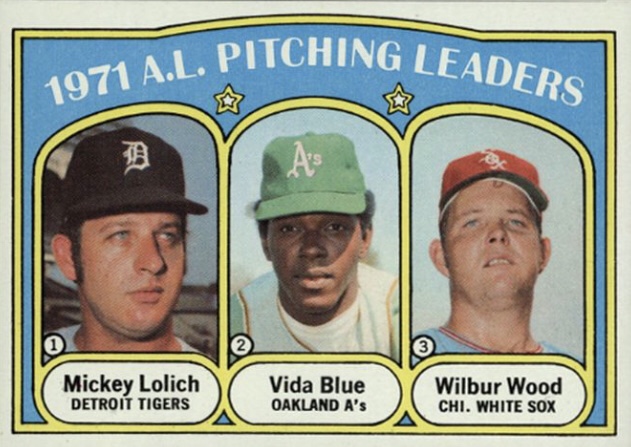
Michael Stephen “Mickey” Lolich (Born in Portland, OR on September 12, 1940-) was the Detroit Tigers star during the 1968 World Series against the St. Louis Cardinals, winning three games including Game 7 off Cards ace Bob Gibson, picking off speedsters Lou Brock and Curt Flood and hitting the only home run of his career. Lolich began his career with the Detroit Tigers and won no less than 14 games for 11 consecutive seasons, topping the 20-win mark twice. His 17-9 record in the 1968 season was overshadowed by the extraordinary rookie campaign put up by teammate Denny McLain as he went 31-6. However, Mickey peaked at the right time during the playoff as he was named the 1968 AL Babe Ruth Award winner and the World Series MVP. In 1971, Mickey led the American League in wins with 25 while also leading the AL in starts (45), complete games (29), innings pitched (372.0 and strikeouts (308) finishing second to Vida Blue in AL Cy Young voting. Lolich holds numerous Detroit Tigers pitching records and stands second on the Majors all-time strikeout list (2,832) behind Hall of Famer Steve Carlton. The three-time All-Star was the model of consistency as he had six consecutive seasons with 200 or more strikeouts (1969-1974), 1,475 Ks during that span. Mickey spent the majority of his career with the Tigers (1963-1975), spent one year with the New York Mets (1976) and finished his career with the San Diego Padres (1978-1979). Mickey Lolich wrapped up his career after compiling a 217-191 record over 16 seasons, with 2,932 strikeouts, 195 complete games and 41 shutouts while posting a 3.44 career ERA.
Vida Rochelle Blue (Born in Mansfield, LA on July 28, 1949-) completed two of the six games he pitched in the 1970 season, throwing a one-hit 2-0 shutout against the Kansas City Royals followed by 6-0 no-hitter against the Minnesota Twins merely ten days later. The Kansas City Athletics selected Blue in the second round of the 1967 MLB June Amateur Draft and he chose to play baseball despite numerous college football scholarship offers to play quarterback. Vida was a unique, hard-throwing left-hander who utilized his blazing fastball, his hard breaking curve and change-up that would buckle your knees. All-time hits leader, Pete Rose, referred to Blue as the hardest throwing left hander he ever faced. In 1971, Vida paced the Oakland A’s and the American League as he went 24-8 with a league leading eight shutouts and 1.82 ERA as he marched to the AL Cy Young Award and Most Valuable Player Award. He earned his first of six All-Star Game appearances and was also named The Sporting News Pitcher of the Year in 1971, which he won again in 1978. In 1972, he led the A’s to their first of three consecutive World Series titles (1972-1974) despite only posting a 6-10 record. Vida’s 17-year career with the A’s (1969-1977), the San Francisco Giants (1978-1981, 1985-1986) and the Kansas City Royals (1982-1983) was marred by confirmed rumors of drug use and even cost him a year ban from baseball as well as a year in prison. Vida Blue finished his career with a 209-161 record, struck out 2,175 batters and posted a 3.27 career ERA over 502 games, 143 complete games and 37 shutouts. In the playoffs, Blue went 1-5 with 47 strikeouts and a 4.31 ERA in 17 postseason appearances.
Wilbur Forrester Wood, Jr. (born in Cambridge, MA on October 22, 1941-) pitched for three different teams, most notably the Chicago White Sox, where he became one of the team’s most dominant pitchers of the early 1970s. The Boston Red Sox signed Wood as an amateur free agent in 1960. He posted lackluster numbers in irregular appearances with the Red Sox (1961-1964) and Pittsburgh Pirates (1954-1965) before beginning a run with the White Sox (1967-1978) that led to 163 of his 164 career victories, as well as his three All-Star Game selections (1971, 1972, 1974). On July 20, 1973, he became the last Major League pitcher to start both ends of a doubleheader. In his 17-season career, Wood compiled a 164-156 record with a 3.24 ERA and 1,411 strikeouts. He compiled 24 shutouts and 114 complete games in 297 games started, and was the last pitcher in American League history to win and lose 20 or more games in the same season (24-20 in 1973).
Phillip Alan Plantier (born in Manchester, NH on January 27, 1969) is an American former professional baseball player who played in the Major League Baseball (MLB) primarily as an outfielder from 1990 to 1997. Listed at 6 feet 0 inches (1.83 m) and 175 pounds (79 kg), he batted left-handed and threw right-handed. After his playing career, he spent three seasons as a hitting coach with the San Diego Padres. Plantier was an 11th round draft pick of the Boston Red Sox in the 1987 Major League Baseball Draft. He developed a knack for hitting home runs in the minor leagues and skipped the Double-A level altogether. Plantier first entered the major leagues in 1990 after a midseason call-up from the Pawtucket Red Soxand primarily served as a pinch hitter, but did not play enough for it to be considered his rookie year. In 1991 he was first called up to Boston in June, and played in 11 games, but was sent back down to Pawtucket two weeks later. He was finally called back up to Boston on August 10 and went on a very impressive run over 42 games. In 53 total games and 148 at-bats, he hit 11 home runs and 35 runs batted in (RBIs) while hitting .331, for an average of a home run hit every 13.38 at-bats. As a result, Plantier finished 8th in Rookie of the Year voting. Plantier was unable to repeat his rookie performance in 1992, and was traded to the San Diego Padres during the following offseason. He enjoyed his best full season in 1993 wherein he hit 34 home runs with 100 RBI, both career highs. After an injury plagued 1994 season, Plantier was part of an eleven player offseason trade between the Padres and the Houston Astrosthat brought Ken Caminiti and Steve Finley to San Diego while sending Derek Bell to Houston, among others. He was later traded back to the Padres in July 1995 after roughly half a season with the Astros. Prior to the 1996 season, Plantier signed with the Detroit Tigers, however, during spring training he was traded to the Oakland Athletics for infielder Fausto Cruz and pitcher Ramon Fermin, spending the 1996 season as a reserve outfielder and designated hitter for the A’s. Plantier signed with the San Diego Padres for the 1997 season, his third stint with the team, and later was traded mid-season to the St. Louis Cardinals, where he again spent time as a reserve outfielder and finished out his major league career. Plantier signed as a free agent with Toronto Blue Jays in 1998, but did not appear in any major league games with the club.
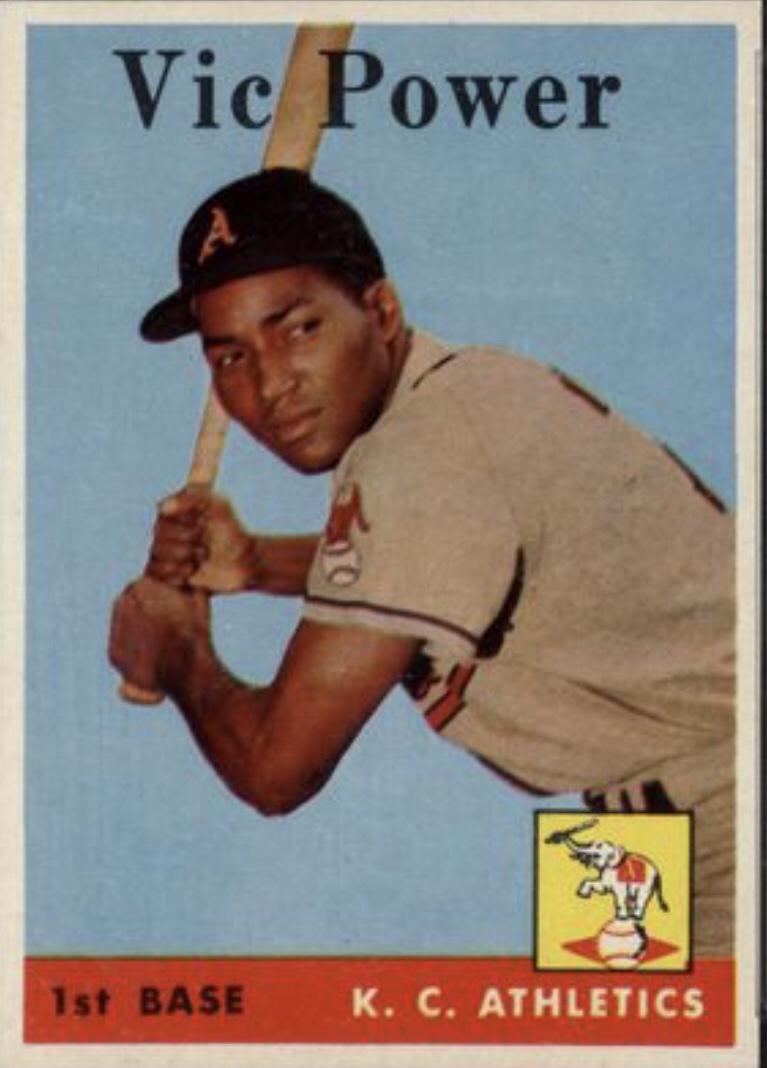
Victor Pellot Power (Born in Arecibo, Puerto Rico on November 1, 1927 – November 29, 2005) born Victor Felipe Pellot Pove – became the first Puerto Rican to play in the American League, the first to play for the Philadelphia Athletics and is the second of five players in Major League history to hit a leadoff and walk-off home run in the same game. Vic was a flamboyant first baseman and utility player with tremendous fielding ability frequently scooping the ball out of the dirt with a wide sweeping grab. Power came up with the Yankees becoming the second black player to be added to an American League and Yankees roster with catcher, Elston Howard. However, he was traded to the A’s prior to the start of the season where he would play for four and a half seasons. Power played 12 seasons for the Philadelphia/Kansas City Athletics (1954/1955-1958), the Cleveland Indians (1958-1961), the Minnesota Twins (1962-1964), the Los Angeles/California Angels (1964/1965) and the Philadelphia Phillies (1964). Vic won seven American League Gold Gloves and was named to the AL All-Star team on six occasions. He shares the record of making two unassisted double plays in one game, and despite the fact that he only stole 45 career bases, he is also one of 11 MLB players to steal home twice in one game. Vic Power ended his career with a .284 career batting average, 1,716 hits including 126 home runs, 765 runs scored and 658 RBI.
Kirby Puckett (born in Chicago, IL on March 14, 1960 – March 6, 2006) was the third youngest player (behind Sandy Koufax and Lou Gehrig) to be elected to the National Baseball Hall of Fame at the age of 41, and in his first year of eligibility. Puckett played his entire career with the Minnesota Twins (1984-1995) and led the team to two American League pennants and World Series championships in 1987 and 1991. Puckett’s 11th inning home runs in Game 6 of the 1991 World Series remains one of his defining moments as well as one of the most spectacular moments in the Fall Classic’s history. Kirby is one of an elite group of hitters who recorded 1,000 hits in the first five full calendar years in the big leagues and 2,000 during his first ten seasons. Puckett won the 1989 batting titles with a .339 average, adding a league leading 215 hits. He would lead the league four times in hits in a six-year span (11987-1992). The ten-time American League All-Star selection and six-time Gold Glove winner’s career was cut short because of a loss of vision in one eye due to glaucoma. Kirby Puckett retired with 2,304 hits, 1,071 runs, 1,085 RBI, 207 home runs and a .318 career batting average. Kirby Puckett was elected to the National Baseball Hall of Fame in 2001.













 High Quality Baseball Cards