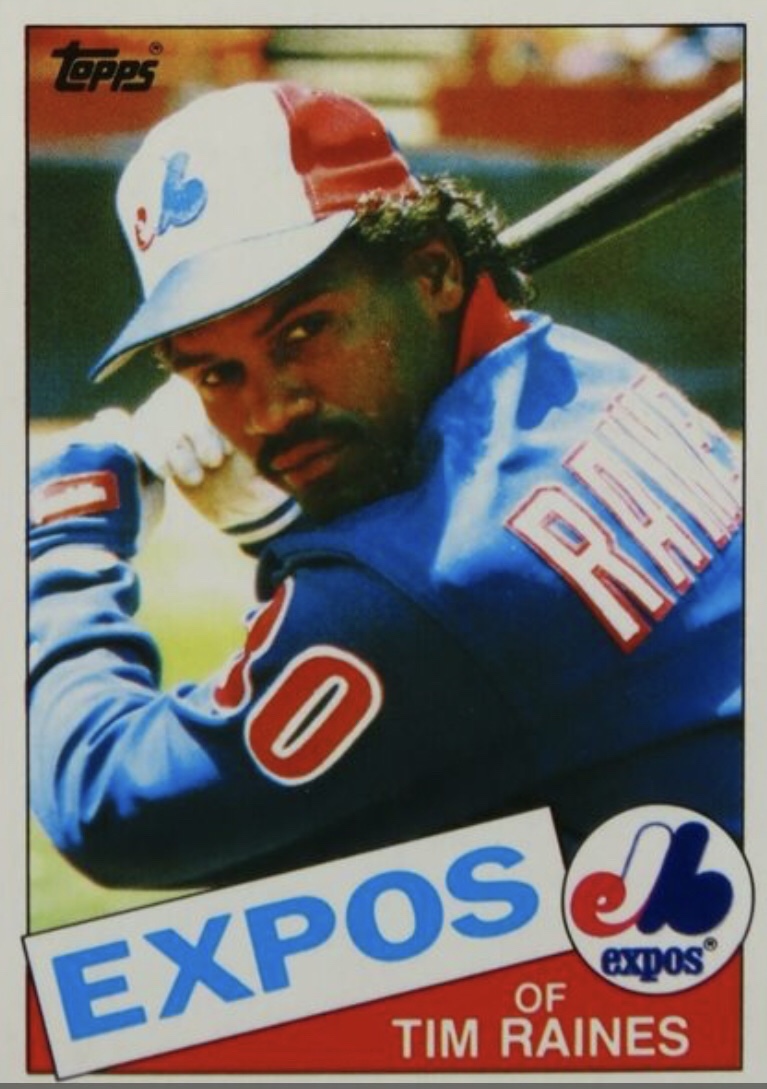
Tim Raines. (1985). $17

1985 Topps #630 – Value: $17.00 – Grade: 9

Hall of Fame Biography: https://youtu.be/pXYa7NQJq28

Timothy Raines Sr. (born in Sanford, FL on September 16, 1959), nicknamed Rock, is an American professional baseball coach and former player. He played as a left fielder in Major League Baseball for six teams from 1979 to 2002 and was best known for his 13 seasons with the Montreal Expos. A seven-time All-Star, four-time stolen base champion, and National League batting champion, Raines is regarded as one of the best leadoff hitters and baserunnersin baseball history. In 2013, Raines began working in the Toronto Blue Jays organization as a roving outfield and baserunning instructor. He was inducted into the Baseball Hall of Fame in 2017. Raines was a National League All-Star in 7 consecutive seasons (1981–1987), and was named the Most Valuable Player of the 1987 All-Star Game. In 1981, The Sporting News named Raines the National League Rookie of the Year. Raines finished in the top 10 in voting for the NL Most Valuable Player Award three times (1983, 1986, 1987). He won a Silver Slugger Award as an outfielder in 1986 when he led the National League in both batting average and on-base percentage. In 2013, Raines was elected into the Canadian Baseball Hall of Fame. On January 18, 2017, Raines was elected to the National Baseball Hall of Fame and Museum. He was formally inducted on July 30. His plaque depicts him in an Expos cap. The baseball complex at Seminole High Schoolin Sanford, Florida, Raines’ alma mater, has been renamed Tim Raines Athletic Park in his honor, and Raines’ number 22 has been retired at the school. Raines was also gifted a ceremonious key to the city of Sanford in March 2019, and the Sanford Historical Museum dedicated an exhibit to Raines, filling it with memorabilia from his career.
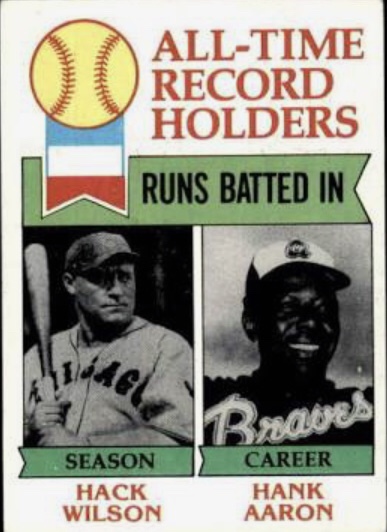
RBI Lead. (Wilson/Aaron) $237

1979 Topps #412 – Value: $237.00 – Grade: Mint

Remembering Hank, One of the Best MLB Players Ever: https://youtu.be/x4mVaJJ4E34

Henry Louis Aaron (Born in Mobile, AL on February 5, 1934 – January 22, 2021), nicknamed “Hammer” or “Hammerin’ Hank”, was an American professional baseball right fielder who played 23 seasons in Major League Baseball (MLB), from 1954 through 1976. Widely regarded as one of the greatest baseball players in history, he spent 21 seasons with the Milwaukee/Atlanta Braves in the National League (NL) and two seasons with the Milwaukee Brewers in the American League (AL). His 755 career home runs broke the long-standing MLB record set by Babe Ruth and stood as the most for 33 years; Aaron still holds many other MLB batting records. He hit 24 or more home runs every year from 1955 through 1973 and is one of only two players to hit 30 or more home runs in a season at least fifteen times. In 1999, The Sporting News ranked Aaron fifth on its list of the “100 Greatest Baseball Players”. In 1982, he was inducted into the National Baseball Hall of Fame in his first year of eligibility.

BaseBallology – Why Was Hack Elected into the Hall of Fame: https://youtu.be/Wj3Ml8mJ55E

Lewis RobertHackWilson (Born in Elwood City, PA on April 26, 1900 – November 23, 1948) was an American Major League Baseball player who played 12 seasons for the New York Giants, Chicago Cubs, Brooklyn Dodgers and Philadelphia Phillies. Despite his diminutive stature, he was one of the most accomplished power hitters in the game during the late 1920s and early 1930s. His 1930 season with the Cubs is widely considered one of the most memorable individual single-season hitting performances in baseball history. Highlights included 56 home runs, the National League record for 68 years; and 191 runs batted in, a mark yet to be surpassed. “For a brief span of a few years”, wrote a sportswriter of the day, “this hammered down little strongman actually rivaled the mighty Ruth.”

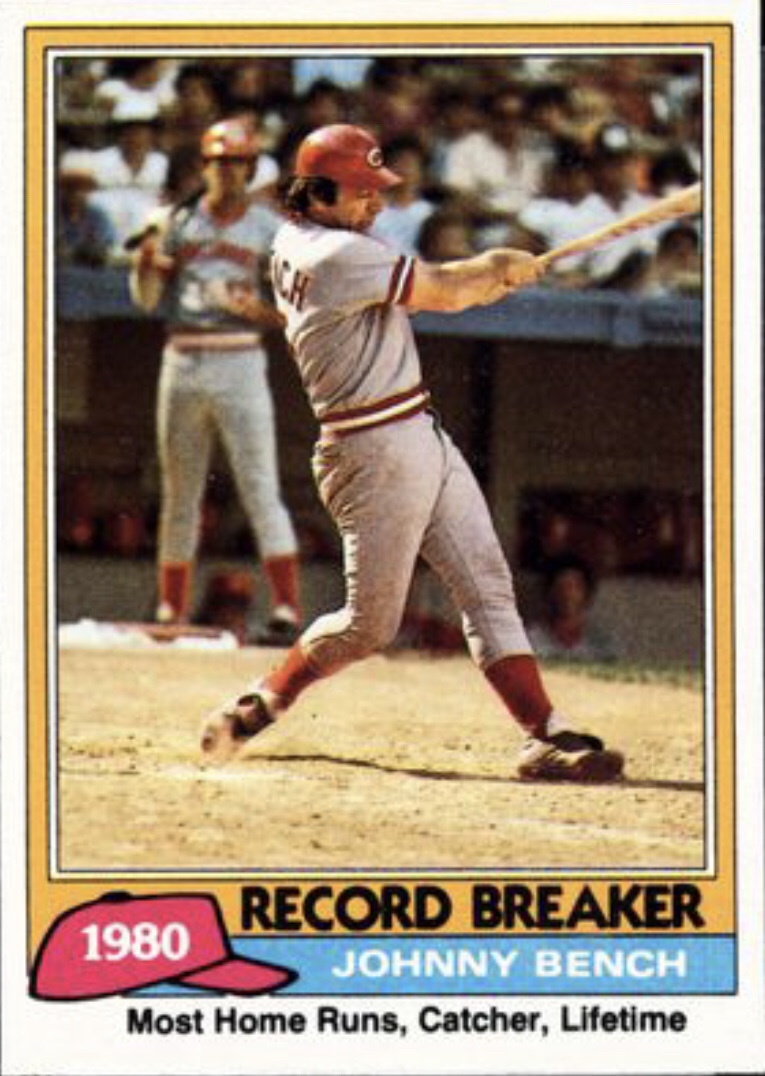
Record (HRs Catch) Bench $15

1981 Topps #201 – Value: $15.00 – Grade: 9

MLB – Bench: https://youtu.be/jOIzikGPPfY

Johnny Lee Bench (Born in Oklahoma City, OK on December 7, 1947-) is considered to be amongst the greatest catchers that Major League Baseball has ever seen and was the team leader that led the Cincinnati Reds “Big Red Machine” to back-to-back World Series titles in 1975 and 1976. Bench was a smart ballplayer, with an exceptional work ethic, who starred for his high school baseball and basketball teams and was named class valedictorian in his senior year. The Cincinnati Reds then took Johnny with the 36th overall pick of the 1965 MLB Amateur Draft. He spent two seasons with the Buffalo Bisons before getting the call-up to the big leagues. In 1968, Bench hit .275 with 15 home runs and 82 RBI to win the National League’s Rookie of the Year Award and his first All-Star selection while also posting a .991 fielding percentage and a 47% caught stealing percentage to win his first Rawlings Golden Glove. These accolades were early signs of what was to come. He won ten consecutive Gold Gloves behind the plate, second only to Ivan Rodriquez who won 13. In 1969, he set the single season caught stealing percentage record gunning down 57% of the opponent’s would-be base stealers and also posted a .992 fielding percentage. That same year, at the plate, Johnny led the NL with 45 home runs and 148 RBI while batting .293 to win the NL Most Valuable Player Award. Two years later, he would repeat as NL MVP, again leading the National League in home runs (40) and RBI (125) as well as throwing out 56% of the opposition’s base runners – second all-time in single season caught stealing percentage. Bench led a host of All-Stars and future Hall of Famers like Pete Rose, Dave Concepcion, Ken Griffey, Tony Perez, Joe Morgan and George Foster during the 1970s, helping the Reds reach the World Series four times (1970, 1972, 1975, 1976). The potent, well-oiled offense of Cincinnati earned the moniker “Big Red Machine” and could beat you with power or manufacture runs. The Reds beat the Boston Red Sox four-games-to-three in what is considered one of the greatest World Series in history and then repeated as champions in 1976, sweeping the New York Yankees. The 14-time MLB All-Star was named the 1976 World Series MVP after batting .533 with two homers and six RBI in four games. Johnny Bench was the Cincinnati Reds catcher for 17 seasons (1967-1983) and was formidable hitter at the plate as he posted a .267 career batting average with 389 home runs and 1,376 RBI. Bench also finished his career with a .990 fielding percentage behind the plate, winning 10 Gold Gloves, and gunning down 44% of the would-be base stealers. Johnny Bench popularized the one-handed style of catching that is commonplace in the game today. Johnny Lee Bench was elected to the National Baseball Hall of Fame in 1989. Since retiring, Bench has remained active in sports even attempting a run at the Senior PGA Tour after turning fifty. The Sporting News ranked him #16 on the “100 Greatest Baseball Players” list.

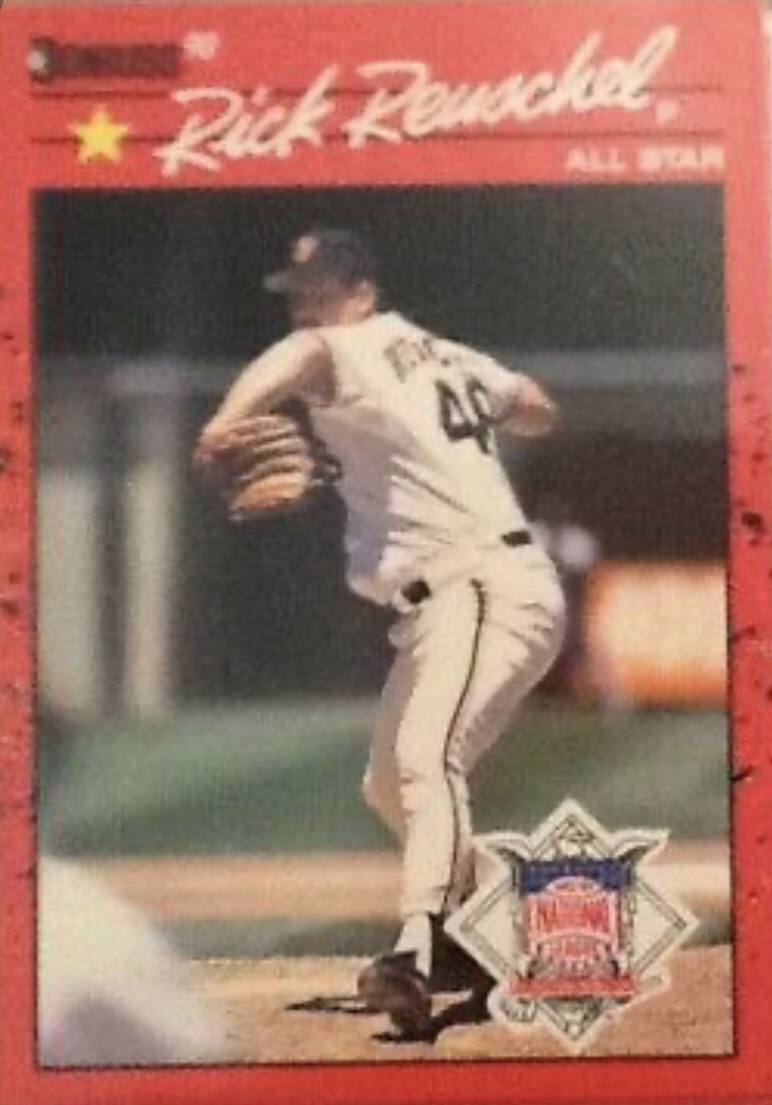
Rick Reuschel. (1990). $25

1990 Donruss #663 – Value: $26.00 – Grade: 9

Best Pitcher Not in the Hall of Fame? https://youtu.be/7PAMTcwvyYY

Ricky Eugene Reuschel (born in Quincy, IL on May 16, 1949) is an American former professional baseball player. He played in Major League Baseball as a right-handed pitcher from 1972 to 1991, winning 214 games with a career 3.37 ERA. His nickname was “Big Daddy” because of his portly physique. He was known for his deceptive style of pitching, which kept hitters off balance by constantly varying the speeds of his pitches. Reuschel was listed as 6-foot-4 and 225 pounds. Reuschel could run surprisingly well for his size (logging four triples in his batting career) and he was frequently used as a pinch runner on days he was not pitching. He was also a fair—though awkward-looking—hitter, batting well over .200 several times. His older brother Paul Reuschel also pitched for the Cubs from 1975 to 1978, as Rick’s teammate. Paul’s career ended with the Cleveland Indians in 1979. The Reuschel brothers were Illinois farm boys, with strong physiques and plain-spoken ways. The two are the only siblings to combine on a shutout. On August 21, 1975, Rick started and went 6⅓ innings against the Los Angeles Dodgers, followed by Paul, who pitched the final 2⅔ innings for the Cubs’ 7–0 win.

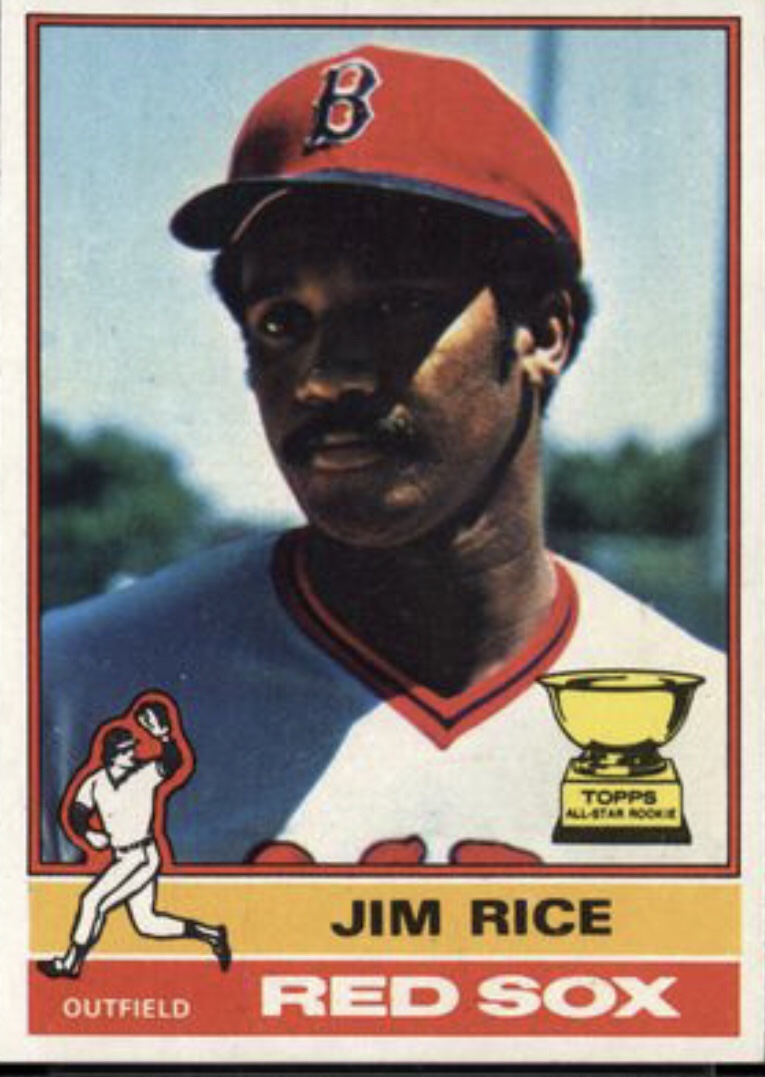
Jim Rice. (1976). $886

1976 Topps #340 – Value: $450.00 – Grade: Mint

Hall of Fame Journey: https://youtu.be/em09lvKy5Ko

James Edward Rice (Born in Anderson, SC on March 8, 1953-) was the 1974 International League Rookie of the Year, Most Valuable Player and Triple Crown winner with the Pawtucket Red Sox batting .337 with 25 home runs and 93 RBI in 117 games. Needless to say, Rice was quickly added to the big club’s roster in Boston and he became the third left fielder in Boston’s long history to spend his entire career with the boys from Beantown (Ted Williams and Carl Yastrzemski). Rice played 16 years in Boston where he clouted 20 home runs in his first eleven seasons and earned the 1978 American League Most Valuable Player Award. In 1979, he became the second player in history after Ty Cobb to lead the league in total bases for three consecutive seasons (1977-1979), and again in 1983. His 406 total bases in 1978 remains an AL record for a season. The eight-time All-Star selection also led the league three times in home runs, and RBI and slugging percentage twice. Jim Rice retired with 2,452 hits, 1,249 runs, 1,451 RBI, and 382 home runs while posting a career .298 batting average. The Veterans Committee elected James Edward Rice to the National Baseball Hall of Fame in 2009.

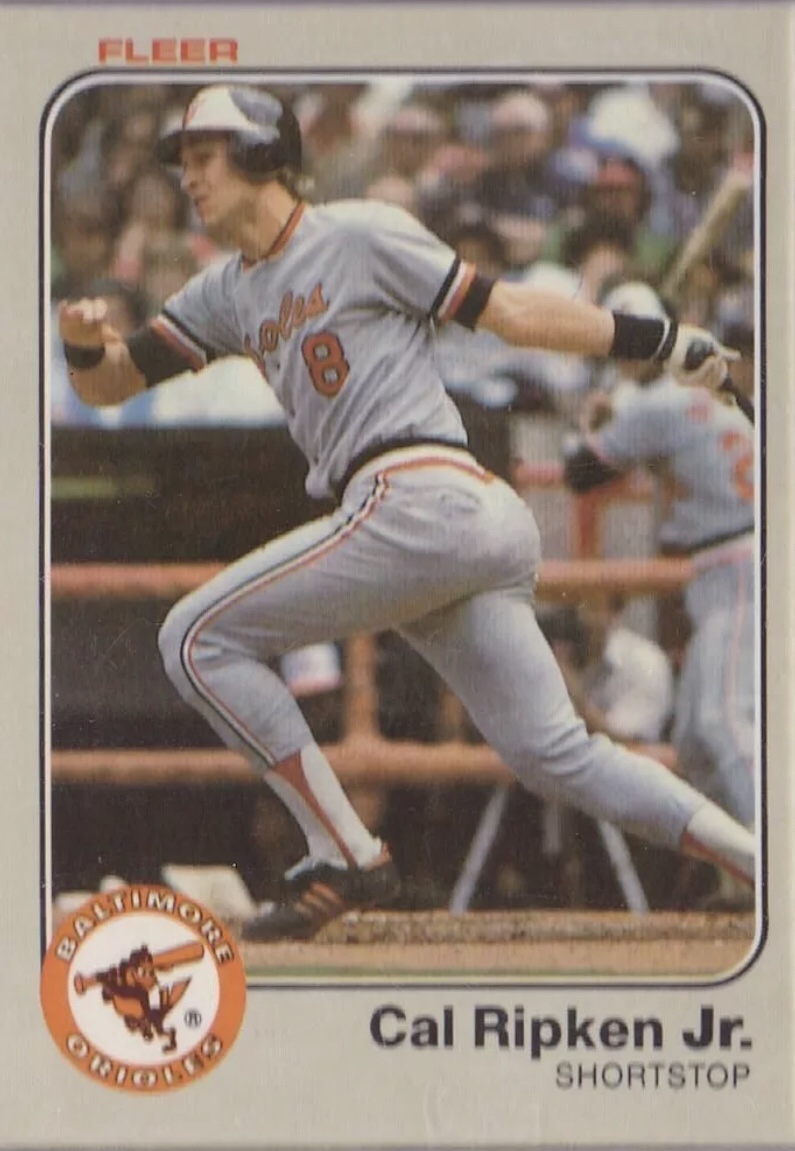
Cal Ripken Jr. (1983). $375

1983 Fleer #70 – Value: $4000.00 – Grade: Mint

Final At Bat of Cal Ripken Jr.’s Career: https://youtu.be/yGJ57cnPh2I

#78 of the Top 100 Players

Cal Ripken (Born in Havre de Grace, MD) is a bridge, maybe the last bridge, back to the way the game was played. Hitting home runs and all that other good stuff is not enough. It’s how you handle yourself in all the good times and bad times that matters. That’s what Cal showed us. Being a star is not enough. He showed us how to be more.” – Joe Torre. Cal Ripken Jr. was a throwback. He played hard, he played to win, and he played in every game. On May 30, 1982, Ripken began “the streak” – the longest stretch of consecutive games played by anyone in baseball history (2,632), and in the process earned the moniker “Iron Man.” Fellow Hall of Fame shortstop Ozzie Smith said: “It is extremely impressive that Cal was able to do something like this while playing shortstop. You have to have size and strength, which he obviously has, you have to have skill and you have to have some luck. I have always thought that shortstops were the best athletes on the field and this just reconfirms that.” A 19-time All-Star and two-time American League Most Valuable Player, Ripken redefined the shortstop position. Traditionally viewed as a position from which you wouldn’t expect a lot of offense, Ripken ushered in an era of superstar shortstops that could not only handle the rigors of the position defensively, but regularly hit 20-30 home runs and bat .300. Ripken was selected in the second round of the 1978 MLB Draft by the Orioles – the franchise where his father worked as a coach. Ripken debuted in the big leagues in 1981, won the American League Rookie of the Year Award in 1982 and the AL Most Valuable Player Award in 1983 while leading Baltimore to the World Series title. Along the way, Ripken moved from third base to shortstop despite conventional thinking that said at 6-foot-4 and 200 pounds he would not be able to cover the necessary ground on defense. But Ripken’s impeccable positioning and instincts proved more than a match for the position. He led all AL shortstops in double plays eight times, assists seven times, putouts six times and fielding percentage four times – winning two Gold Glove Awards. Offensively, Ripken was a craftsman – continually making adjustments to his batting stance and plate approach. He posted 12 seasons with at least 20 home runs, including 10 in a row, and reached the 100 RBI mark four times. He won his second AL MVP in 1991 while leading the league in total bases with 368. On Sept. 6, 1995, baseball’s “Iron Man” passed Lou Gehrig’s mark of 2,130 consecutive games played. When he removed himself from the Orioles lineup on Sept. 20, 1998, he ended a streak that helped heal the game following the 1994-95 strike. Ripken retired after the 2001 season with 3,184 hits, 603 doubles, 431 home runs, 1,695 RBI and 19 All-Star Game selections. He was elected to the Hall of Fame in 2007.

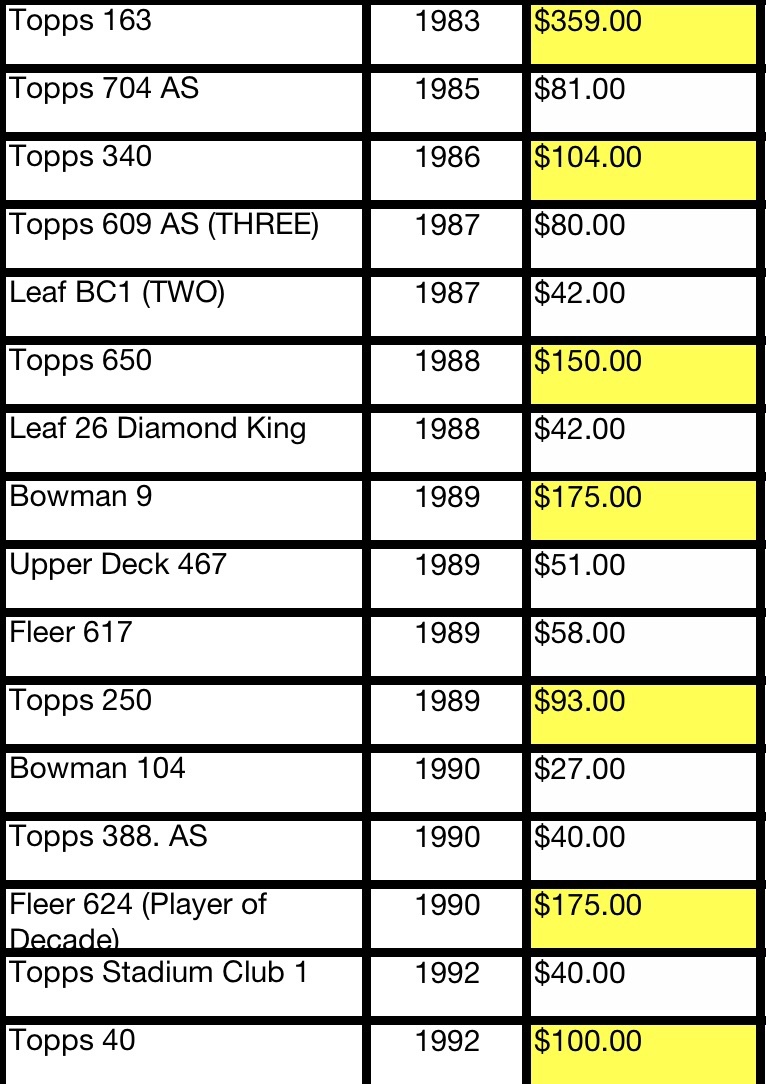
More Cal Ripken Jr. cards in my collection:

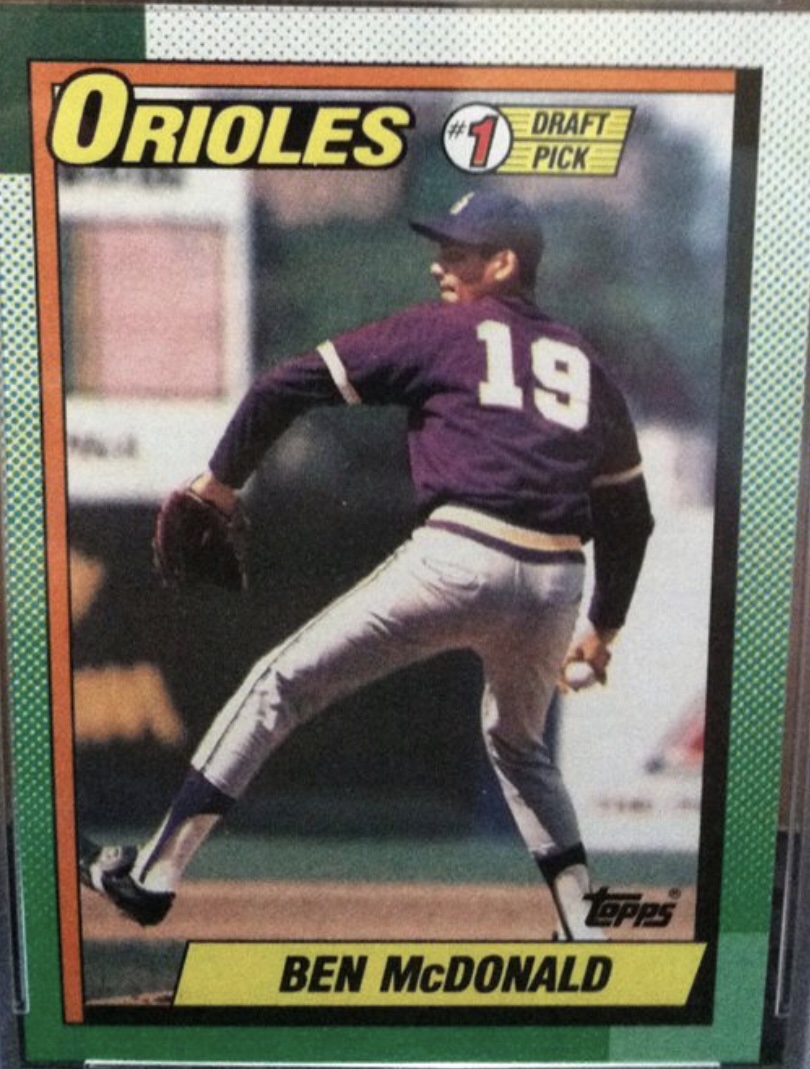
Ben McDonald. (1990 RC). $18

1990 Topps #774 – Rookie Card
Value: $18.00 – Grade: 9

Teaches Arm Strength and Accuracy: https://youtu.be/8LrLDojJLeg

Larry Benard McDonald (born in Denham Springs, LA on November 24, 1967) is a former Major League Baseballpitcher. The first overall pick in the 1989 MLB Draft, McDonald played for the Baltimore Orioles and Milwaukee Brewers from 1989 through 1997. A collegiate star at Louisiana State University who also played varsity basketball there, McDonald stands 6’7″. He also led the 1988 US Olympic Team to a gold medal for baseball, winning complete games against host South Korea and Puerto Rico. During his three-year college career at LSU, McDonald twice helped his team reach the College World Series. He gave up a notable walk-off grand slam to Stanford’s Paul Carey in the 1987 series. His best collegiate season came in 1989, which he finished with a 14–4 record, a 3.49 ERA, and a Southeastern Conference record 202 strikeouts. That year, he was selected as a member of the All-America team, and he won the Golden Spikes Award. In 1989, he played collegiate summer baseball with the Orleans Cardinals of the Cape Cod Baseball League, recording one start. In the finale of the 1989 season, McDonald tossed one scoreless inning of relief versus the American League East champion Toronto Blue Jays, logging his first career win. Of note, he would become the sixth player to make the majors in the same season that he was selected as the number one overall pick in the Major League Baseball Amateur Draft. McDonald joined the Orioles’ starting rotation in 1990, and in his first major league start on July 21, he threw a complete game shutout against the Chicago White Sox. At the end of the season, he finished eighth in Rookie of the Yearvoting, with the award going to catcher Sandy Alomar, Jr. McDonald would go on to spend seven seasons with the Orioles, before leaving as a free agent in 1996 to join the Milwaukee Brewers. He never led his league in a major category, but ranked among the top 10 at various times in categories such as complete games, wins, ERA, WHIP, and strikeouts. McDonald was the first #1 draft pick to win his first three starts in Major League history, a feat which has been equalled by Gerrit Cole.

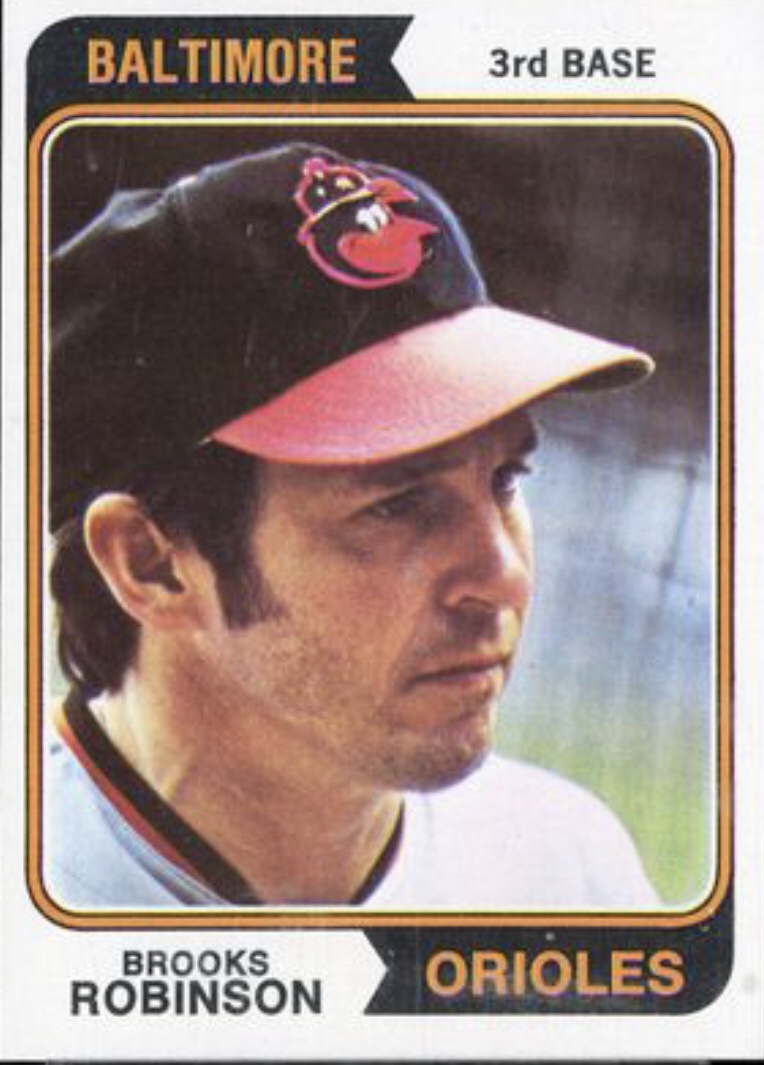
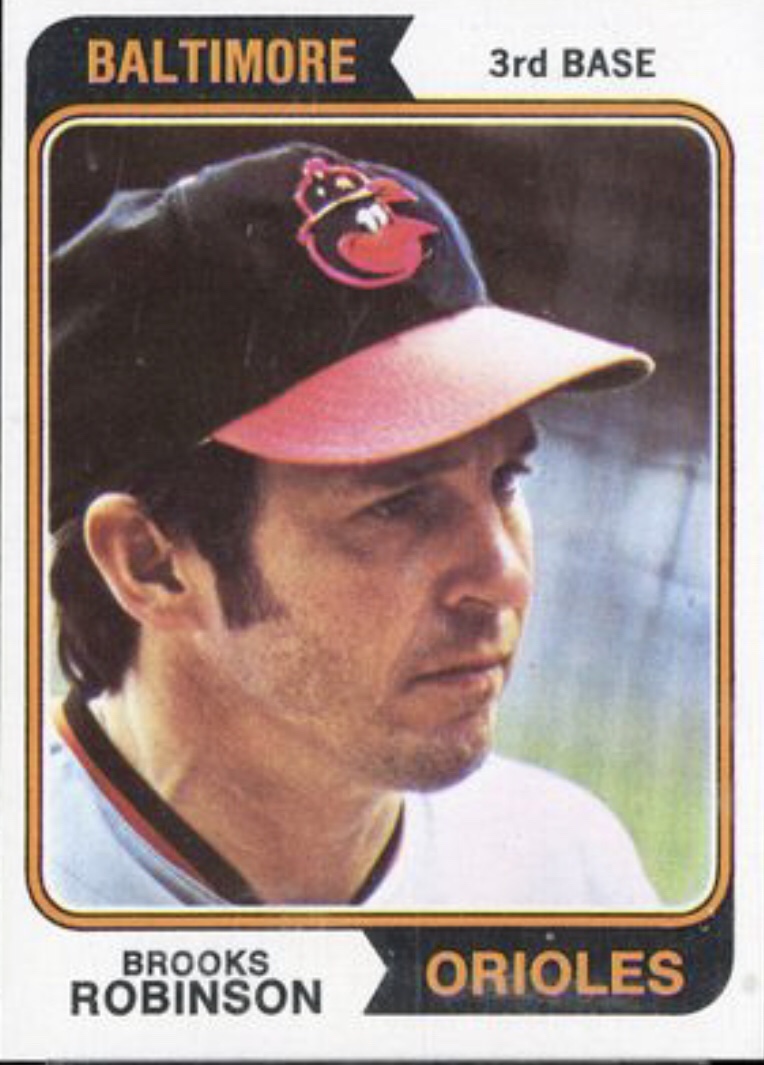
Brooks Robinson. (1974). $576

1974 Topps #160 – Value: $300.00 – Grade: 8

Brooks Robinson Collection: https://youtu.be/FVqMgvUe75E

#80 of the Top 100 Players

Brooks Calbert Robinson (Born in Little Rock, AR on May 18, 1937-) is generally considered to be the greatest defensive third baseman in the history of baseball. He was selected to 18 straight All-Star appearances from 1960-1974, won the 1964 American League Most Valuable Player award, and was the second recipient of the Roberto Clemente Award as “best exemplifying the game of baseball, sportsmanship, community involvement and the individual’s contribution to his team.” Brooks played his entire 23-year career with the Baltimore Orioles, helping them to four American League pennants and two World Series championships (1966, 1970). He was voted the 1970 World Series Most Valuable Player after batting .583 during the ALCS against the Minnesota Twins and a continuing his hot hitting during the Fall Classic, batting .429 against the Cincinnati Reds. Robinson’s acrobatic and athletic plays at the hot corner led to his records of most career game at third (2,870), career putouts (2,670), career assists (6,205) career chances (8,902) and double plays (618) at the time of his retirement. Brooks Calbert Robinson was elected to the National Baseball Hall of Fame in 1983.

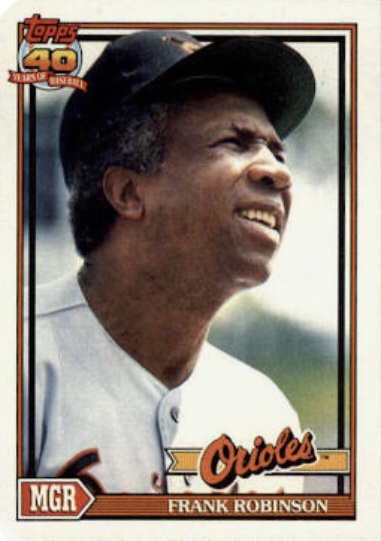
Frank Robinson (1991). $246

1991 Topps #639 – Value: $246.00 – Grade: Mint

Legendary Career: https://youtu.be/OinURXkmwqw

#22 of the Top 100 Players

Frank Robinson (Born in Beaumont, TX on August 31, 1935 – February 7, 2019) was an American professional baseball outfielder and manager in Major League Baseball (MLB) who played for five teams, from 1956 to 1976. The only player to be named Most Valuable Player (MVP) of both the National League (NL) and the American League(AL), he was named the NL MVP after leading the Cincinnati Reds to the pennant in 1961 and was named the AL MVP in 1966 with the Baltimore Orioles after winning the Triple Crown; Robinson’s 49 home runs (HR) that year tied for the most by any AL player between 1962 and 1989, and stood as a franchise record for 30 years. He helped lead the Orioles to the first two World Series titles in franchise history in 1966 and 1970, and was named the Series MVP in 1966 after leading the Orioles to a four-game sweep of the Los Angeles Dodgers. In 1975, Robinson became the first black manager in big league history, as the Cleveland Indians’ player-manager.

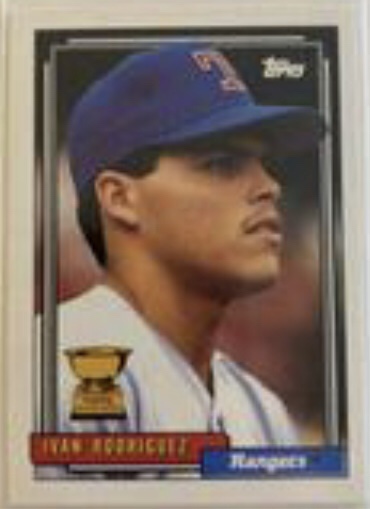
Ivan Rodriguez. (1992 RC) $750

1992 Topps #78 – Rookie Card
Value: $350.00 – Grade: Mint

Hall of Fame Tribute: https://youtu.be/efx9WniNsD8

IvánPudgeRodríguez Torres (born in Manati, Puerto Rico on November 27, 1971) is a Puerto Rican former Major League Baseball catcher. He played for the Texas Rangers (in two separate stints, comprising the majority of his career), Florida Marlins, Detroit Tigers, New York Yankees, Houston Astros and Washington Nationals. Rodríguez was awarded the AL MVP award in 1999 and is widely regarded as one of the greatest catchers in MLB history. Rodríguez won the World Series with the Florida Marlins in 2003, and also played in the 2006 World Series while with the Tigers. He is the major league career leader in putouts by catchers. On June 17, 2009, Rodríguez set an MLB record by catching his 2,227th game, passing Carlton Fisk (coincidentally also known by the nickname “Pudge”). During his career, he had the best caught stealing percentage of any major league catcher, at 45.68% (versus a league average of 31%), and he had nine seasons with a caught stealing rate of 50% or higher. On January 18, 2017, he was elected to the National Baseball Hall of Fame and Museum in Cooperstown in his first year of eligibility, receiving 76% of the votes cast, and was officially inducted on July 30, 2017.