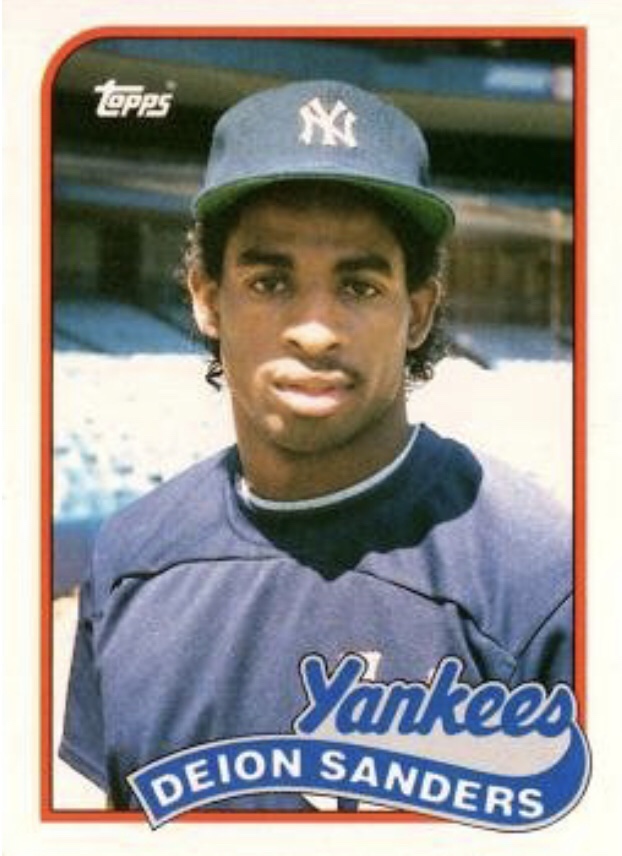
Deion Sanders. (1989). $50

1989 Topps #110T – Rookie Card
Value: $100.00 – Grade: Mint

Baseball Career Highlights: https://youtu.be/w_wamMTXVCg

Deion Luwynn Sanders Sr. (born in Fort Myers, FL on August 9, 1967), nicknamed “Prime Time” and “Neon Deion”, is an American athlete, sports analyst, and football coach. He is often considered to be one of the most talented NFL players of all time. He is currently the head football coach at Jackson State University. He played in the National Football League (NFL) for 14 seasons as a member of the Atlanta Falcons, San Francisco 49ers, Dallas Cowboys, Washington Redskins, and Baltimore Ravens. Sanders was also a baseball outfielder for nine seasons in Major League Baseball (MLB), where he played with the New York Yankees, Atlanta Braves, Cincinnati Reds, and San Francisco Giants. He won two Super Bowl titles and made one World Series appearance in 1992, making him the only athlete to play in both a Super Bowl and a World Series. Sanders played a nine-year, part-time baseball career, playing left and center field in 641 games with four teams. He was originally drafted by the Kansas City Royals in the sixth round of the 1985 draft, but did not sign with them. The New York Yankees selected Sanders in the 30th round of the 1988 Major League Baseball draft, and he signed with the team on June 22. He opened the 1989 season with the Albany-Colonie Yankeesof the Class AA Eastern League. Though Sanders planned to leave the Yankees in July to attend NFL training camp, he became embroiled in a contract dispute with the Falcons, and used the Yankees as leverage. He received a promotion to the major leagues, and spent the summer with the Columbus Clippersof the Class AAA International League. Sanders made his major league baseball debut on May 31, 1989. During the 1989 season, he hit a major league home run and scored a touchdown in the NFL in the same week, becoming the only player ever to do so. Sanders is also the only man to play in both a Super Bowl and a World Series. Sanders and Bo Jackson were the pre-eminent multi-sport athletes of their time, but prior to the 1990 season, they had never squared off against each other in a professional game. That changed in 1990, when Jackson and Sanders met five times on the diamond — the most memorable of which came on July 17, in what was billed as “The Bo and Prime Time Show.” After Bo Jackson’s three-homer night, Sanders said, “He’s (Bo’s) one of the best athletes who ever put on a uniform.” Sanders made the Yankees’ Opening Day roster for the 1990 season. On May 22, 1990, Sanders became involved in a dispute with Chicago White Sox catcher Carlton Fisk. Sanders started by stepping up to the plate with one out and a runner on third, drawing a dollar sign in the dirt before the pitch and then failed to run to first base after hitting a routine pop fly to shortstop, trotting back to the dugout instead. The Yankee fans booed, and Fisk told Sanders to “run the f**king ball out” and called Sanders a “piece of s**t.” Later in the game, Sanders told Fisk that “the days of slavery are over.” Fisk was furious. “He comes up and wants to make it a racial issue, there’s no racial issue involved. There is a right way and a wrong way to play this game.” By mid-July, Sanders expressed that he was unsure if he would remain with the Yankees or report to training camp for the upcoming NFL season. He requested a $1 million salary for the 1991 season, and the Yankees ended negotiations on a contract extension with Sanders. He left the team, finishing the 1990 season with a .158 batting average and three home runs in 57 games. In September 1990, the Yankees placed Sanders on waivers with the intention of giving him his release, as Yankees’ general manager Gene Michael said that Sanders’ football career was stunting his baseball development. Sanders later signed with the Atlanta Braves for the 1991 MLB season. On July 31, Sanders hit a key three-run homer to spark a comeback win against the Pittsburgh Pirates during the Braves’ run to the National League West Division title. However, he had to leave the Braves the very next day to report to the Atlanta Falcons because of a clause in his NFL contract and missed the postseason. Before the 1992 season, Sanders reworked his NFL deal, whereby he still reported to the Falcons for training camp in August, but was allowed to rejoin the Braves for the postseason. During the 1992 season, his best year in the majors, Sanders hit .304 for the team, stole 26 bases, and led the NL with 14 triples in 97 games. In four games of the 1992 World Series, Sanders batted .533 with 4 runs, 8 hits, 2 doubles, and 1 RBI while playing with a broken bone in his foot. His batting average, on-base percentage, slugging percentage, total bases and win probability added each led the team in the series. Despite Sanders’ performance, the Braves ultimately lost to the Toronto Blue Jays in six games.[23] In Game 3, he narrowly avoided being a victim of what would have been only the second triple play in World Series history (following Bill Wambsganss’s unassisted triple play in 1920). With Sanders on second base and Terry Pendleton on first, David Justice hit a deep fly ball to center field that Blue Jays center fielder Devon White unexpectedly caught with a leaping effort. Pendleton passed Sanders on the bases for the second out, but umpire Bob Davidson called Sanders safe after he scampered back to second base. Replays showed that Toronto third baseman Kelly Gruber tagged him on the heel before he returned to second. In 1997, Sanders finished second in the NL with 56 stolen bases in 115 games while with the Cincinnati Reds before leaving baseball for three years. Sanders returned to the Reds in 2001, but was released after playing in only 29 games and batting just .173. Following his release from the Reds, he signed a minor league contract with the Toronto Blue Jays. Sanders was hitting .252 for Syracuse Chiefs before the Washington Redskins found a loophole in his contract which compelled him to return to the Redskins. Sanders’ football contract had been negotiated to allow for him to play both baseball and football, but the terms of the contract stated that Sanders could miss NFL training camp and the first few games of the season only if he were playing Major League Baseball. Since he was not then on an MLB roster, Sanders had to leave Syracuse and return to the Redskins so he would not violate his NFL contract. But before arriving at training camp, Sanders informed Redskins personnel he was retiring from professional baseball. In his final professional baseball game, Sanders hit a solo home run and an RBI single in Syracuse’s 12–6 win over the Toledo Mud Hens. As those in MLB and the NFL urged Sanders to concentrate on only one sport (similar to what they did with Bo Jackson), he would often explain, “football is my wife and baseball is my mistress.”

Manny Sanguillen. (1972). $348

1972 Topps. #60 – Value: $348.00 – Grade 9

Appreciate Manny: https://youtu.be/xTUzWJppAI8

Manuel De Jesus Sanguillén Magan, better known as Manny Sanguillén (Born in Colon, Panama on March 21, 1944- ), is a former Panamanian catcher who played for the Pittsburgh Pirates (1967, 1969-1976, 1978-1980) and Oakland A’s (1977). Sanguillen was an integral part of the Pirates teams of the 1970s and won World Series championships with the team in 1971 and 1979. He was a fantastic defensive catcher who also hit .296 for his career, though he was not a power hitter. Sanguillen was a three-time All-Star, even though he was often overshadowed by his National League counterpart, Johnny Bench.

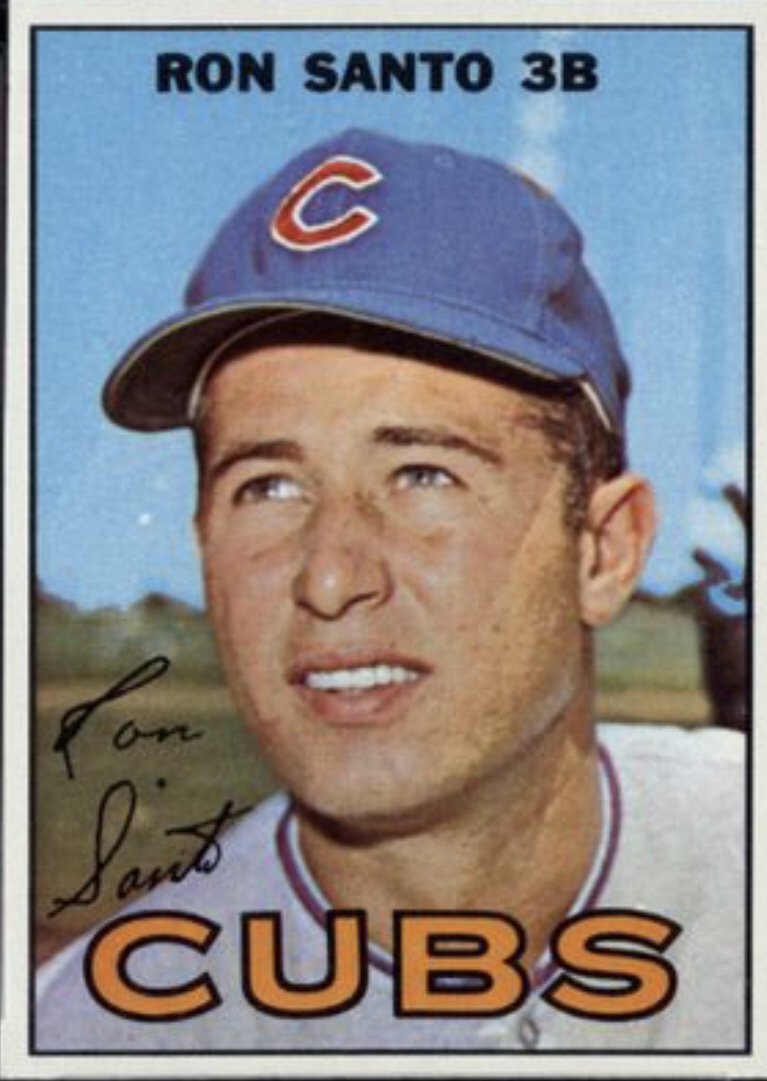
Ron Santo. (1967). $24

1967 Topps #70 – Value: $24.00 – Grade: 5

Hall of Fame Biography: https://youtu.be/ZwPLSLw4W1w

Ronald Edward Santo (Born in Seattle, WA on February 25, 1940 – December 3, 2010) played his entire career in a Chicago baseball uniform wowing fans with his superb defensive ability at the hot corner and his powerful bat at the plate. After signing with the Chicago Cubs in 1959, Ron played half the seasons at third in 1960 eventually filling the spot vacated by All-Star third baseman Al Dark. Ron possessed surprising power, excellent range and speed and a superb glove as he won five National League Gold Gloves at third. From his second year with the Cubs until his last, Santo hit 20 or more home runs 11 of his 14 years with the club including four straight 30+ (1964-1967). Ron was a key member of the Chicago infield that included All-Stars Don Kessinger and Glenn Beckert and Hall of Famer Ernie Banks. He led all National League third basemen in putouts and assists seven times and four times in double plays. At the plate, Santo led the NL in triples once, games and on-base percentage twice, three times in sacrifice flies and four times in walks. The nine-time NL All-Star won the 1973 Lou Gehrig Memorial Award as the “player who best exemplifies his character and integrity both on and off the field. Always the showman, Santo became a fan favorite in Chicago and endeared himself at the friendly confines of Wrigley Field as he would “click his heels” after each win during the Cubs unlikely run at the 1969 National League pennant. Ron played 15 years in the Major Leagues for the Cubs (1960-1973) and the Chicago White Sox (1974). He posted a .954 career fielding percentage with 1,955 putouts, 4,581 assists, 395 double plays and 317 errors in 6,853 chances. Ron Santo finished his career with a .277 career batting average with 2,254 hits including 365 doubles and 342 home runs, scored 1,138 runs and drove in 1,331 RBI. Following his playing days, Santo spent four decades in the broadcast booth until his death from bladder cancer and diabetes in 2010. In 2011, Ron Santo was voted into the National Baseball Hall of Fame in the Class of 2012.

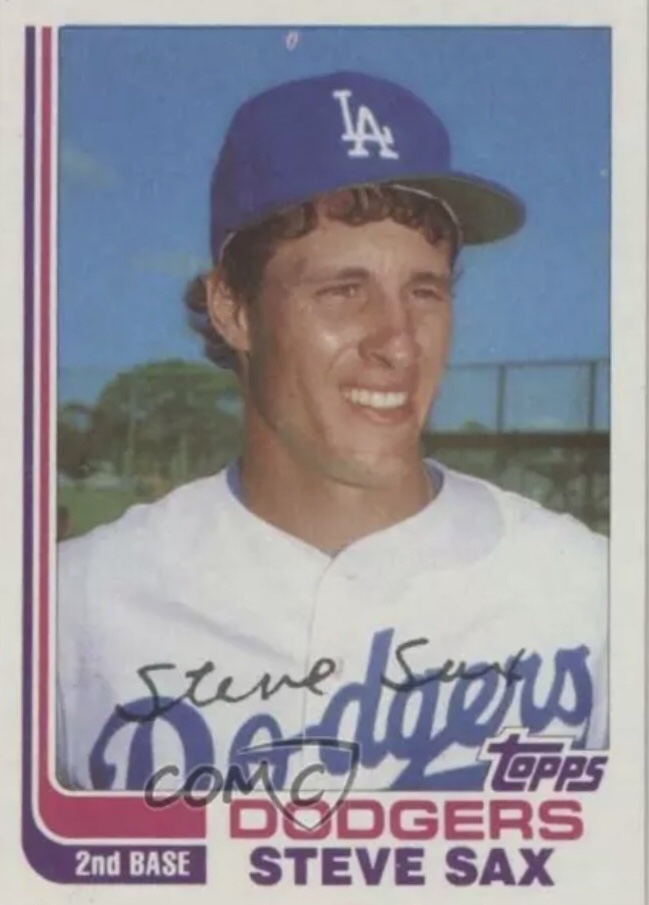
Steve Sax. (1982). $67

1982 Topps #103T – Value: $67.00 – Grade: 9

Steve’s Dad’s Dying Last Words Cured Him of the Yips: https://youtu.be/E86fhY7Uqfs

Stephen Louis Sax (born in Sacramento, CA on January 29, 1960) is an American former professional baseball player and coach. He played as a second baseman in Major League Baseball from 1981 to 1994, most notably as a member of the Los Angeles Dodgers with whom he won two world championships in 1981 and 1988. A five-time All-Star player, Sax was named the National League Rookie of the Year in 1982 and won the Silver Slugger Award in 1986. He also played for the New York Yankees, Chicago White Sox, and the Oakland Athletics. Sax currently hosts on SiriusXM’s MLB Network Radio. Sax starred at James Marshall High school (now known as River City High School) in West Sacramento from 1975 to 1978 before being drafted by the Los Angeles Dodgers on June 6, 1978, in the ninth round of the 1978 Amateur Draft 1978. Sax was a late season call up in 1981, playing 31 games. Sax broke into the majors as a regular in 1982, earning the National League Rookie of the Year award. Throughout his career, Sax was on the All-Starteam five times and had a batting average over .300 in three seasons. He had great success on the basepaths, stealing over 40 bases in six different seasons, finishing with a career total of 444 stolen bases. He also set the Yankees team record for most singles in a season (171 in 1989). Sax has two World Series rings, both with the Los Angeles Dodgers in 1981 and 1988. Sax was also a higher-up in the Players Association during his career. He controversially opined that major league players should not speak to or assist anyone who was a replacement player during the infamous 1994–95 Major League Baseball strike and later joined a club when the strike had ended. He also opined that such players should be denied pensions by the union.

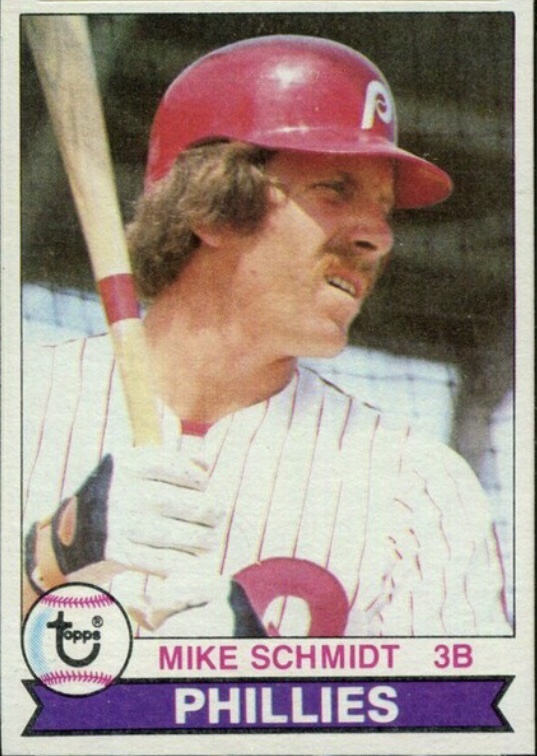
Mike Schmidt. (1979). $400

1979 Topps #610 – Value: $350.00 – Grade: 8

Career Highlights: https://youtu.be/bqfPn5hWJsU

#28 of the Top 100 Players

Michael Jack Schmidt (born in Dayton, OH on September 27, 1949) is an American former professional baseball third baseman who played 18 seasons in Major League Baseball (MLB) for the Philadelphia Phillies. Schmidt was a 12-time All-Star and a three-time winner of the National League (NL) Most Valuable Player award (MVP), and he was known for his combination of power hitting and strong defense. As a hitter, he compiled 548 home runs and 1,595 runs batted in (RBIs), and led the NL in home runs eight times and in RBIs four times. As a fielder, Schmidt won the National League Gold Glove Award for third basemen ten times. Schmidt was elected to the Baseball Hall of Fame in 1995 and is widely considered to be the greatest third baseman in baseball history. Having an unusual batting stance, Schmidt turned his back somewhat toward the pitcher and rocked his rear end back and forth while waiting for a pitch. By standing far back in the batter’s box, he made it almost impossible to jam him by pitching inside. Schmidt was one of the best athletes of his era; teammate Pete Rose once said, “To have his body, I’d trade him mine and my wife’s, and I’d throw in some cash.”

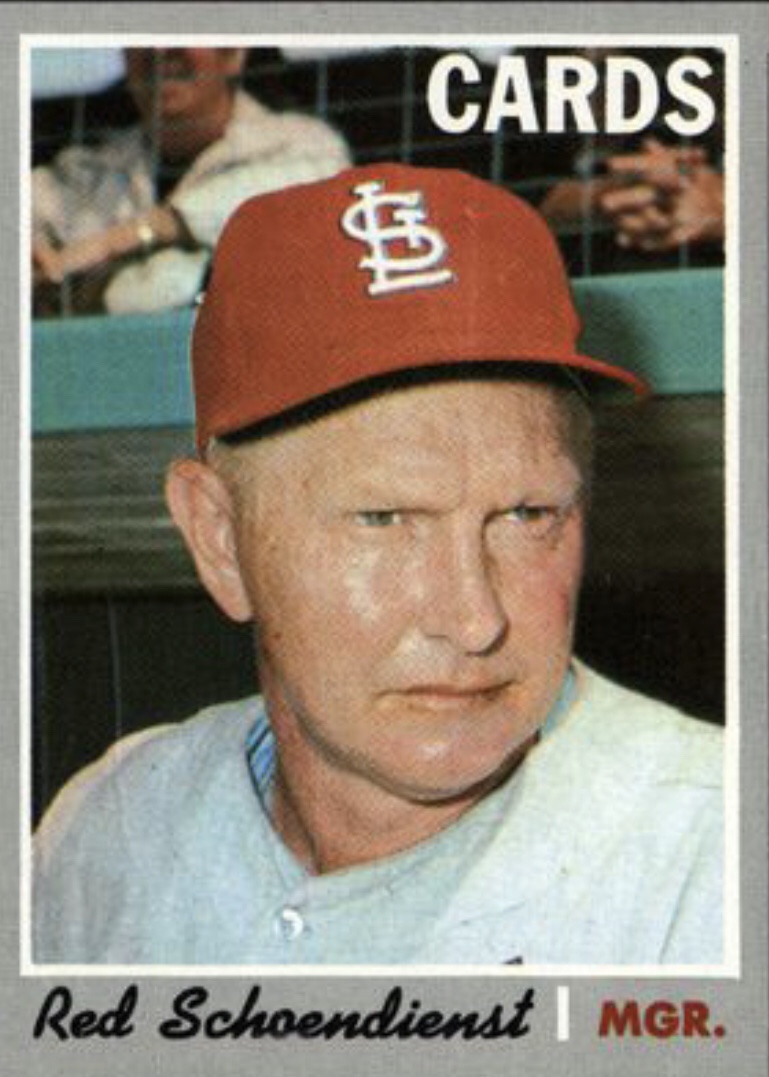
Red Schoendienst. (1970). $535

1970 Topps #346 – Value: $535.00 – Grade: 8

Hall of Fame Remembers Red: https://youtu.be/GCppSSIncHQ

Albert Fred “Red” Schoendienst (Born in Germantown, IL on February 2, 1923 – June 6, 2018) played 19 seasons at second base and left field with the St. Louis Cardinals (1945-1956, 1961-1963), the New York Giants (1956-1957) and the Milwaukee Braves (1957-1960). In his rookie season, he led the National League in stolen bases with 26, but resolved after the following season to focus on hitting and fielding. Red hit better than .300 in seven seasons and led the NL in fielding percentage six times. Schoendienst was a t10-time All-Star selection and was among the top ten in voting for the NL Most Valuable Player Award twelve times (never winning). Red Schoendienst retired with 2,449 hits, 1,223 runs, 773 RBI and a .289 career batting average. As a player, Schoendienst won two World Series titles with the 1946 Cardinals and 1957 Braves. He added another three championships with the Cardinal organization, as manager in 1967, and as a member of the coaching staff in 1964 and 1982. Red has donned a Major League uniform for seven decades The Veterans Committee elected Albert Fred “Red” Schoendienst to the National Baseball Hall of Fame in 2007.

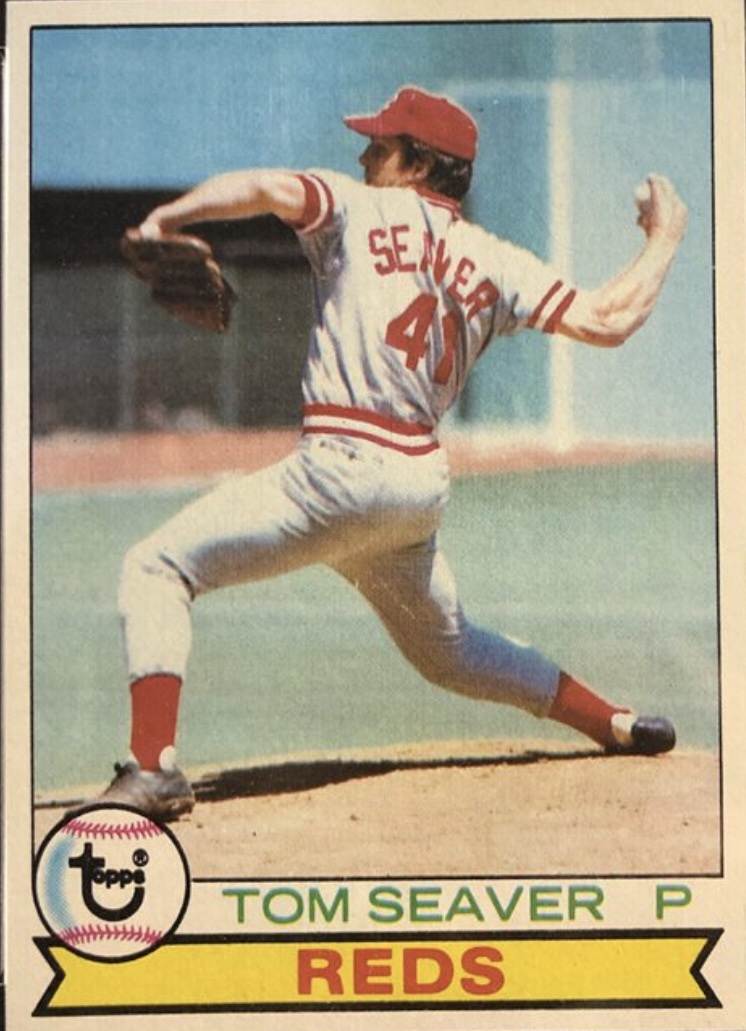
Tom Seaver. (1979). $450

1979 Topps #100 – Value: $2000.00 – Grade: 8

MLB Hall of Fame Remembers Tom: https://youtu.be/B_s0r9cJ0fU

#32 of the Top 100 Players

George Thomas Seaver (Born in Fresno, CA on November 17, 1944 – August 31, 2020), nicknamed “Tom Terrific” and “the Franchise”, was an American professional baseball pitcher who played 20 seasons in Major League Baseball (MLB). He played for the New York Mets, Cincinnati Reds, Chicago White Sox, and Boston Red Sox from 1967 to 1986. A longtime Met, Seaver played a significant role in their victory in the 1969 World Series over the Baltimore Orioles. With the Mets, Seaver won the National League’s (NL) Rookie of the Year Award in 1967, and won three NL Cy Young Awards as the league’s best pitcher. He was a 12-time All-Star and ranks as the Mets’ all-time leader in wins. During his MLB career, he compiled 311 wins, 3,640 strikeouts, 61 shutouts, and a 2.86 earned run average, and he threw a no-hitter in 1978. In 1992, Seaver was inducted into the Baseball Hall of Fame by the highest percentage of votes ever recorded at the time. Along with Mike Piazza, he is one of two players wearing a New York Mets hat on his plaque in the Hall of Fame. Seaver’s No. 41 was retired by the Mets in 1988, and New York City changed the address of Citi Field to 41 Seaver Way in 2019. Seaver is also a member of the New York Mets Hall of Fame and the Cincinnati Reds Hall of Fame.

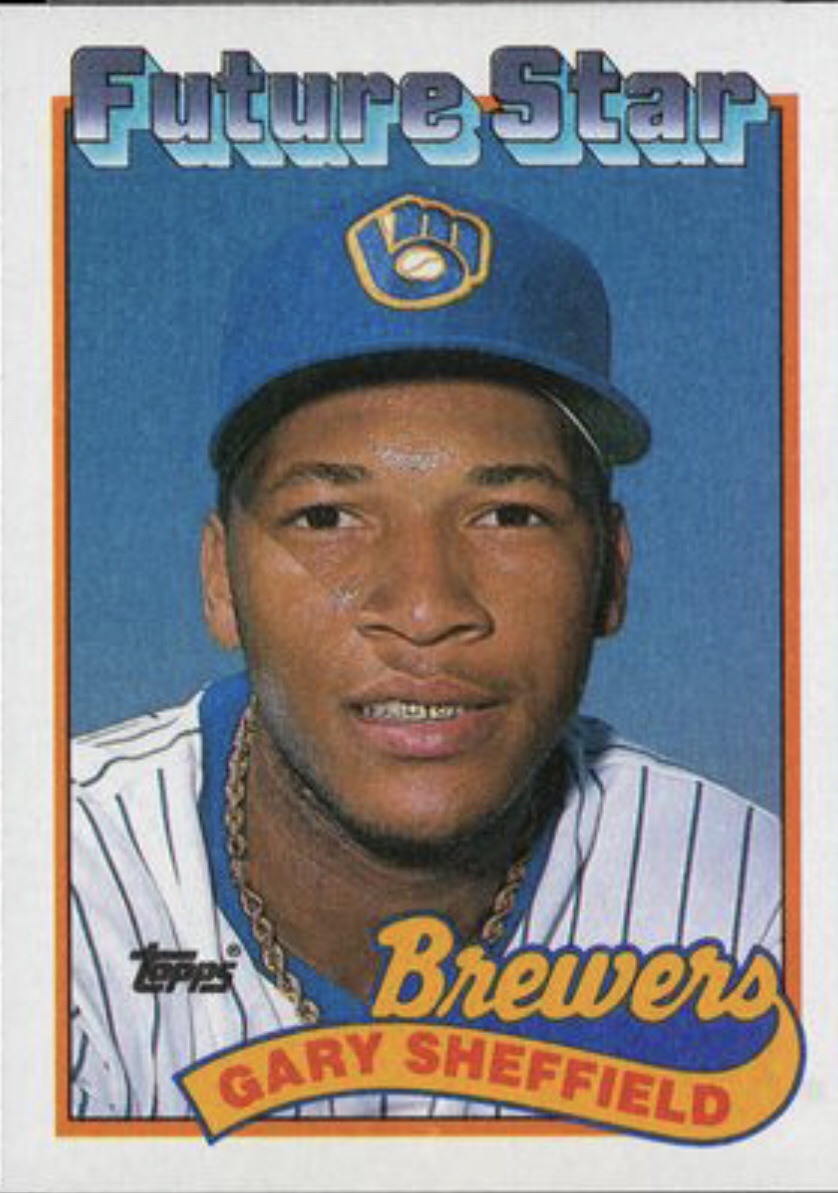
Gary Sheffield. (‘89 RC). $32

1989 Topps #343 – Rookie Card
Value: $32.00 – Grade: 9

Career Highlights: https://youtu.be/PV2lFQBedQY

Gary Antonian Sheffield (Born in Tampa, FL on November 18, 1968-) was a Major League slugger for 22 seasons and hit his first home run in his first Major League at-bat. The Milwaukee Brewers took Gary with the sixth overall pick of the 1986 MLB June Amateur Draft plugging him in at third base and in the outfield until he contended for the starting spot at short in 1989. After four seasons in Milwaukee (1988-1991), he was traded to the San Diego Padres where he contended for the National League Triple Crown as he led the league in batting average (.330) and finished third in home runs with 33 and fifth in RBI with 100. Sheffield’s arrogance and bad attitude tended to sour management, despite the numbers he posted each season. Gary played with eight different teams during his 22-year career, spending time in Milwaukee, San Diego (1992-1993) and playing for the Florida Marlins (1993-1998), the Los Angeles Dodgers (1998-2001), the Atlanta Braves (2002-2003), the New York Yankees (2004-2006), the Detroit Tigers (2007-2008) and the New York Mets (2009). He batted .300 or better in ten seasons, had eight seasons with 100 or more RBI and hit 20 or more home runs 14 times. He is the first player in Major League history to hit 25 or more home runs with six different teams. Sheff played primarily as a right fielder and posted a .964 career fielding percentage. Gary was a nine-time All-Star and five-time Silver Slugger Award winner. Interestingly, Gary is the nephew of All-Star pitcher and 1985 NL Cy Young Award winner Dwight Gooden. In 1992, Sheffield faced Doc Gooden for the first time, recording one hit in three at-bats. In 1997, Sheff was a member of the World Champion Florida Marlins and was then shipped to Los Angeles in typical Marlins fashion of selling of players after championship seasons. Gary Sheffield finished his career with a .292 career batting average with 2,689 hits including 467 doubles and 509 home runs, 1,636 runs scored, 253 stolen bases and 1,676 RBI in more than 2,500 games. He also posted a .964 career fielding percentage. After his playing days, Gary became an agent representing other MLB players.

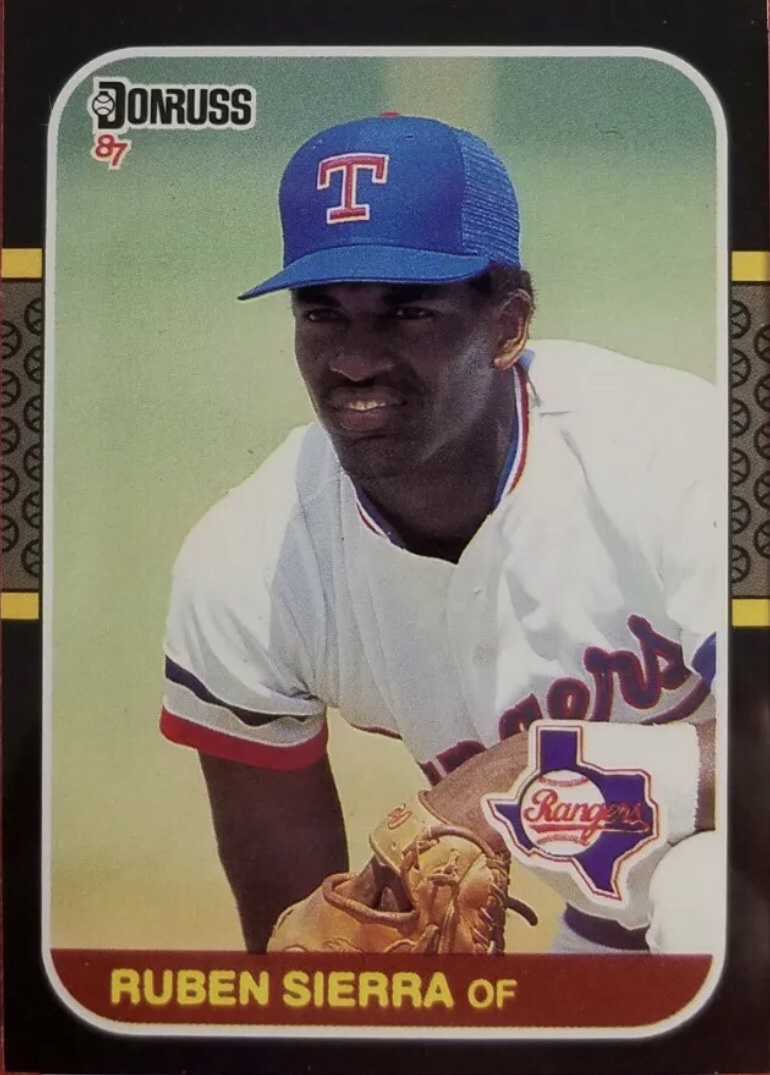
Rubin Sierra. (1987. RC). $38

1987 Leaf #346 – Rookie Card
Value: $38.00 – Grade: 9

Texas Ranger Feature: https://youtu.be/Y1Le-j4heNA

Rubén Angel Sierra García (born in Rio Piedras, PR on October 6, 1965) is a former Major League Baseball outfielder. Sierra goes by the nicknames El Caballo and El Indio. In November 1982, the Texas Rangers signed 17-year-old Sierra out of Puerto Rico. Sierra made his major league debut on June 1, 1986 as an outfielder and hit a home run in just his second MLB at bat becoming the first Texas Rangers player to accomplish this feat. Sierra had a decent rookie year, hitting .264 with 16 home runs and 55 RBIs. In 1989, Sierra hit 29 home runs and led the league in RBIs (119), triples (14), slugging percentage (.543), total bases (344) and extra base hits (78), and finished second in MVP voting to Robin Yount. He went on to have 3 years with 100+ RBIs with the Rangers. In August 1992, the Rangers traded Sierra to the Oakland Athletics for José Canseco. He later played more years with the Rangers. In 1995, the A’s traded Sierra to the New York Yankees for Danny Tartabull. After helping the Yankees reach the playoffs for the first time in 14 years in 1995, Sierra was traded to the Detroit Tigers with Matt Drews for Cecil Fielder. Sierra was considered a journeyman because of playing for numerous teams during the late-1990s, including the Reds, Blue Jays, White Sox and Indians. After making a comeback with the Rangers in late 2000, he would go on to achieve moderate success with the Rangers in 2001, winning AL Comeback Player of the Year, and Mariners in 2002. In 2003, during Sierra’s third stint with the Rangers, he was traded back to the Yankees, who were looking for a power-hitter off the bench. Sierra was an important part of the 2004 Yankees, a team that hit over 240 home runs. Sierra himself slugged 17 of those homers as the usual designated hitter, playing in 56 games at the position. In Game 4 of the 2004 American League Division Series, with the Yankees down to the Minnesota Twins 5–2, Sierra hit a 3-run home run to tie the game at 5–5 off of reliever Juan Rincón. His clutch home run helped the Yankees rally to win the game and the series. However, he was the final out of Game 7 of the 2004 American League Championship Series, hitting a ground ball to Pokey Reese, which secured the dramatic comeback victory of the Boston Red Sox. Sierra had an injury-plagued 2005 season and was let go by the Yankees after hitting just 4 home runs. In 2006, Sierra signed a minor league contract with the Minnesota Twins, but was released on July 10. In August, Sierra was offered a chance to sign on with the New York Mets for the September run and playoffs. However, due to family issues (illness to his mother), he opted not to play again in 2006.

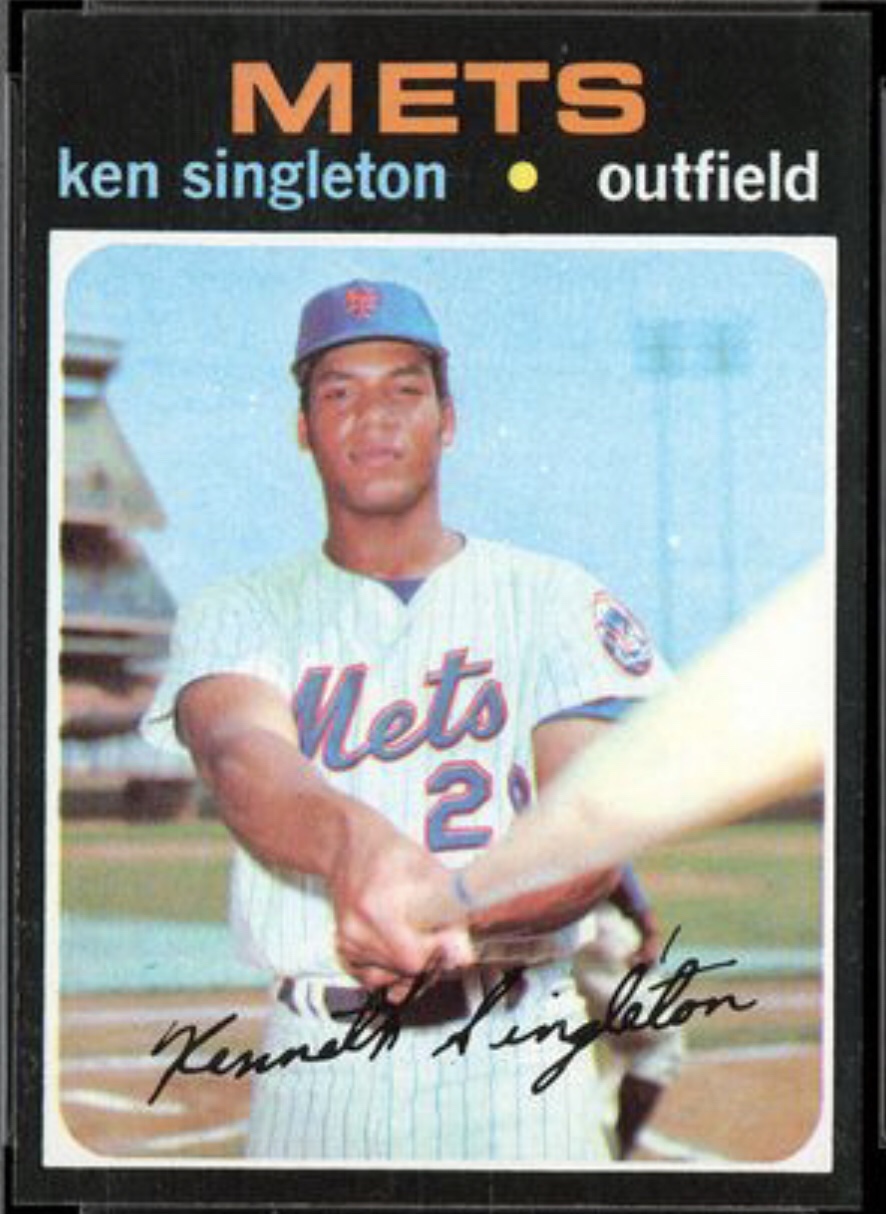
Ken Singleton. (1971). $1,477

1971 Topps #16 – Rookie Card
Value: $1,477.00 – Grade: 9

His Biography: https://youtu.be/xoTtuN7wsFA

Kenneth Wayne Singleton (born in New York City on June 10, 1947) is an American former professional baseball player and former television sports commentator. He played as an outfielder and designated hitter in Major League Baseball for the New York Mets, Montreal Expos, and Baltimore Orioles. Born in Manhattan, New York City, and raised in nearby Mount Vernon, Singleton played both baseball and basketball in high school. He also played baseball in the Bronx Federation League at Macombs Dam Park, across the street from Yankee Stadium. Singleton was drafted out of Hofstra University by the New York Mets as the third overall pick in the 1st round of the 1967 Major League Baseball draft. He made his major league debut with the Mets on June 24, 1970 at the age of 23. On April 5, 1972, he was part of a package deal when traded to the Montreal Expos with infielders Tim Foli and Mike Jorgensen for Rusty Staub. Singleton’s best year of the three in Montreal was 1973, when he led the league in on-base percentage (one of nine top-ten finishes in that category over the course of his career) and collected 23 home runs, 103 RBIs and a .302 batting average (his first .300 season). Singleton was acquired along with Mike Torre by the Orioles from the Expos for Dave McNally, Rich Coggins and minor-league right-handed pitcher Bill Kirkpatrick at the Winter Meetingson December 4, 1974. During his ten years in Baltimore, Singleton played the best baseball of his career as the Orioles won two pennants, in 1979 and 1983, and won the 1983 World Series. In 1977, he posted a career-high .328 batting average, third highest in the American League. In 1979 he had career-highs with 35 home runs and 111 RBIs. Singleton would accumulate 1455 hits as an Oriole. He was described by his manager with the Orioles Earl Weaver as “the kind of hitter who can start a rally by getting on base or end one by driving in the winning run.” Being a slow runner was the only deficiency he had as a ballplayer. Singleton played in his final major league game on September 25, 1984, at the age of 37.