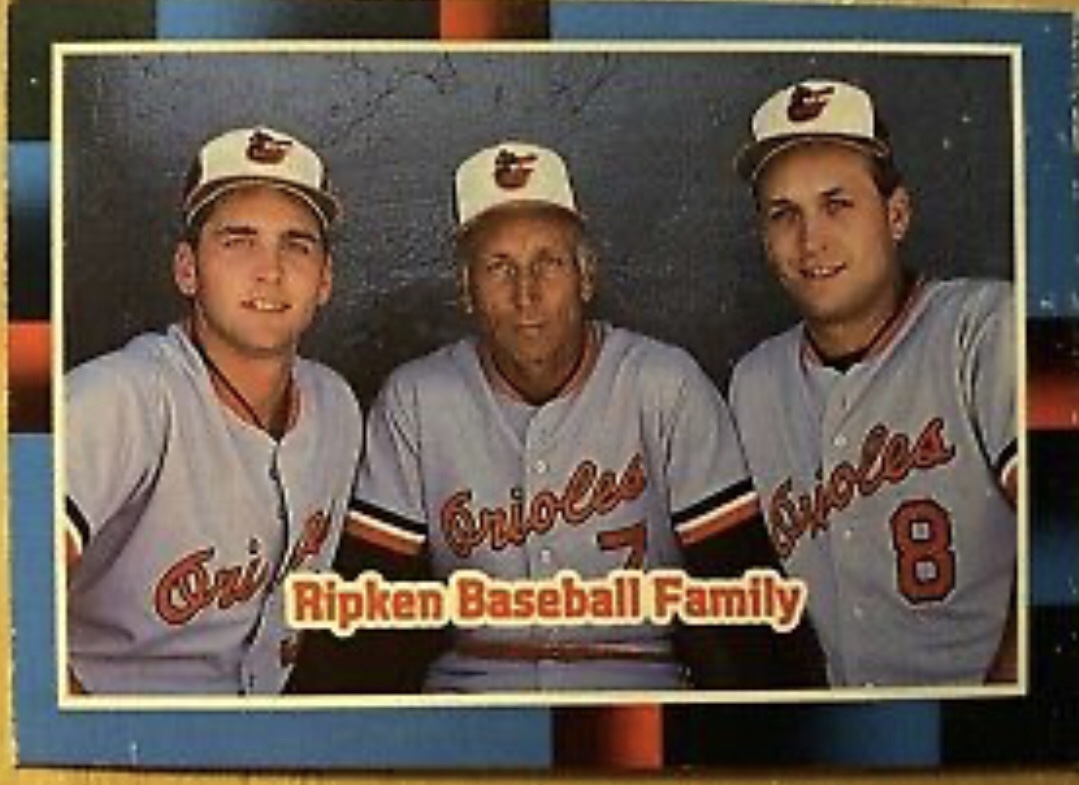
Ripken Baseball Family (87)$27

1987 Leaf #625 – Value: $27.00 – Grade 9

Short Movie: https://youtu.be/p8qFj_3Hn74

Calvin Edwin Ripken Jr. (born in Havre de Grace, MD on August 24, 1960), nicknamed “The Iron Man”, is an American former baseball shortstop and third baseman who played 21 seasons in Major League Baseball (MLB) for the Baltimore Orioles(1981–2001). One of his position’s most offensively productive players, Ripken compiled 3,184 hits, 431 home runs, and 1,695 runs batted in during his career, and he won two Gold Glove Awards for his defense. He was a 19-time All-Star and was twice named American League (AL) Most Valuable Player (MVP). Ripken holds the record for consecutive games played, 2,632, surpassing Lou Gehrig’s streak of 2,130 that had stood for 56 years and that many deemed unbreakable. In 2007, he was elected to the National Baseball Hall of Fame in his first year of eligibility with 98.53% of votes, the sixth-highest election percentage ever.

Remembering Their Dad: https://youtu.be/8wS5QIfLcjo

Calvin Edwin Ripken Sr. (Born in Aberdeen, MD on December 17, 1935 – March 25, 1999) was an American baseball player, scout, coach and manager. who spent 36 years in the Baltimore Orioles organization. He played in the Orioles’ farm system beginning in 1957, and later served as manager of the parent club, on which his sons Cal Jr. and Billy played. Altogether, Ripken spent 36 years in the Baltimore Orioles organization, serving as a player, a scout, a coach, and a manager. He is remembered for helping bring about “The Oriole Way”, Baltimore’s tradition of excellence. The Baltimore Sun wrote, “Most Baltimore fans couldn’t define the term exactly, but they liked that it implied reverence for the sport and the skills needed to play it well.” Elrod Hendricks, another longtime Oriole coach who kept in touch with Ripken throughout the years, said “He was baseball and baseball was him.” Sam Perlozzo, who like Ripken spent many years as a third base coach, said “When you were around him, you didn’t say much. One reason was out of respect. The other was because you could learn from him, no matter how long you had been in the game.” Despite his 36 years with the organization, only a little more than one of them were as manager of the team, causing Thomas Boswell to write, “The idea that a person could find deep satisfaction through fulfilling difficult responsibilities – while never focusing on personal rewards – seems antique these days. Yet Ripken’s example makes you wonder if the century, not Senior, has lost its way.” Since his death, no Oriole has worn Cal Sr.’s number 7, although the number has not been officially retired.

Fielding Drills with Billy: https://youtu.be/Cm4NVmmnS8o

William Oliver Ripken (born in Havre de Grace, MD on December 16, 1964), nicknamed Billy The Kid, is an American former professional baseball infielder. He played in Major League Baseball (MLB) from 1987–1998 for the Baltimore Orioles (1987–92, ’96), Texas Rangers (1993–94, ’97), Cleveland Indians (1995), and Detroit Tigers (1998). During his career, he batted and threw right-handed. He is the younger brother of Hall of Famer Cal Ripken Jr.. He currently serves as a radio host for XM Satellite Radio and a studio analyst for MLB Network.

Rookie Infielders (1976) $27

1976 Topps #592 – Value: $27.00 – Grade 7

Wild Facts About Willie You Probably Didn’t Know: https://youtu.be/d9PLwgKeK2g

Willie Larry Randolph (born in Holy Hill, SC on July 6, 1954) is an American former professional baseball second baseman, coach, and manager. During an 18-year baseball career, he played from 1975 to 1992 for six different teams, most notably the New York Yankees with whom he won back-to-back world titles against the Los Angeles Dodgers. He has joined ESPN as a post-season baseball analyst, beginning in September 2013. Mainly, he appeared on Baseball Tonight and provided updates during Monday and Wednesday night September network telecasts. At the end of his playing career, he ranked fifth in major league history in games at second base (2,152), ninth in putouts (4,859), seventh in assists (6,336), eighth in total chances(11,429), and third in double plays (1,547). Upon retiring as a player, he joined the Yankees as a coach for 11 years. He later served as manager of the New York Mets from 2005 to June 2008, leading the Mets to a league-best record and NLCS in 2006.

Rookie Outfielders (‘73 RC) $28

1973 Topps #614 – Rookie Card
Value: $28.00 – Grade 9

Career Highlights: https://youtu.be/CYq8vTk2hIA

Dwight Michael “Dewey” Evans (born in Santa Monica, CA on November 3, 1951) is an American former professional baseball right fielder and right-handed batter who played with the Boston Red Sox (1972–1990) and Baltimore Orioles (1991) in Major League Baseball (MLB). He was a three-time All-Star, won eight Gold Glove Awards, and won two Silver Slugger Awards. Evans played the second-most career games for the Red Sox of any player, surpassed only by Carl Yastrzemski. Evans was drafted in the fifth round of the 1969 MLB draft by the Red Sox, with the 107th overall pick, and then played in Boston’s minor leaguesystem from 1969 through 1972. He played for the Florida Instructional League Red Sox (1969), short season Class A Jamestown Falcons (1969), Single-A Greenville Red Sox(1970), Single-A Winston-Salem Red Sox(1971), and Triple-A Louisville Colonels (1972). Evans acquired the nickname “Dewey” while playing for Winston-Salem in 1971. It was coined by manager Don Lock who had already called Don Newhauser “Newie” and another teammate “Louie.” In 1972, with Louisville, Evans was named MVP of the International League.

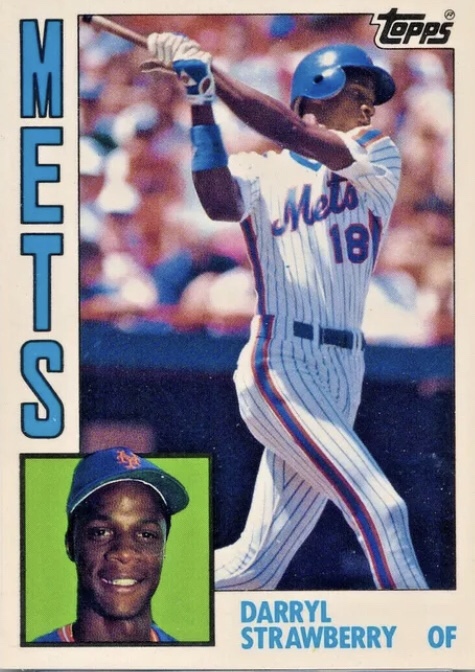
D. Strawberry (1984 RC) $240

1984 Topps #182 – Rookie Card
Value: $250.00 – Grade: Mint

Career Highlights: https://youtu.be/Q6mhp5ihZrM

Darryl Eugene Strawberry (born in Los Angeles, CA on March 12, 1962) is an American former professional baseball right fielder and author who played 17 seasons in Major League Baseball (MLB). Throughout his career, Strawberry was one of the most feared sluggers in the sport, known for his prodigious home runs and his intimidating presence in the batter’s box with his 6 ft 6 in (1.98 m) frame and his long, looping swing that elicited comparisons to Ted Williams. During his career, he helped lead the New York Mets to a World Series championship in 1986 and the New York Yankees to three World Series championships in 1996, 1998 and 1999. He was also suspended three times by MLB for substance abuse, leading to many narratives about his massive potential going unfulfilled. A popular player during his career, Strawberry was voted to the All-Star Game eight straight times from 1984 to 1991. Strawberry was formerly an analyst for SportsNet New York. His memoir, Straw: Finding My Way, written with author John Strausbaugh, was published in April 2009. Strawberry was drafted first overall in the 1980 Major League Baseball draft by the New York Mets. Darryl’s older brother, Michael Strawberry, was also selected in that draft, going to the Dodgers in the 31st round. Employing a distinctive batting stance with a high leg kick, Strawberry rose through the Mets system and reached the major league level in 1983, posting 26 home runs, 7 triples, and 74 runs batted in, while hitting for a .257 average. He was named the National League’s Rookie of The Year. In 1984, he made it to the All-Star game for the first of 8 consecutive appearances (the first 5 as a starter), and he once again hit 26 home runs, this time driving in 97 runs. Strawberry’s Mets from 1984–1990 formed one of the premier teams in the National League, finishing either first or second in the division every year. During the period from 1983 to 1990, Strawberry was very popular, with his image used on action figures (Kenner’s Starting Lineup), posters and banners. He was also known for his disruptive behavior. He got into a physical altercation on team picture day with team captain Keith Hernandez and in the midst of a war of words with infielder Wally Backman, threatened to “bust that little redneck in the face”. He often overslept and was late for, or missed, team workouts. He publicly complained about manager Davey Johnson after he was removed from the game in a double switch during the ninth inning of Game 6 of the 1986 World Series, which the Mets would go on to win. During the regular season in 1986, Strawberry hit 27 home runs and had 93 RBIs. In 1987, Strawberry hit 39 home runs and stole 36 bases, joining the exclusive 30–30 club at the time becoming one of only 10 players in baseball history to accomplish the feat. In addition to that, he hit 32 doubles and drove in 104 runs. Despite this, the 1987 team missed the playoffs. In 1988, Strawberry once again hit 39 home runs to lead the National League. He also drove in 101 runs and led the league in slugging percentage at .545 and OPS at .911. He finished a very close second in MVP voting to the Dodgers’ Kirk Gibson. Strawberry led the Mets to the playoffs, losing to the Dodgers in seven games in the National League championship series. In 1989, Strawberry’s offensive numbers declined: He had 29 home runs and 77 runs batted, but only had a .225 average. Nevertheless, the Mets came in a close second place to the Chicago Cubs in the National League East. In 1990, Strawberry rebounded by hitting 37 home runs, while driving in 108 runs and batting for a .277 average. His Mets, however, came once again in a close second place in the NL’s east, losing to the Pittsburgh Pirates by three games. Strawberry himself finished third in MVP voting that season. Strawberry signed as a free agent with the Los Angeles Dodgers on November 8, 1990, inking a lucrative five-year $22.25 million contract. In California, he was named Big Brother of The Year for 1991. After hitting 28 home runs and bringing in 99 runs batted in a successful first year for the Dodgers, injuries and personal problems kept him sidelined for much of the next two seasons, hitting five home runs in each season. By the end of the 1991 season, he had 280 lifetime homers at the age of only 29, drawing comparisons to home run king Hank Aaron.

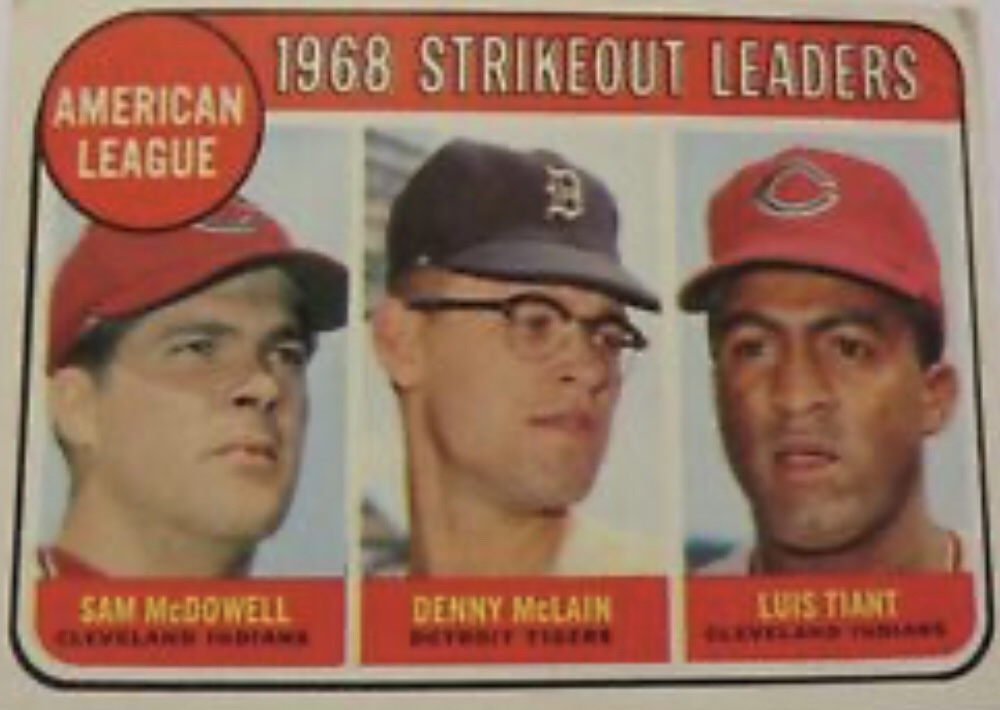
Strikeout Leaders (1968) $510

1968 Topps #11 – Value: $510.00 – Grade: 7

Beyond the Glory: https://youtu.be/hQ1RFzwdBTM

Dennis Dale McLain (born in Markham, IL on March 29, 1944) is an American former professional baseballplayer. He was a pitcher in Major League Baseball for ten seasons, most notably for the Detroit Tigers. In 1968, McLain became the most recent Major League Baseball pitcher to win 30 or more games during a season (with a record of 31–6) — a feat accomplished by only 11 players in the 20th century.

Baseball History Digest: https://youtu.be/snfCHD8lTEU

Samuel Edward Thomas McDowell (born in Pittsburgh, PA on September 21, 1942), is an American former professional baseball player. He played in Major League Baseball as a starting pitcher from 1961 to 1975, most notably for the Cleveland Indians. A six-time All-Star, McDowell led the American League in strikeouts five times. Tall (6 feet, 5 inches) and powerful, his left-handed fastball was delivered with an unusually calm pitching motion which led to his memorable nickname, Sudden Sam.

Career Highlights: https://youtu.be/4lpk3BZuKtA

Luis Clemente Tiant Vega (born in Marianao, Cuba on November 23, 1940) is a Cuban former Major League Baseball (MLB) right-handed starting pitcher. He pitched in MLB for 19 years, primarily for the Cleveland Indians and the Boston Red Sox. Tiant compiled a 229–172 record with 2416 strikeouts, a 3.30 ERA, 187 complete games, and 49 shutouts in 3486+1⁄3 innings. He was an All-Star for three seasons and 20-game winner for four seasons. He was the American League (AL) ERA leader in 1968 and 1972. He also was the AL leader in strikeouts per nine innings pitched in 1967 and the AL leader in shutouts in 1966, 1968, and 1974. He was inducted to the Boston Red Sox Hall of Fame in 1997, the Hispanic Heritage Baseball Museum Hall of Fame in 2002, the Venezuelan Baseball Hall of Fame and Museum in 2009, and the Baseball Reliquary’s Shrine of the Eternals in 2012. Tiant was considered for election to the National Baseball Hall of Fame via voting of the Baseball Writers’ Association of America from 1988 to 2002, and by the Hall of Fame’s era committees in 2011, 2014, and 2017, falling short of the required votes for induction each time.

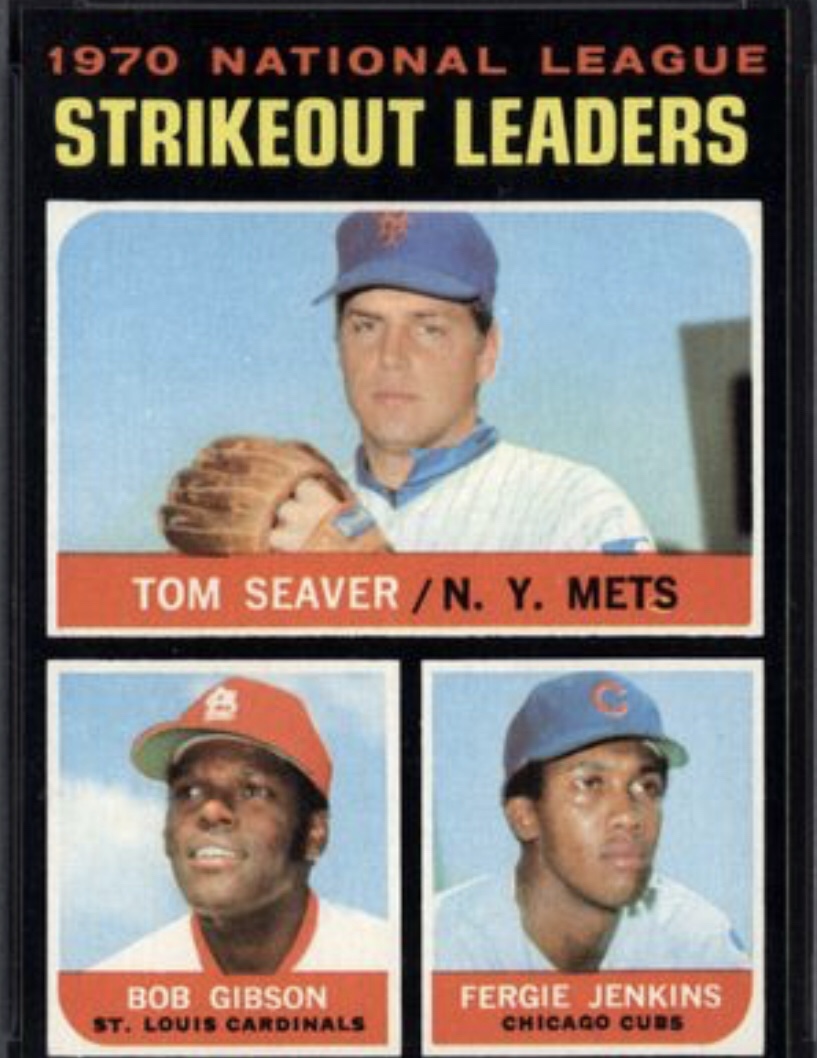
Strikeout Leaders (1971). $40+

1971 Topps #72 – Value: $101.00
Best Offer Over $40.00

Pack Robert Gibson (Born in Omaha, NE on November 9, 1935-October 2, 2020) began his professional career playing baseball for the St. Louis Cardinals and basketball for the Harlem Globetrotters where he was “Bullet Bob Gibson.” Bob Gibson, “Gibby” played his entire 17-year career with the St. Louis Cardinals (1959-1975). Gibson established himself as one of the great power pitchers in his time, brushing batters back and “owning” the plate with two separate fastballs, sliders and sweeping curveballs. In 1968, Gibson posted a remarkable record 1.12 ERA for the season earning him his first of two National League Cy Young Awards, the league’s Most Valuable Player award and his third NL pennant. Gibson appeared in three World Series with the Redbirds, winning the titles in 1964 and 1967, and pitching to a 7-2 record with 92 strikeouts including 17 in Game 1of the 1968 Series. Gibson’s extraordinary performance in the 1968 campaign in often credited for the pitcher’s mound being lowered by five inches in 1969, taking partial advantage back from the pitcher and “leveling the playing field.” Bob Gibson retired with a record of 251-174 adding 3,117 strikeouts and posting a career 2.91 ERA. His 1968 record ERA of 1.12 remains the mark to which pitchers aim. Pack Robert Gibson was elected to the National Baseball Hall of Fame in 1981.

Ferguson Jenkins (Born in Chatham, Ontario on December 13, 1943-) was the first Chicago Cubs pitcher and first Canadian to win the Cy Young Award. Fergie won 20 games in his first full season with the Chicago Cubs, earning a second place finish for the 1967 National League Cy Young Award voting, and award he would later win in 1971. He was also named the 1971 National League TSN Pitcher of the Year. The 1967 campaign began a stretch of six straight 20-win seasons, and seven out of eight from 1967-1974. Jenkins was a premier pitcher for 19 seasons primarily with the Chicago Cubs (1966-1973, 1982-1983), the Texas Rangers (1974-1975, 1978-1981) and the Boston Red Sox (1976-1977). Though somewhat prone to give up the long ball, leading the league in home runs allowed seven times, he was a workhorse who led the league in complete games four times, games started three times and twice in wins. The three-time All-Star selection is among three pitchers to record 3,000 strikeouts or more while allowing fewer than 1,000 walks in a career. Fergie Jenkins retired with a record of 284-226 with 3,192 strikeouts and a career 3.34 earned run average. Ferguson Jenkins was elected to the National Baseball Hall of Fame in 1991.

George Thomas “Tom” Seaver (Born in Fresno, CA on November 17, 1944-August 31, 2020) was the 1967 National League Rookie of the Year posting a 16-13 record adding 170 strikeouts and a throwing to a 2.76 ERA. Dubbed “The Franchise” by the Mets, Tom pitched 20 seasons for the Mets (1967-1977, 1983), the Cincinnati Reds (1977-1982), the Chicago White Sox (1984-1986) and the Boston Red Sox (1986). Seaver is the only player to have his number retired by the Mets organization, though Gil Hodges played for the club, his number was retired as a manager. Tom was a 12-time All-Star selection, three-time Cy Young Award winner (1969, 1973, 1975) and twice was a member of the NL pennant winners. In 1969, Seaver was the ace of the Mets pitching staff that also included Hall of Famer Nolan Ryan that won 100 games en route to the World Series title over the Baltimore Orioles. In 1978, Tom threw a no-hitter against the St. Louis Cardinals. Tom Seaver led the league three times in wins and ERA and five times in strikeouts. Tom Terrific compiled a record of 311-205 with 3,640 strikeouts and a 2.86 ERA over 20 seasons. George Thomas Seaver was elected to the National Baseball Hall of Fame in 1992 by the highest percentage ever recorded, 98.8%.

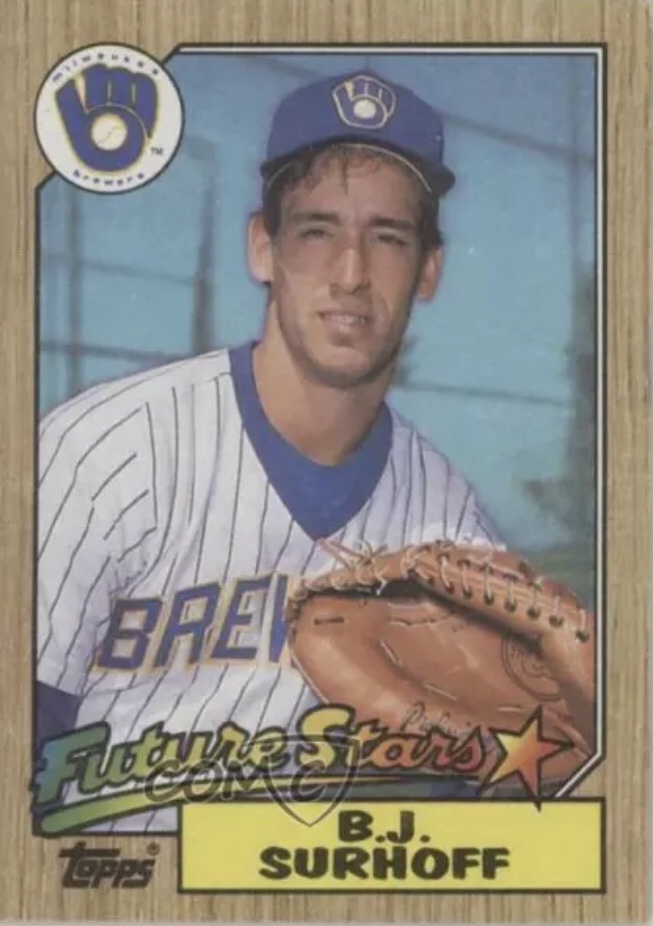
B. J. Surhoff. (1987 RC). $50

1987 Topps #216 – Rookie Card
Value: $50.00 – Grade: 9

Hero for the Milwaukee Brewers: https://youtu.be/NbhXrLYjscM

William James “B. J.” Surhoff (born in The Bronx, NY on August 4, 1964) is an American former catcher, outfielder, first baseman, third baseman, and designated hitter in Major League Baseball (MLB). Over his 18-year MLB career, he played every position except pitcher. After playing for the Orioles from 1996 to 2000, he rejoined the team in 2003 and played through the 2005 season. He started his career with the Milwaukee Brewers (1987–1995) and also played for the Atlanta Braves (2000–2002). Surhoff began his career as a catcher, and after playing third base in the mid-1990s, shifted to become primarily a left fielder. Born in the Bronx, Surhoff attended Rye High School in Westchester, New York. After high school he attended the University of North Carolina at Chapel Hill. In 1983, he played collegiate summer baseball with the Wareham Gatemen of the Cape Cod Baseball League. Surhoff was honored as the 1985 ACC Male Athlete of the Year, and played on the very first (1984) U.S. Olympic baseball team. He was a two-time first team All-American at UNC and his career batting average of .392 was a school record until Dustin Ackley set the mark at .412 in 2009. Surhoff was selected by the Brewers with the first overall pick of the 1985 Major League Baseball draft. He was a very versatile player, having appeared at every position except pitcher over the course of his career. He had 2,326 hits, 188 home runs and 1,153 RBI in his career. Although always a consistent hitter, having hit over .280 in 12 of his 19 seasons, Surhoff’s finest season was his 1999 campaign with the Orioles, in which he led the American League in at-bats (673), ranked second in hits (207), was selected to the American League All-Star team, and ultimately won Most Valuable Oriole honors for the season, becoming one of five players to get 200 or more hits in a season for the team. He also participated in the Home Run Derby. In other notable seasons, he finished sixth in the AL in doubles in 1993 with the Brewers and finished fifth in batting average in the AL with the Brewers in 1995 with a .320 average. In 2007, Surhoff was elected to the Orioles Hall of Fame, with the official induction ceremony occurring before the start of the Orioles–Twins game on August 25, 2007, at Oriole Park at Camden Yards.

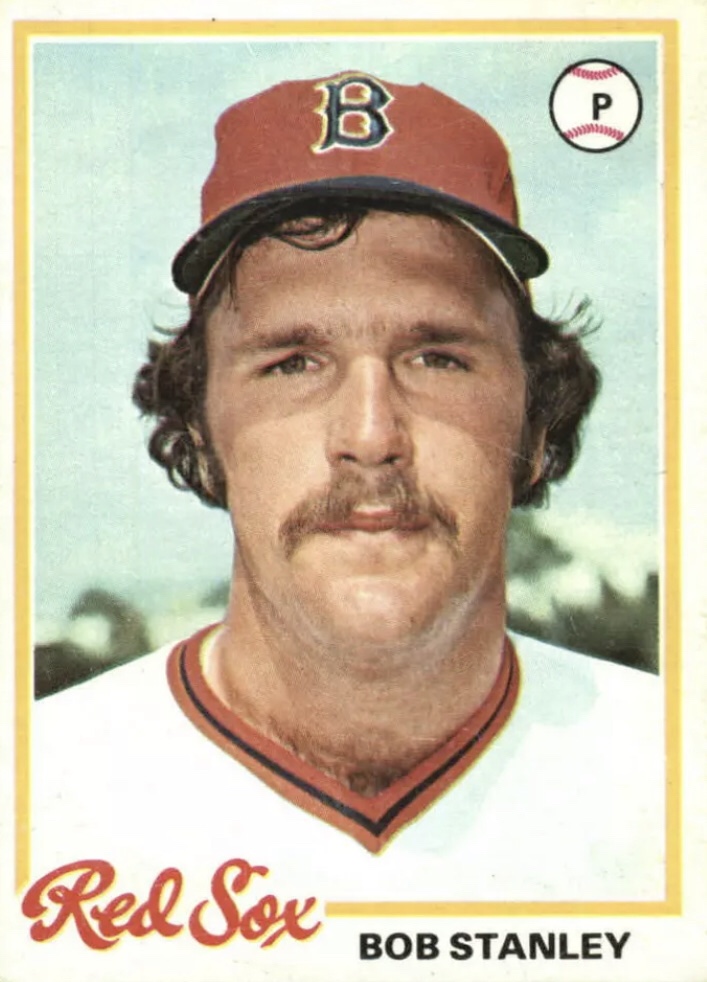
Bob Stanley. (1978). $72

1978 Topps #186 – Value: $72.00 – Grade: 9

Bob Stanley Baseball:
https://www.mlb.com/video/bob-stanley-c20021035

Robert William Stanley (born in Portland, Maine on November 10, 1954) is an American former professional baseball relief pitcher who spent his entire Major League Baseball (MLB) career with the Boston Red Sox. He was later the pitching coach for the Buffalo Bisons, Triple-A affiliate of the Toronto Blue Jays, through the 2018 season. Stanley was selected by the Los Angeles Dodgers in the ninth round of the June 1973 MLB draft, but did not sign with the team, choosing instead to attend college. During this era, another draft was held in the winter; Stanley was selected by the Boston Red Sox in the first round of the January 1974 secondary draft, and this time elected to sign. He began his professional career with the Elmira Pioneers in 1974, spent 1975 with the Winter Haven Red Sox, and advanced to the Bristol Red Sox at the Double-A level in 1976. Stanley made his major league debut with the Red Sox on April 16, 1977. Stanley was named an All-Star in 1979, a year in which he pitched in 40 games (30 starts). He won 16 games and lost 12, with an earned run average (ERA) of 3.99. He earned his second All-Star nod in 1983, when he was used exclusively as a relief pitcher. He appeared in 64 games and pitched 145+1⁄3 innings, recording 33 saves and a 2.85 ERA. Stanley was a key member of the 1986 Red Sox team that came within one strike of winning the World Series but ultimately fell to the New York Mets in seven games. Stanley entered Game 6 with the Red Sox one out away from clinching their first World Series since 1918, holding a one-run lead with runners on first and third. Stanley threw a wild pitch to Mookie Wilsonwhich allowed Kevin Mitchell to score the tying run and Ray Knight to move to second base, putting him in position to score the winning run on Bill Buckner’s fielding error. Stanley and the Red Sox returned to Shea Stadium for Game 7, which the New York Mets won by a score of 8–5. In 1987, Stanley was converted to a starting pitcher for the first time since 1979. He went 4–15 with 67 strikeouts and a 5.01 ERA. On September 25, 1989, Stanley announced his retirement. In a 13-year career spent entirely with the Red Sox, he compiled a 115–97 win–loss record with 693 strikeouts, a 3.64 ERA, 21 complete games, seven shutouts, 132 saves, and 1707 innings pitched in 637 games (85 as a starter). A sinker ball specialist, Stanley is the Red Sox all-time leader in appearances and relief wins, and was inducted to the Red Sox Hall of Famein 2000. Stanley was also the team’s all-time saves leader, a record he held for 20 years, until Jonathan Papelbon tied him on June 29, 2009, and then passed him on July 1, 2009. Stanley is the first, and to date only, player born in Maine to be named to an MLB All-Star Game.

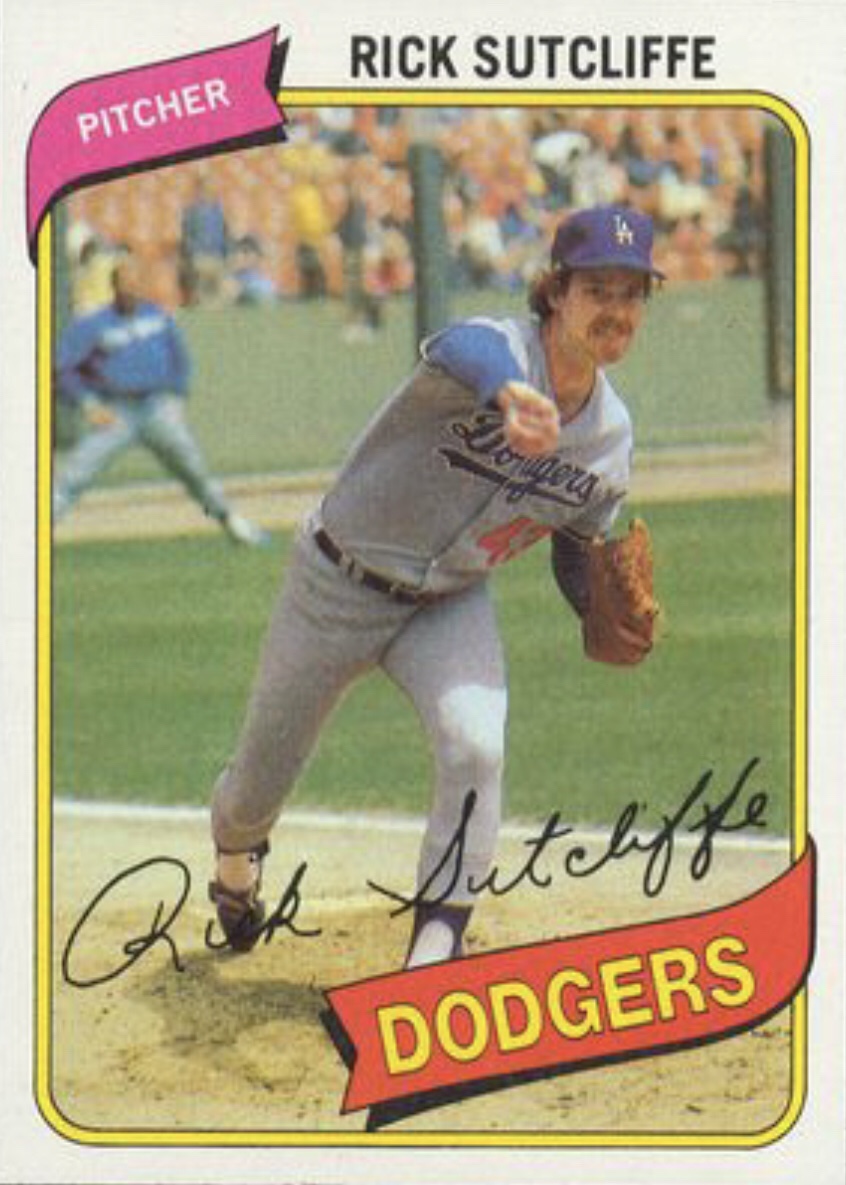
Rick Sutcliffe. (1980). $97

Sharing Stories with Dan Patrick: https://youtu.be/efGSgWlG_28

1980 Topps #544 – Value: $75.00 – Grade: 9

Richard Lee “Rick” Sutcliffe (Born in Independence, MO on June 21, 1956-) was a Major League starting pitcher best remembered for his remarkable rookie start with the Los Angeles Dodgers and for helping the Chicago Cubs reach the postseason after years of futility. The Los Angeles Dodgers selected Sutcliffe in the 1st round (21st pick) of the 1974 amateur draft. He broke into the big leagues for his first full season in 1979, winning 17 games for the Dodgers (1976, 1979-1981) and capturing the National League Rookie of the Year award. Traded to the Cleveland Indians (1982-1984), he made his first of three All-Star Game appearances in 1983, but Sutcliffe began to struggle on the mound, and the Indians traded “The Red Baron” to the Chicago Cubs (1984-1991), where he found new life and went 16-1 in 1984. The record helped propel the Cubbies to National League Central Division Championship and earned him the 1984 Cy Young Award by a unanimous vote. With injuries occasionally hampering otherwise stellar seasons through the rest of the 1980s, he missed most of the 1990 and 1991 campaigns with a sore arm, forcing his release from the Cubs. Signing with the Baltimore Orioles (1992-1993), the pitcher was named the American League Comeback Player of the Year in 1992, before finishing his big league tour with the St. Louis Cardinals (1993). He retired with a 171-139 record, 4.08 ERA and 1,679 strikeouts, and also holds the distinction of having won each of the following league awards, once each, and each in a different season: Rookie of the Year (1979), Cy Young Award (1984), ERA leader (1982), and wins leader (1987).

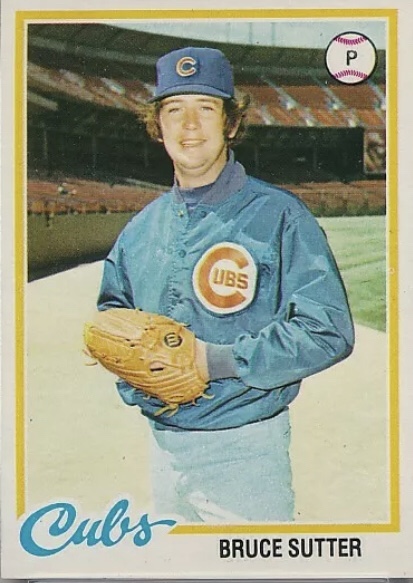
Bruce Sutter. (1978). $70

1978 Topps #325 — Value: $50.00 – Grade: 8

Hall of Fame Biography: https://youtu.be/Vmhx98BxX6k

Howard Bruce Sutter (born in Lancaster, PA on January 8, 1953) is an American former professional baseball pitcher who played 12 seasons in Major League Baseball (MLB) between 1976 and 1988. He was one of the sport’s dominant relievers in the late 1970s and early 1980s, making effective use of the split-finger fastball. A six-time All-Star and 1982 World Series champion, Sutter recorded a 2.83 career earned run average and 300 saves, the third-most in MLB history at the time of his retirement. Sutter won the National League’s (NL) Cy Young Award in 1979 as its top pitcher, and won the NL Rolaids Relief Man Award four times. He became the only pitcher to lead the NL in saves five times (1979–1982, 1984). Born in Lancaster, Pennsylvania, Sutter briefly attended Old Dominion University and was subsequently signed by the Chicago Cubs as an undrafted free agent in 1971. He played five years for the Cubs, four for the St. Louis Cardinals, and three for the Atlanta Braves, serving as each team’s closer during his tenure. His usage in the eighth and ninth innings of games was partly responsible for ushering in a more specialized era for the closer role. In the mid-1980s, Sutter began to experience shoulder problems, undergoing three surgeries before retiring in 1989. Sutter was inducted into the Baseball Hall of Fame in 2006, his 13th year of eligibility. He was also honored by the Cardinals with the retirement of his uniform number 42 in 2006 and induction into the Cardinals Hall of Fame in 2014. Sutter has served as a minor league consultant for the Philadelphia Phillies.

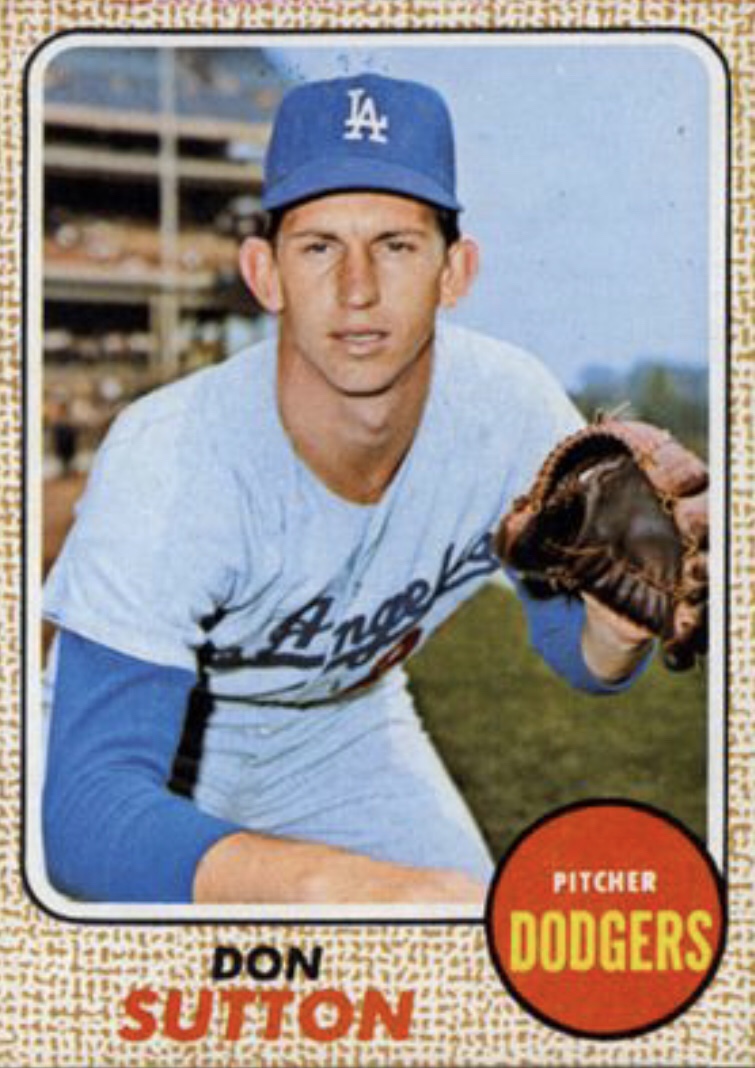
Don Sutton. (1968). $128

1968 Topps #103 – Value: $40.00 – Grade: 8

Hall of Fame Biography: https://youtu.be/j99r1TcnBrU

Donald Howard Sutton (Born in Clio, AL on April 2, 1945-January 18, 2021) holds the Major League record for most losses to one team in a career (13), the Chicago Cubs. Despite his struggles against the Northsiders, Sutton averaged 14 wins over 23 seasons with the Los Angeles Dodgers (1966-1980, 1988), the Houston Astros (1981-1982), the Milwaukee Brewers (1982-1984), the Oakland A’s (1985) and California Angels (1985-1987). Sutton owned the strike zone, striking out more than 130 batters in each of first 21 seasons, earning him four All-Star selections. An exceptional athlete growing up, Don was the model for consistency and durability, starting 756 games in his career, averaging 34 per season, and pitched deep into games, completing 178 game and throwing 5,282.1 innings. With a career .144 batting average, Sutton was an atypical pitcher who struggled at the plate, but Don has the distinct honor to be the player with the most at-bats (1,354) without a home run. Don Sutton finished his career with a record of 324-256 with 3,574 strikeouts and a career 3.26 ERA. Donald Howard Sutton was elected to the National Baseball Hall of Fame in 1998.