Ldrs ‘88(McGwire/Canseco) $92

1988 Topps #759 – Value: $92.00 – Grade: 9

Career Highlights: https://youtu.be/ujGv98U6iAY

José Canseco Capas Jr. (born in Havana, Cuba on July 2, 1964), nicknamed Parkway Jose, Mr. 40-40 and El Cañonero Cubano (The Cuban Cannon), is a Cuban-American former Major League Baseball(MLB) outfielder and designated hitter. During his time with the Oakland Athletics, he established himself as one of the premier power hitters in the game. He won the Rookie of the Year (1986), and Most Valuable Player award (1988), and was a six-time All-Star. Canseco is a two-time World Series champion with the Oakland A’s (1989) and the New York Yankees (2000). In 1988 Canseco became the first player to hit 40 home runs and steal 40 bases in one season. He won the Silver Slugger award four times: three as an AL outfielder (1988, 1990, 1991), and once as a designated hitter (1998). He ranks 4th all time in A’s history with 254 home runs and is one of 14 players in MLB history with 400 home runs and 200 stolen bases. Despite his many injuries during the later part of his career, Canseco averaged 40 home runs, 120 RBIs and 102 runs scored every 162 games, playing a total of 1887 games in 17 seasons with 7 different teams. As of 2021, Canseco’s 462 career home runs rank him 37th on the MLB all-time list, among active players, slugger Nelson Cruz is the closest to Canseco on the list, with 449 home runs. At one time Canseco was the all-time leader in home runs among Latino players; but was later surpassed by Manny Ramirez, Albert Pujols, David Ortiz, Carlos Delgado, Rafael Palmeiro, Alex Rodriguez, Sammy Sosa, and Miguel Cabrera. He was the first player to hit 30 home runs for four different teams: Oakland (1986–88, 1990, 1991), Texas (1994), Toronto (1998), and Tampa Bay (1999). This record was later surpassed by Fred McGriff and Gary Sheffield who did it for five different teams. Canseco admitted using performance-enhancing drugs during his major-league playing career, and in 2005 wrote a tell-all book, Juiced: Wild Times, Rampant ‘Roids, Smash Hits & How Baseball Got Big, in which he claimed that the vast majority of MLB players use steroids. After retiring from Major League Baseball, he also competed in boxing and mixed martial arts.

Career Highlights: https://youtu.be/xtUBuSRT8Lw

Mark David McGwire (born in Pomona, CA on October 1, 1963), nicknamed Big Mac, is an American former professional baseball first baseman. His Major League Baseball (MLB) playing career spanned from 1986 to 2001 while playing for the Oakland Athletics and the St. Louis Cardinals, winning one World Series championship each, with Oakland as a player in 1989 and with St. Louis as a coach in 2011. One of the most prolific home run hitters in baseball history, McGwire holds the major league career record for at bats per home run ratio (10.6), and is the former record holder for both home runs in a single season (70 in 1998) and home runs hit by a rookie (49 in 1987). He ranks 11th all time in home runs with 583, and led the major leagues in home runs in five different seasons, while establishing the major league record for home runs hit in a four-season period from 1996 to 1999 with 245. Further, he demonstrated exemplary patience as a batter, producing a career .394 on-base percentage (OBP) and twice leading the major leagues in bases on balls. Injuries cut short the manifestation of even greater potential as he reached 140 games played in just eight of 16 total seasons. A right-handed batter and thrower, McGwire stood 6 feet 5 inches (1.96 m) tall and weighed 245 pounds (111 kg) during his playing career. A part of the 1998 Major League Baseball home run record chase of Roger Maris’ 61 with the Cardinals, McGwire set the major league single-season home run record with 70, which Barry Bonds broke three years later with 73. McGwire also led the league in runs batted in, twice in bases on balls and on-base percentage, and four times in slugging percentage. Injuries significantly cut into his playing time in 2000 and 2001 before factoring into his retirement. He finished with 583 home runs, which was fifth all-time when he retired. McGwire was one of several central figures in baseball’s steroids scandal. In 2010, McGwire publicly admitted to using performance-enhancing drugs during a large portion of his career.

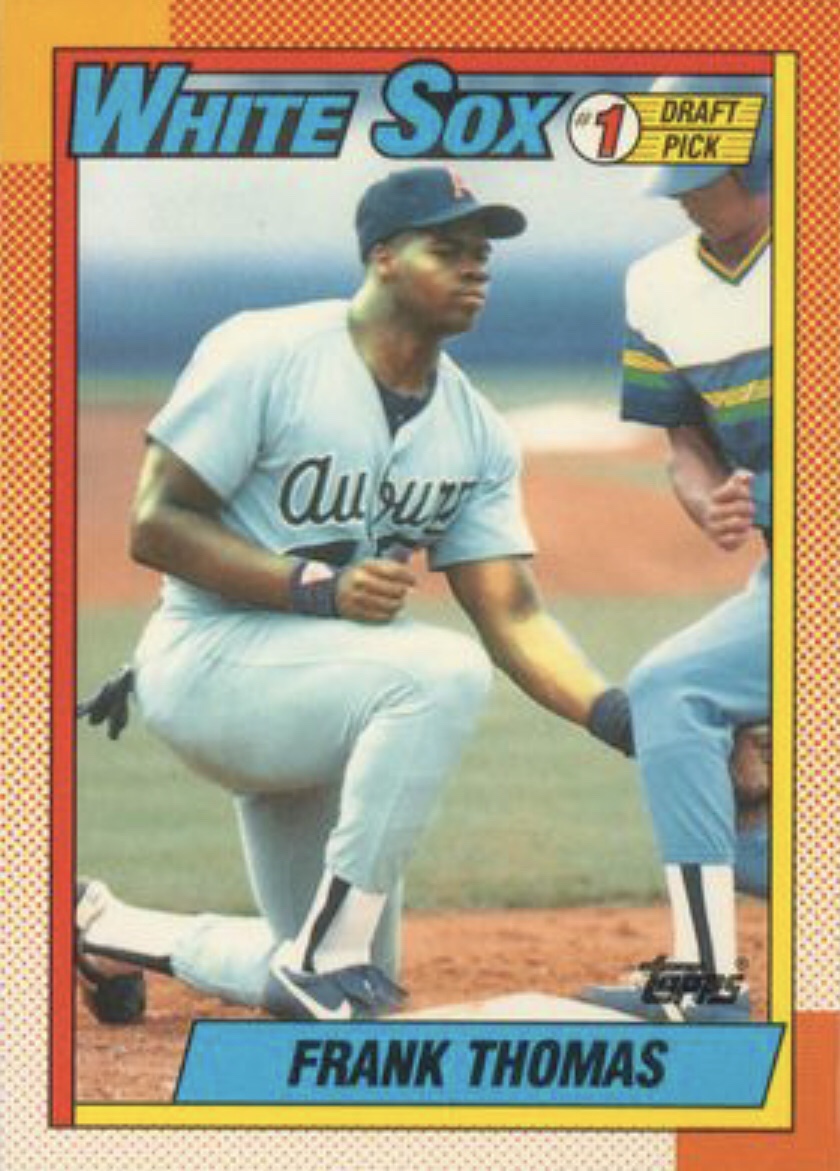
Frank Thomas. (‘90 RC) $1200

1990 Topps #414 – Rookie Card
Value: $1200.00 – Grade: Mint

Hall of Fame Biography: https://youtu.be/-wCrh0JsY0c

Frank Edward Thomas, Jr. (Born in Columbus, GA on May 27, 1968-) was a multi-talented hitter and one of the Major League’s greatest stars of the 1990s, and in 2007 became the 21st member of the 500 Home Run Club. Nicknamed “The Big Hurt” for his powerful swing, the Chicago White Sox selected Thomas in the 1st round (7th overall) of the 1989 amateur draft, making his first appearance for the team the following season. As a member of the White Sox (1990-2005), Thomas was selected for five consecutive All-Star Games and won four Silver Slugger Awards (in the process becoming the first player to capture two such awards at two different positions). He also was a two-time American League MVP and won the 1997 AL batting title. In a remarkable 1993 campaign, Thomas batted .317 with a club-record 41 home runs, plus 128 RBI, 106 runs scored, and 112 walks. He joined Hall of Famers Babe Ruth, Lou Gehrig, Jimmy Foxx, and Ted Williams as the only players in baseball history to eclipse .300 with more than 20 homers and more than 100 RBI, runs, and walks in three straight seasons. After taking home his only World Series ring for the 2005 White Sox, Thomas played for the Oakland Athletics (2006, 2008) and Toronto Blue Jays (2007-2008). He retired with 521 home runs, 2,468 hits, 1,704 RBI, and a .301 batting average. Frank Thomas was inducted into the National Baseball Hall of Fame in 2014.

More Frank Thomas cards in my collection:

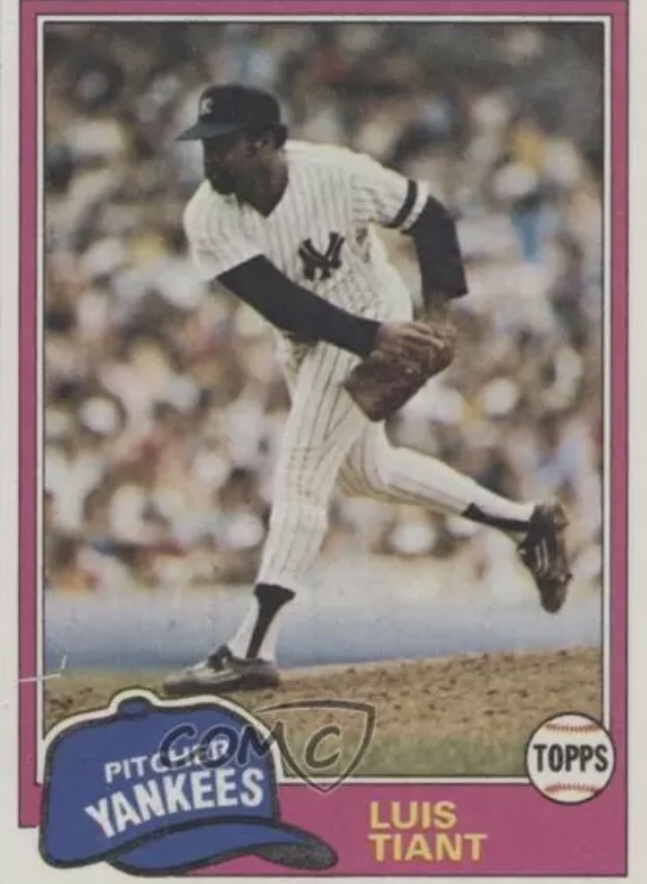
Luis Tiant. (1981). $52

1981 Topps #627 – Value: $52.00 – Grade: 9

Career Highlights: https://youtu.be/4lpk3BZuKtA

Luis Clemente Tiant Vega (born in Marianao, Cuba on November 23, 1940) is a Cuban former Major League Baseball (MLB) right-handed starting pitcher. He pitched in MLB for 19 years, primarily for the Cleveland Indians and the Boston Red Sox. Tiant compiled a 229–172 record with 2416 strikeouts, a 3.30 ERA, 187 complete games, and 49 shutouts in 3486+1⁄3 innings. He was an All-Star for three seasons and 20-game winner for four seasons. He was the American League (AL) ERA leader in 1968 and 1972. He also was the AL leader in strikeouts per nine innings pitched in 1967 and the AL leader in shutouts in 1966, 1968, and 1974. He was inducted to the Boston Red Sox Hall of Fame in 1997, the Hispanic Heritage Baseball Museum Hall of Fame in 2002, the Venezuelan Baseball Hall of Fame and Museum in 2009, and the Baseball Reliquary’s Shrine of the Eternals in 2012. Tiant was considered for election to the National Baseball Hall of Fame via voting of the Baseball Writers’ Association of America from 1988 to 2002, and by the Hall of Fame’s era committees in 2011, 2014, and 2017, falling short of the required votes for induction each time.

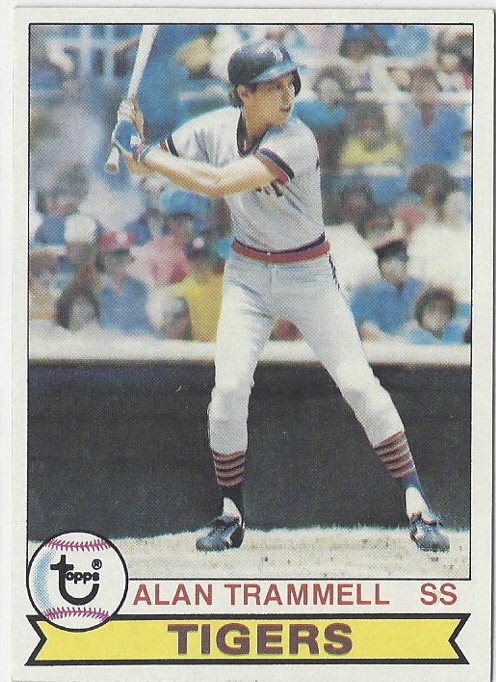
Alan Trammel. (1979). $1,114

1979 Topps #358 – Value: $1,000.00 – Grade: Mint

Hall of Famer: https://youtu.be/3RdqwByo8zI

For 20 seasons, Alan Trammell was the face of the Detroit Tigers. And during those 20 years, Trammell’s all-around excellence led the Tigers to victories while putting him on the path to Cooperstown. Born on Feb. 21, 1958, in Garden Grove, Calif., Trammell was drafted by the Tigers in the second round of the 1976 amateur draft. He made his big league debut at the age of 19 on Sept. 9, 1977, and by 1978 Trammell was the Tigers starting shortstop – finishing fourth in the American League Rookie of the Year voting. In 1980, Trammell earned his first All-Star selection, batted .300 for the first time and won his first of four Gold Glove Awards. In 1983, Trammell hit .319 with 14 homers, 66 RBI and 30 stolen bases and was awarded the Comeback Player of the Year in the American League following two straight years where he hit .258. In 1984, Trammell battled shoulder tendinitis to finish fifth in the AL batting race (.314) and eighth in on-base percentage (.382). The Tigers went 104-58 to win the AL pennant and the World Series. Going 9-for-20 with two homers and six RBI, Trammell was named World Series MVP. Tigers manager Sparky Anderson asked Trammell to move from the two hole to cleanup in 1987, and Trammell responded with his best season. He became the first Tiger to have 200 hits and 100 RBI in a season since 1955 and finished in the league top 10 in batting average (.343), RBI (105), hits (205), runs (109), total bases (329), on-base percentage (.402) and slugging percentage (.551). Trammell finished second in MVP voting that year to Toronto’s George Bell. That season, Trammell became the first player in big league history to hit at least .340 with 28 home runs and 100 RBI in a season while playing at least half his games at shortstop. Trammell retired following the 1996 season with six All-Star Game selections, three Silver Slugger Awards and four Gold Glove Awards. He batted better than .300 seven times in his career, finishing with a .285 batting average, 185 home runs, 1,003 RBI, 412 doubles and 2,365 hits. Three times he finished in the Top 10 in AL MVP voting. YIn 1978, the Trammell was paired with second baseman Lou Whitaker. By the time their careers were over, Trammell and Whitaker played in 1,918 games together – the most by any double-play combination in history. Trammell was elected to the Hall of Fame in 2018.

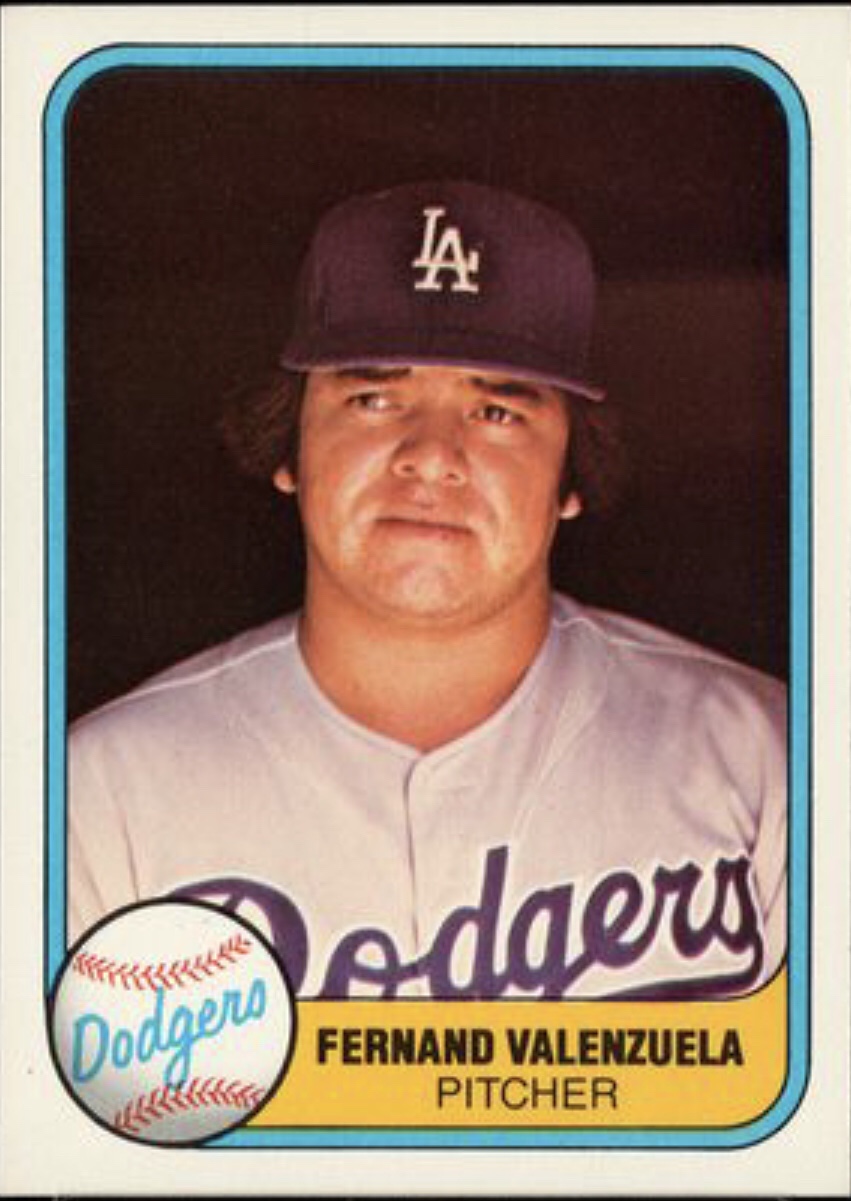
Fernando Valenzuela ‘81. $500

1981 Fleer #140 – Rookie Card –
Value: $400.00 – Grade: Mint

Remembering Fernandomania: https://youtu.be/5dqgtpqscT0

Fernando (Anguamea) Valenzuela (Born in Etchohuaquila, Mexico on November 1, 1960-) began his career as an everyday start with a 2-0 shutout of the Houston Astros to kick off the 1981 season, a small snapshot of what was to come with the Los Angeles Dodgers new young ace. Fernando stunned the National League as he began the season 8-0 with five shutouts and a 0.50 ERA, leading the Dodgers to the 1981 World Series title over the New York Yankees, while capturing the National League Rookie of the Year, Silver Slugger and the Cy Young Awards. Valenzuela is the first player to win the Rookie of the Year and Cy Young Awards in the same year finishing the year 13-7 a league leading 25 starts, 11 complete games, eight shutouts, 192.1 innings pitches and 180 strikeouts as well as a 2.48 ERA. Valenzuela wowed Latino fans sparking “Feranandomania” as he mowed down National League batters with his dominant screwball, earning six All-Star Games selections and leading the NL in wins and strikeouts once each and complete games three times. He dominated batter throughout the 1980s in Los Angeles winning ten or more game nine times from 1982-1990. Fernando pitched for the Dodgers (1980-1990), the California Angels (1991), the Baltimore Orioles (1993), the Philadelphia Phillies (1994), the San Diego Padres (1995-1997) and the St. Louis Cardinals (1997). Valenzuela was injured and unable to pitch when the Dodgers captured the 1988 World Series title over the Oakland Athletics. Fernando Valenzuela finished his career with a 173-153 record, 113 complete games, 31 shutouts, 2,074 strikeouts and a 3.54 career ERA in 453 games.

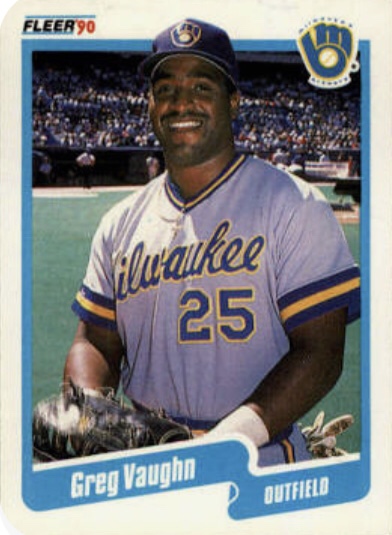
Greg Vaughn. (1990 RC). $50

1990 Fleer #339 – Rookie Card
Value: $50.00 – Grade: 9

The Gospel of Baseball: https://youtu.be/e7LKY0-aOj8

Gregory Lamont Vaughn (born in Dallas, TX on July 3, 1965) is an American former baseball left fielder who played for the Milwaukee Brewers (1989–1996), San Diego Padres (1996–1998), Cincinnati Reds (1999), Tampa Bay Devil Rays (2000–2002) and Colorado Rockies (2003) in Major League Baseball (MLB). He was born in Sacramento, California, where he attended Kennedy High School. He then played baseball at the University of Miami. He is the cousin of fellow former major leaguers Mo Vaughn and Jerry Royster. Vaughn was selected by the Brewers in the fourth round (75th pick) of the 1984 amateur draft. A slugger whose batting average dropped below .250 as often as rising above it, he compensated with excellent power. He had three seasons with at least 100 runs batted in, and four with 30 or more home runs – including the 1998 season, when he hit 50 to finish 4th in the major leagues behind Ken Griffey, Jr., Sammy Sosa, and Mark McGwire, who set the home run record that season. In 1999, he became the first player in major league history to be traded after a 50-homer season when the Padres traded him to the Cincinnati Reds. Vaughn’s arrival in Cincinnati caused a bit of a controversy with club ownership, as he refused to shave his goatee to comply with the Reds’ policy of no facial hair. Fans urged owner Marge Schott to lift the long-standing policy that had been in place since 1967, which she eventually did. On the field, Vaughn hit 45 homers and became the second player in major league history to hit 40 or more homers in consecutive seasons with two different teams (one year after Andrés Galarraga became the first). Throughout his career, Vaughn batted .242 with 355 home runs, 1072 RBI, 1017 runs, 1475 hits, 284 doubles, 23 triples and 121 stolen bases in 1731 games. Vaughn became eligible for the National Baseball Hall of Fame in o2009. 75% of the vote was necessary for induction, and 5% was necessary to stay on the ballot. He received no votes and dropped off the ballot.

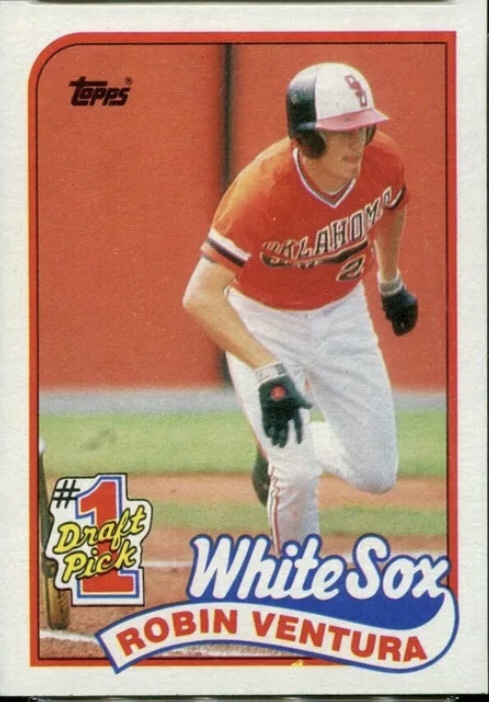
Robin Ventura (1989 RC) $24

1989 Topps #764 – Rookie Card
Value: $24.00 – Grade: Mint

Oklahoma State Hall of Honor: https://youtu.be/-022rnzkDP4

Robin Mark Ventura (born in Santa Maria, CA on July 14, 1967) is an American former professional baseball third baseman and manager. Ventura played 16 seasons in Major League Baseball (MLB) for the Chicago White Sox, New York Mets, New York Yankees and Los Angeles Dodgers. He was also the manager for the White Sox for five seasons. The White Sox selected Ventura with the tenth overall pick in the 1988 amateur draft from Oklahoma State University (OSU). He is a six-time Rawlings Gold Glove winner, two-time MLB All-Star selection and a National College Baseball Hall of Fame inductee. While playing college baseball for the Cowboysat OSU, Ventura was a three-time All-American who authored a Division I-record 58-game hitting streak. In 1988, he won the Dick Howser Trophy and Golden Spikes Award and played for the gold medal-winning Olympic baseball team. In his MLB career, he hit 18 grand slams, ranking fifth all-time. In Game 5 of the 1999 National League Championship Series, Ventura hit the “Grand Slam Single” that won the game but did not actually become a home run because he was unable to complete the circuit around the base paths. Later in his playing career, cartilage and arthritis issues in his ankle hampered his abilities in the field. After the 2011 season, the White Sox hired him to be their manager, making him the 17th former White Sox player to manage the club. After being picked tenth in the 1988 Major League Baseball draft by the White Sox, Ventura spent much of 1989 at AA Birminghambefore joining the Sox that September. While in Birmingham, he earned a spot in the Southern League All-Star Game and was voted the league’s top defensive third baseman. He was named to the 1990 Topps All-Star Rookie Roster and earned the starting third base role with the White Sox the next spring. While his 1990 rookie year was marred by an 0-for-41 slump and 25 errors, his 123 hits were the most by a White Sox rookie since Ozzie Guillén in 1985; he also led AL rookies with 150 games played. The next year he won his first Gold Glove Award for fielding excellence, set a team record for RBIs at third base, and led the AL in putouts. In 1992, Ventura won another Gold Glove and earned a spot on the All-Star team. In 1993, Ventura saw his batting average drop 20 points to .262, though both his slugging and on-base percentages rose slightly. He also collected his 500th hit that May and won his third straight Gold Glove, while becoming the first AL third baseman with three consecutive 90-RBI campaigns since Graig Nettles (1975–78). On August 4, 1993, during a game against the Texas Rangers, Ventura was hit by a pitch thrown by Nolan Ryan. Ventura charged the mound, where Ryan, 20 years Ventura’s senior, placed Ventura in a headlock and punched him several times, causing a bench-clearing brawl. This brawl was voted the top baseball brawl of all time by ESPN’s SportsCenter. (https://youtu.be/R3niGu9d_pY) The White Sox won the AL West that year, which resulted in Ventura’s only playoff trip while in Chicago. They would lose in the ALCS to the Toronto Blue Jays. When play resumed in 1995 following the 1994 strike, Ventura had ten errors in the first ten games. He spent some time at first base that year amid trade rumors, but ended the year with a career-high .295 average, and on September 4 hit two grand slams in one game, the eighth player in history to do so and the first since Frank Robinson in 1970. The next season, he won his fourth Gold Glove, reached new highs in fielding percentage, homers and RBIs, and set team records in career homers by a third baseman (142) and grand slams (9). When spring training began in 1997 the White Sox were picked by many to win their division. In a spring training game at Ed Smith Stadium, Ventura slid into home plate and caught his foot in the mud, suffering a broken and dislocated right ankle. The initial prognosis was that he would be lost for the season. However, Ventura returned on July 24, more than a week ahead of the most optimistic predictions. He collected the game-winning hit that night, and homered in his first at-bat the next evening. The White Sox did not make the playoffs, in part due to the “White Flag Trade”. In 1998, Ventura’s final season with the Sox, he won his fifth Gold Glove, but only hit .263. His homer and RBI totals were close to his career averages, but the Sox attempted repeatedly to trade him and declined to renew his contract, with owner Jerry Reinsdorf claiming that he was “deteriorating”.

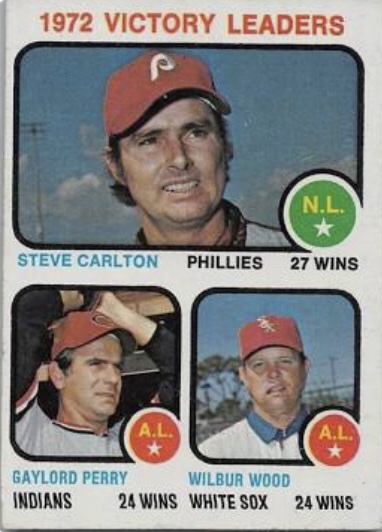
Vict. Lead. S Carlton (‘73) $12

1973 Topps #66 – Value: $12.00 (tape across top)

1994 Hall of Fame Speech: https://youtu.be/mO1cIH1EszQ

Steven Norman Carlton (born in Miami, FL on December 22, 1944) is an American former professional baseball player. He played in Major League Baseball as a left-handed pitcher for six different teams from 1965 to 1988, most notably as a member of the Philadelphia Phillies with whom he won four Cy Young Awards as well as the 1980 World Series. He was elected to the Baseball Hall of Fame in 1994. Nicknamed “Lefty”, Carlton has the second-most lifetime strikeouts of any left-handed pitcher (4th overall), and the second-most lifetime wins of any left-handed pitcher (11th overall). He was the first pitcher to win four Cy Young Awards in a career. He held the lifetime strikeout record several times between 1982 and 1984, before his contemporary Nolan Ryan passed him. One of his most remarkable records was accounting for nearly half (46%) of his team’s wins, when he won 27 games for the last-place (59–97) 1972 Phillies. He is the last National League pitcher to win 25 or more games in one season, as well as the last pitcher from any team to throw more than 300 innings in a season. He also holds the record with the most career balks of any pitcher, with 90 (double the second on the all-time list, Bob Welch). Carlton debuted with the St. Louis Cardinals as a 20–year-old in 1965 and by 1967 was a regular in the Cardinals rotation. An imposing man (6 feet 4 inches (1.93 m)) with a hard fastball and slider, Carlton was soon known as an intimidating and dominant pitcher. Carlton enjoyed immediate success in St. Louis, posting winning records and reaching the World Seriesin 1967 and 1968. In 1967, Carlton was 14–9 with a 2.98 ERA in 28 starts. In 1968, he was 13–11 with a 2.99 ERA. On September 15, 1969, Carlton struck out 19 New York Mets, while losing to the Mets, 4–3, setting the modern-day record at that time for strikeouts in a nine-inning game. He finished 1969 with a 17–11 record, a 2.17 ERA, second-lowest in the NL, and 210 strikeouts. In the 1967 World Series, Carlton started Game 5 and pitched 6 strong innings, giving up only an unearned run, but taking a 3–1 loss. The Cardinals beat the Boston Red Sox to capture the World Series. In the 1968 World Series, Carlton pitched in two games in relief, giving up three runs over four innings as the Cardinals lost to the Detroit Tigers in seven games. A contract dispute with the Cardinals (he had made $26,000 in 1969 and was holding out for $50,000, as opposed to the Cardinals’ contract offer for $31,000) made Carlton a no-show at spring training in 1970. He proceeded to go 10–19 with a 3.73 ERA, leading the NL in losses. In 1971, Carlton rebounded in 1971, going 20–9 with a 3.56 ERA, his first of six 20–win seasons. Following another salary dispute, Cardinals owner Gussie Busch ordered Carlton traded. The Cardinals were offering $55,000 and Carlton wanted $10,000 more. He was traded to the Philadelphia Phillies on February 26, 1972, just before the 1972 season for pitcher Rick Wise. The trade is now considered one of the most lopsided deals in baseball history. However, at the time, the trade appeared to make sense from the Cardinals’ perspective. Carlton had won 77 games to Wise’s 75, and both were considered among the game’s best pitchers. Tim McCarver, who had caught for Carlton in St. Louis and for Wise in Philadelphia (and who would later become Carlton’s personal catcher again with the Phillies), described the trade at the time as “a real good one for a real good one.” He felt Carlton had more raw talent, but Wise had better command on the mound. Wise pitched in the majors for another 11 years (he pitched two seasons with the Cardinals before being traded to Boston), and the trade is reckoned as an epoch-making deal for the Phillies, as well as one of the worst trades in Cardinals history. Carlton was 77–62 with a 3.10 ERA in 190 games and 172 starts with the Cardinals over parts of seven seasons, with 66 complete games and 16 shutouts. He was selected to the NL All-Star team in 1968, 1969 and 1971.

Legend Pitcher: https://youtu.be/EXjTfrNTBhc

Gaylord Jackson Perry (born in Williamston, NC on September 15, 1938) is an American former professional baseball player. He played in Major League Baseball as a right-handed pitcher for eight different teams from 1962 to 1983. During a 22-year baseball career, Perry compiled 314 wins, 3,534 strikeouts, and a 3.11 earned run average. He was elected to the Baseball Hall of Fame in his third year of eligibility in 1991. Perry, a five-time All-Star, was the first pitcher to win the Cy Young Award in each league, winning it in the American League in 1972 with the Cleveland Indians and in the National League in 1978 with the San Diego Padres. He is also distinguished, along with his brother Jim Perry, for being part of the second-winningest brother combination in baseball history—second only to the knuckleball throwing brothers, Phil Niekro and Joe Niekro. While pitching for the Seattle Mariners in 1982, Perry became the 15th member of the 300 win club. Despite Perry’s notoriety for doctoring baseballs (e.g. throwing a spitball), and perhaps even more so for making batters think he was throwing them on a regular basis – he even went so far as to title his 1974 autobiography Me and the Spitter – he was not ejected for the illegal practice until August 23, 1982, in his 21st season in the majors.

How Good of a Pitcher was Wilbur in 1972? https://youtu.be/OD8-XkeUvB8

In a 17-year major league career, Wilbur Wood (Born in Cambridge, MA on October 22, 1941) compiled a 164–156 record with a 3.24 ERA in 661 games. He had 1,411 strikeouts in 2,684 innings pitched, completing 114 games (24 of which were shutouts) of his 297 games started. Wood started 70 games on two days’ rest, the highest total since 1914 with the exception of Grover Cleveland Alexander, who did so 72 times in that period. At the plate, Wood posted a .084 batting average (27 hits in 322 at bats) with only two extra-base hits (both doubles) and just 13 RBI. As a fielder, he recorded a .977 fielding percentage. First eligible for the Hall of Fame in 1984, Wood received votes for six years. His best year was 1988, when he garnered seven percent of the vote. After receiving just 3.1% of the vote in 1989, he became ineligible to appear on further ballots, as players must receive at least five percent each year to remain potential selections.

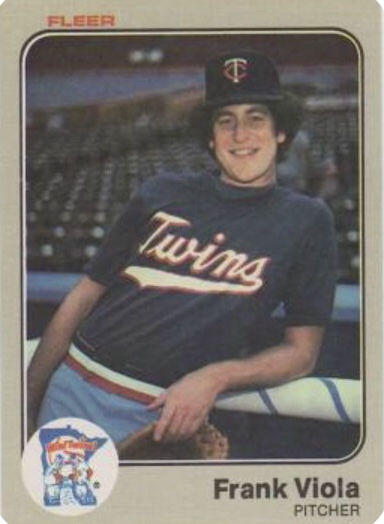
Frank Viola. (1983 RC). $50

1983 Fleer #625 – Rookie Card
Value: $50.00 – Grade: 9

Metrodome Streak: https://youtu.be/Q3Px55ZhVWE

Frank John Viola Jr. (born in Hempstead, NY on April 19, 1960) is an American former starting pitcher in Major League Baseball who played for the Minnesota Twins (1982–1989), New York Mets (1989–1991), Boston Red Sox (1992–1994), Cincinnati Reds (1995), and Toronto Blue Jays (1996). A three-time All-Star, he was named World Series MVP with the Twins in 1987 and won the AL Cy Young Award in 1988. He is the pitching coach of the High Point Rockers. He batted and threw left-handed, and he was nicknamed “Sweet Music” – a nickname he picked up after a Minnesota sports writer declared that when Viola pitched, there was “Sweet Music” in the Hubert H. Humphrey Metrodome. The nickname was a play on the fact that his last name is also a name of a musical instrument, although pronounced differently. A fan began displaying a banner bearing the phrase in the outfield’s upper deck whenever Viola pitched. Twins fans considered the banner to be a good luck charm. The banner is now the property of the Minnesota Historical Society. It was again displayed when Viola was inducted into the Twins Hall of Fame. He was honored as a member of the Twins’ “All Dome” team in 2009. Viola was born and grew up in East Meadow, New York, with his brother John and sister Nancy, and he went on to attend and play baseball for East Meadow High School before playing at the collegiate level for St. John’s University. On May 21, 1981, Viola faced future Mets teammate Ron Darling, then playing for Yale University. The game, often considered to be the best in college baseball history, saw Darling pitch 11 innings of no-hit ball before surrendering his only hit, a leadoff single in the 12th, leading to the game’s only run. Viola himself threw 11 innings of shutout ball. Viola was drafted following his senior year in the 16th round of the 1979 Major League Baseball draft by the Kansas City Royals, but he did not sign. Viola signed with the Minnesota Twins after the team drafted him in the second round of the 1981 Major League Baseball draft. After spending less than a full season in the minor leagues, Viola made his major league debut on June 6, 1982. Although his statistics were fairly disappointing—he finished 11–25 with a 5.37 ERA in the 1982 and 1983 seasons—Viola became a permanent fixture of the Twins’ starting staff for the next 7 seasons, picking up 112 of his 176 career wins. Viola helped pitch the Twins to their second World Series appearance and first World Series win in 1987; he finished the season with a 17–10 record, a 2.90 ERA, and 197 strikeouts in 251+2⁄3innings. Viola would then sparkle in the post-season, going a combined 3–1 with 25 strikeouts in 31+1⁄3 innings despite a 4.31 ERA. Following the Twins’ Game 7 series–clinching win—a game which Viola won 4–2—he was named the 1987 World Series Most Valuable Player. Most baseball enthusiasts agree that Viola’s best year was 1988, his last full year with the Twins. That year, he threw his signature circle change with skill, compiling an impressive 24–7 record with 7 complete games and 2 shutouts in 255 innings pitched with a career-low ERA of 2.64. He also gave up only 20 home runs and 54 walks. Viola led the league in wins and would go on to win the AL Cy Young Award in a landslide, finishing with 27 of the 28 first-place votes and beating out second-place Dennis Eckersley by 86 total votes.

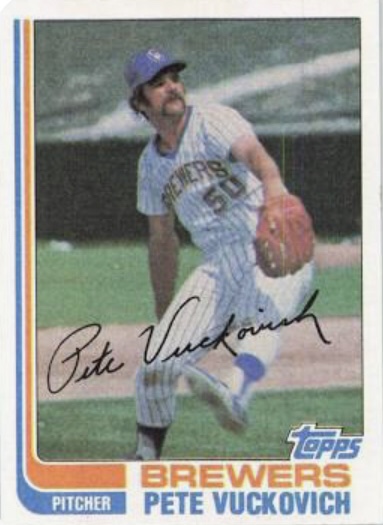
Pete Vuchovich (1982). $16

1982 Topps #643 – Value: $16.00 : Grade: 9

What is Pete doing here? https://youtu.be/QnDWSKhXA84

Peter Dennis Vuckovich (born in Johnstown, PA on October 27, 1952) is a retired Serbian-American starting pitcher in Major League Baseball who came across as an intimidating presence on the mound with his 6’4″ (1.93 m) 220 lb (100 kg) frame and horseshoe moustache. Vuckovich was drafted by the Chicago White Sox in 1974. Despite a notable 12-year career in MLB, he is now known mainly for his part as Yankees slugger Clu Haywood, the chief nemesis of Charlie Sheen’s character Ricky Vaughn, in the popular 1989 film Major League. Vuckovich graduated from Conemaugh Valley High School then went on to Clarion University to play baseball. Nearly 30 years to the day after the Chicago White Sox drafted Vuckovich they drafted his son, Peter Vuckovich, Jr., who also attended both Conemaugh Valley High School and Clarion University, in the 48th round of the 2004 amateur draft. Vuckovich, winner of the 1982 AL Cy Young Award, is a member of the Clarion University Sports Hall of Fame. Vuckovich is also a member of both the Western PA Sports Hall of Fame and the Pennsylvania Sports Hall of Fame. Vuckovich developed a reputation for bizarre, hyper-competitive behavior during his 12 season career. He would fidget, twitch, pace, and convulse while on the mound. He was known to cross his eyes and stick his tongue out at batters. He would spit in his glove, scream at umpires while in the stretch, and sometimes step to the back of the mound and dry heave. His colorful personality made him a fan favorite. After minimal duty with Chicago from 1975–76, Vuckovich was selected by the Toronto Blue Jays in the 1976 MLB expansion draft. Even though the young Blue Jays lost 107 games in 1977, and although mostly used in relief, Vuckovich managed a 7-7 record with eight saves. He recorded the first shutout in Toronto franchise history, a 2-0 victory over Jim Palmerand the Orioles. He also recorded the first save in Toronto franchise history on Opening Day on April 7, 1977 at Exhibition Stadium in Toronto, Ontario,, versus the Chicago White Sox. Involved in a multi-player trade to the St. Louis Cardinals, Vuckovich’s career went to the next level. In 1978, he started more often, winning 39 games for the Cardinals during three years. He finished third in the National League in ERA with a 2.55 mark in 1978, and ranked fourth in shutouts (3) in 1980. A part of a blockbuster seven-player trade in December 1980, Vuckovich went to the Milwaukee Brewers along with Rollie Fingers and Ted Simmons. With the Brewers, Vuckovich continued his stellar pitching. He led the American League in wins (14) and winning percentage Win-Loss % (.778) during the strike-shortened 1981 season. When Milwaukee won the AL pennant in 1982, Vuckovich won the Cy Young Award with an 18-6 record and a 3.34 ERA, and once again tied for the league lead with the Baltimore Orioles’ Jim Palmer in winning percentage Win-Loss %(.750). He lost Game Two of the ALCS to the Angels 4-2, and started the decisive fifth game, though not figuring in the decision. In the 1982 World Series, the Cardinals beat him 6-2 in Game Three, and he got a no-decision in the final loss. This was, however, proved to be the zenith of his career, as Vuckovich had been battling shoulder pain for two seasons, and in spring training of 1983, it was discovered he had torn his rotator cuff. Vuckovich skipped surgery in favor of an exercise rehabilitation. He attempted an unsuccessful comeback for three games and went 0-2 in 14 innings, then missed all of 1984. Subsequent and prolonged comeback attempts all failed, and by the end of the 1986 season, Milwaukee released Vuckovich. In an eleven-season career, Vuckovich posted a 93-69 record with 882 strikeouts and a 3.66 ERA in 1455.1 innings pitched. In postseason play, he was 1-2 with a 3.74 ERA. While with the Brewers, Vuckovich co-owned a bar in Milwaukee with outfielder Gorman Thomas. It was called “Stormin’ & Vuke’s”, a play on their nicknames.