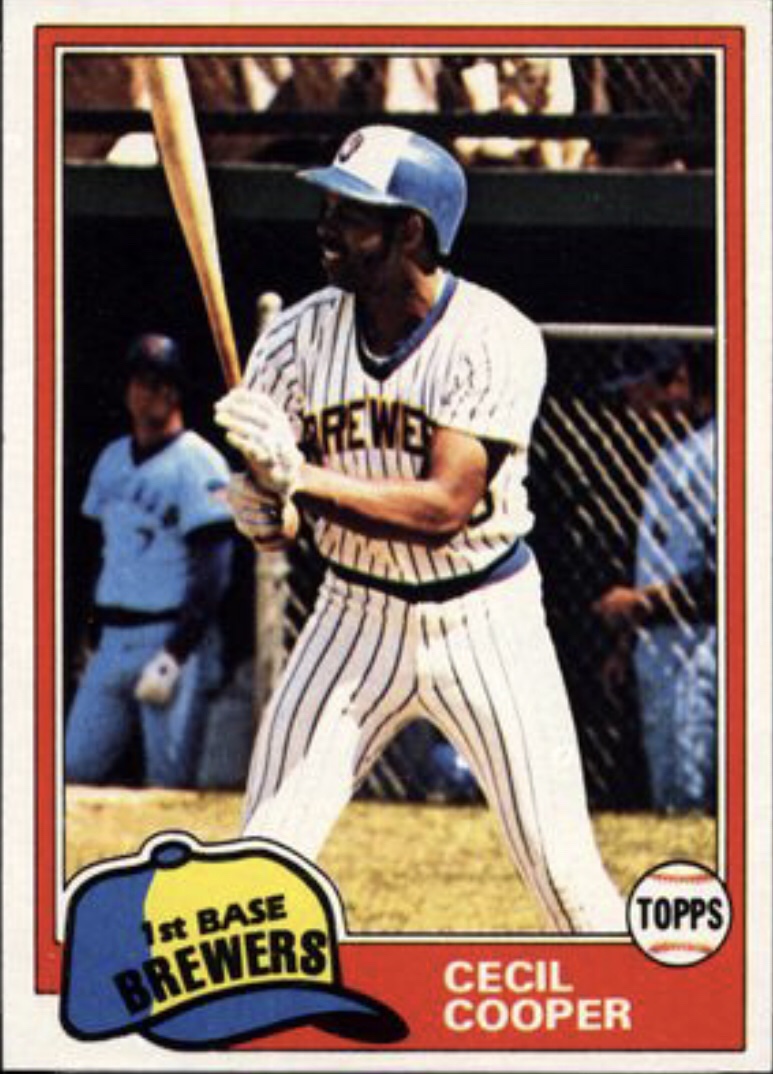
Cecil Cooper. (1981). $140

1981 Topps #555 – Value: $140.00 – Grade: 9

Relives clutch single in game 5 of the 1982 ALCS: https://youtu.be/9BUywFkTBws

Cecil Celester Cooper (Born in Brenham, TX on December 20, 1949-) became one half of a duo, along with teammate Don Money, who each hit a grand slam in the same inning, only the fourth pair of teammate to accomplish the feat. Cooper grew up in a baseball family in rural Texas, outside of Houston, with his father having played in the Negro Leagues and two of his brothers playing for the barnstorming Indianapolis Clowns, also of the Negro Leagues. Cecil helped lead his Pickard High School baseball team to two Texas state championships and was then drafted by the Boston Red Sox in the sixth round of the 1968 MLB Draft. Though he was later selected by the St. Louis Cardinals in the 1970 Rule 5 Draft, he chose to play for the BoSox and headed for the minors. By 1971, playing first base for the Pawtucket Red Sox of the Eastern League, Coop hit .343 with 10 home runs to earn a call up in September. For three seasons in Boston, Cecil battled for the first baseman’s position with the likes of future Hall of Famer Carl Yastrzemski, All-Star George Scott and newly acquired Danny Cater and was more often used as a pinch-hitter or DH. In 1974, Cecil won the first baseman slot out of spring training and did not disappoint. From 1974 to 1976, he batted .287 while averaging 112 hits, 12 home runs and 55 RBI. But then, after six seasons in Beantown (1971-1976), Cooper was traded to the Milwaukee Brewers for George Scott, who had been traded to the Brewers in 1971. It was in Milwaukee that Cecil would put up his best numbers and earn five selections to the MLB All-Star Game. Former Major Leaguer Sal Bando once reflected that there were player who hit for power and “guys who can hit singles. But no many can do both. Cecil can.” Cooper slipped seamlessly into the Brewers lineup that already included future Hall of Famer Robin Yount and then Paul Molitor. Cecil Cooper hit .300 or better in his first seven seasons with the Brewers and led the American league in doubles and RBI twice. During that span, he also averaged 22 home runs per season. In 1979, he was named to his first of five MLB All-Star Games and though renown for his bat won his first of two consecutive Rawlings Gold Gloves at first base. He also won three Silver Slugger Awards (1980-82). In 1980, Cooper batted an astonishing .352, but fell well short of Kansas City Royals third baseman George Brett’s assault on .400 as he completed the year with a .390 batting average. In 1982, Cecil helped lead the Brewers to their first American League pennant and World Series in franchise history before they lost to the St. Louis Cardinals in seven games. Coop went 8-for-28 with six RBI in the effort. Cecil Cooper played 11 seasons with the Brew Crew (1977-1987) before retiring in 1987 having collected 2,192 hits including 415 doubles and 241 home runs, 1,012 runs scored, 89 stolen bases and 1,125 RBI while batting .298 over his 17-year career. In the field, Coop posted a spectacular .992 fielding percentage with 1,000 assists and 1,348 double plays though committing only 121 errors. In 1983, he was named the Roberto Clemente Award recipient for his excellent play and devotion to his community. Following his playing days, Cecil served as coach with the Brewers and Houston Astros. And, in 2007, replaced Phil Garner as Astros manager compiling a record of 171-170 in 341 games.

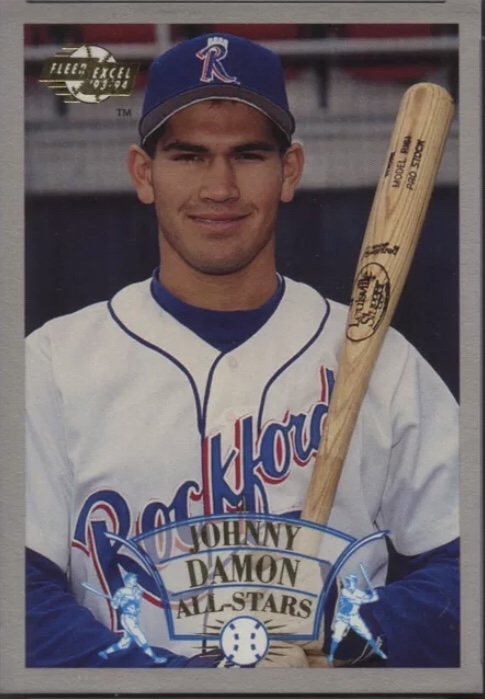
Johnny Damen. (‘93 RC) $100

1993 Fleer #6. Rookie Card.
Value: $100.00 – Grade: Mint

Career Highlights: https://youtu.be/zDI0ZE0aGmc

Johnny David Damon (born in Fort Riley, KS on November 5, 1973) is an American former professional baseball outfielder who played in Major League Baseball (MLB) from 1995 to 2012. During his MLB career, Damon played for the Kansas City Royals (1995–2000), Oakland Athletics (2001), Boston Red Sox (2002–2005), New York Yankees (2006–2009), Detroit Tigers (2010), Tampa Bay Rays (2011) and Cleveland Indians (2012). Damon also played for the Thailand national baseball team and was a member of the squad for the 2013 World Baseball Classic qualifiers.

  • 1993 – Midwest League All-Star OF
  • 1994 – Carolina League All-Star Royals Minor League Player of the Year
  • 1995 – Baseball America 1st team Minor League All-Star, KC Royals Minor League Player of the Year, Texas League All-Star & Most Valuable Player, AA All-Star, and AA Player of the Year
  • 2000 – KC Royals Player of the Year
  • 2002 – All-Star (Inaugural AL All Star Final Vote Winner)
  • 2005 – Baseball America 2nd-Team All-Star, AL All-Star
  • 2009 – TYIB Award: Best Post season Moment
  • 2017 – Asian American Hall of Fame

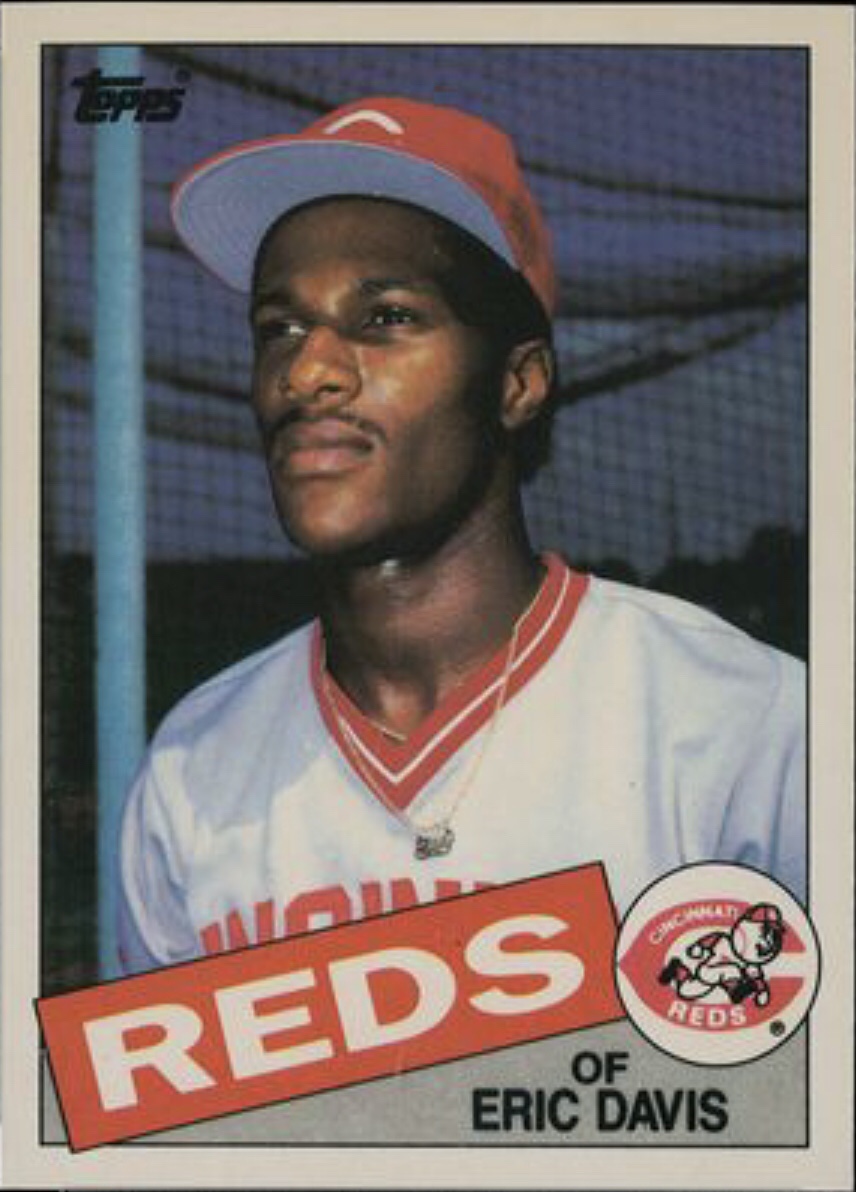
Eric Davis. (1985 RC). $836

1985 Topps #627 – Rookie Card
Value: $836.00 – Grade: Mint

Highlight Reel: https://youtu.be/Vi2h0g5GeXA

Eric Keith Davis (Born in Los Angeles, CA on May 29, 1962-) was a highly touted Major League outfielder whose career was often hampered by a series of injuries and other health concerns. The Cincinnati Reds took Davis in the 8th round of the 1980 amateur draft, debuting for the team during the 1984 season. From 1986 to 1990, he began cultivating superstar status by averaging 30 home runs and 40 steals, garnering regular MVP support, and finishing in the top 10 for home runs in the National League. During Game 4 of the 1990 World Series, Davis lacerated a kidney while diving for a ball … an injury that would require surgery and mark the beginning of a series of health concerns for the ballplayer. After eight seasons with the Reds (1984-1991) – which included two All-Star appearances and three Gold Glove Awards — a continuous string of injuries resulted in his trade to the Los Angeles Dodgers (1992-1993) and then to the Detroit Tigers (1993-1994). Davis sat out the 1995 season before returning to the Reds (1996) with a .287 average while belting 26 home runs. Diagnosed with colon cancer before the start of the 1997 season, Davis finished his career with injury-shortened seasons with the Baltimore Orioles (1997-1998), St. Louis Cardinals (1997-2000), and San Francisco Giants (2001). He retired with a .269 average, 282 home runs, and 934 RBI.

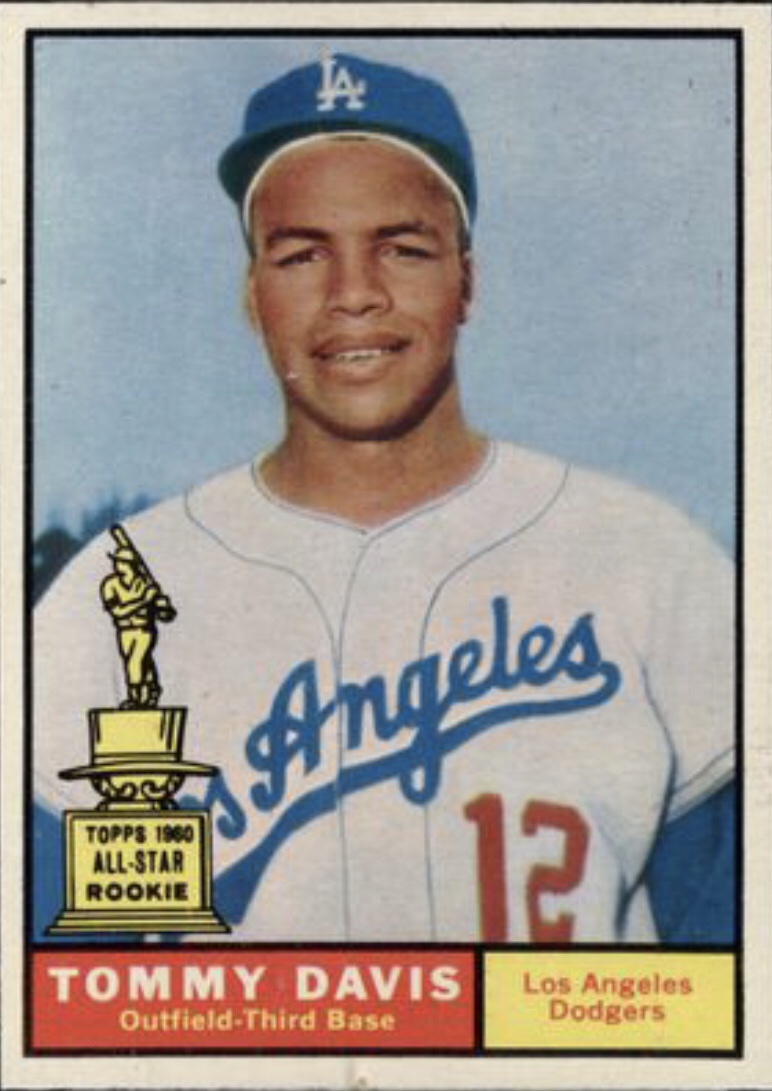
Tommy Davis. (1961 RC) $289

1961 Topps #168 – Rookie Card
Value: $289.00 – Grade: 10

Talking Hitting: https://youtu.be/Np6WNBFiBY0

Herman Thomas “Tommy” Davis, Jr. (Born in Brooklyn, NY on March 21, 1939-) won four professional batting titles grabbing his last two in back-to-back campaigns (1962 & 1963) as a Los Angeles Dodger, edging out Hall of Fame sluggers Frank Robinson and Roberto Clemente, respectively. He also won the 1957 Midwest and 1959 Pacific Coast League batting championships. The Brooklyn native signed with his hometown Dodgers in 1956 at the goading of Dodgers Hall of Fame second baseman Jackie Robinson, but he did not debut with the big club until the franchise relocated to Los Angeles. Davis was a superb hitter and an excellent fielder playing primarily left field and third base. In 1962, Davis led the National League in hits (230), RBI (153) and batting average (.346) to earn his first of back-to-back batting championships and All-Star appearances. His 230 hits are still the most by a right-hander Dodger batter and his 153 RBI remain a franchise record. Tommy’s .346 average edged Cincinnati Reds slugger Frank Robinson by 0.04 points in 1962 and his .326 topped Roberto Clemente’s .320 average the following season. Davis spent eight years in Dodger blue and helped lead them to the 1963 World Series championship over the New York Yankees. He suffered a broken ankle in 1965, limiting him to only 17 games, and he was unable to appear in the Fall Classic once more as the Dodgers won their second World Series in three years. Tommy played for the Dodgers (1959-1966), the New York Mets (1967), the Chicago White Sox (1968), the Seattle Pilots (1969), the Houston Astros (1969-1970), the Oakland Athletics (1970, 1971), the Chicago Cubs (191970, 1972), the Baltimore Orioles (1972-1975), the California Angels (1976) and the Kansas City Royals (1976). The three-time National League All-Star selection for left field posted a .970 fielding percentage. After playing his final ten years with ten teams, Tommy Davis decided to retire having amassing 272 doubles, 811 runs scored, 136 stolen bases and 1,052 RBI while bating .294 over the course of 18 seasons.

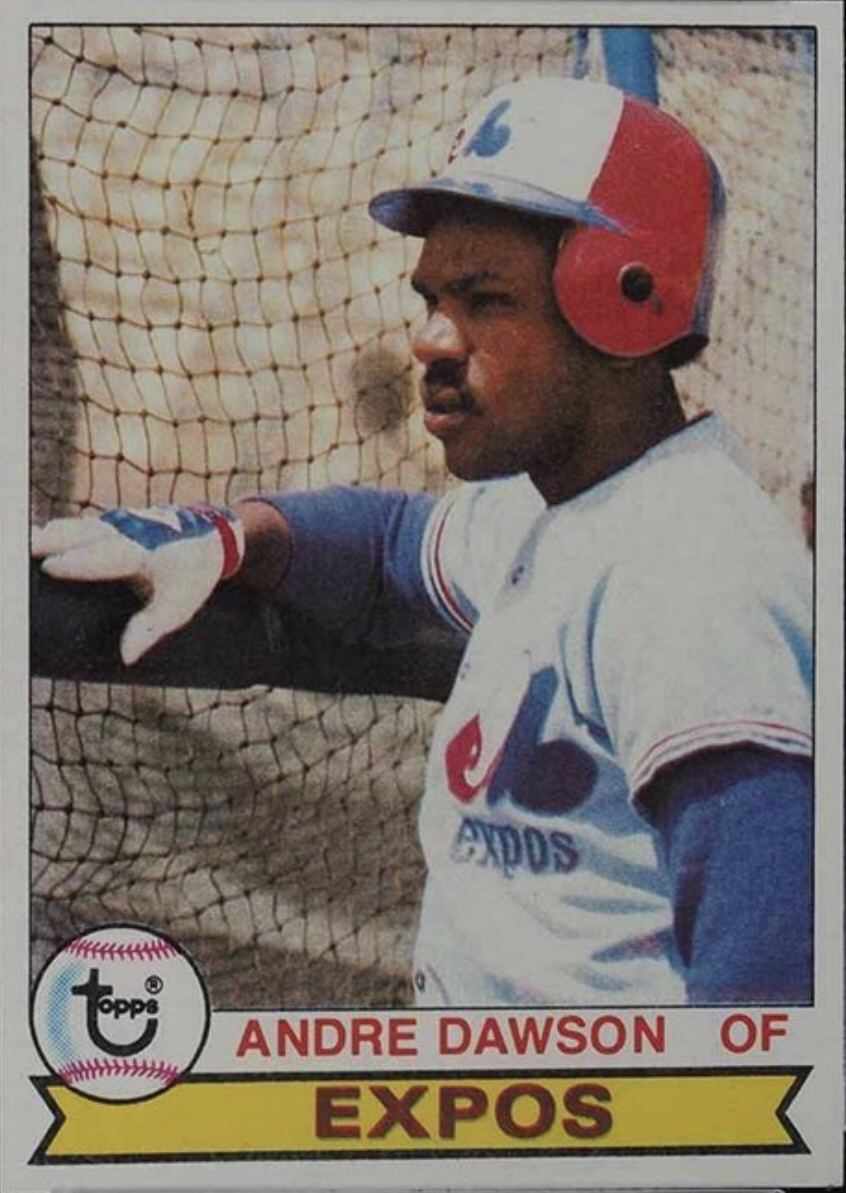
Andre Dawson. (1979). $350

1979 Topps #348 – Value: $200.00 – Grade: 9

Underrated Superstar: https://youtu.be/jcLOsjyz8Ss

Andre Nolan Dawson (born in Miami, FL on July 10, 1954), nicknamed “The Hawk” and “Awesome Dawson”, is an American former professional baseball player and inductee into the Baseball Hall of Fame. During a 21-year baseball career, he played for four different teams as a center and right fielder, spending most of his career with the Montreal Expos (1976–1986) and Chicago Cubs (1987–1992). An 8-time National League (NL) All-Star, he was named the league’s Rookie of the Year in 1977 after batting .282 with 19 home runs and 65 runs batted in (RBI), and won the Most Valuable Player Award in 1987 after leading the league with 49 homers and 137 RBI; he had been runner-up for the award in both 1981 and 1983. He batted .300 five times, drove in 100 runs four times and had 13 seasons of 20 home runs. A strong base-runner early in his career, he also stole 30 bases three times. He is one of eight MLB players with at least 300 home runs and 300 stolen bases during his career.

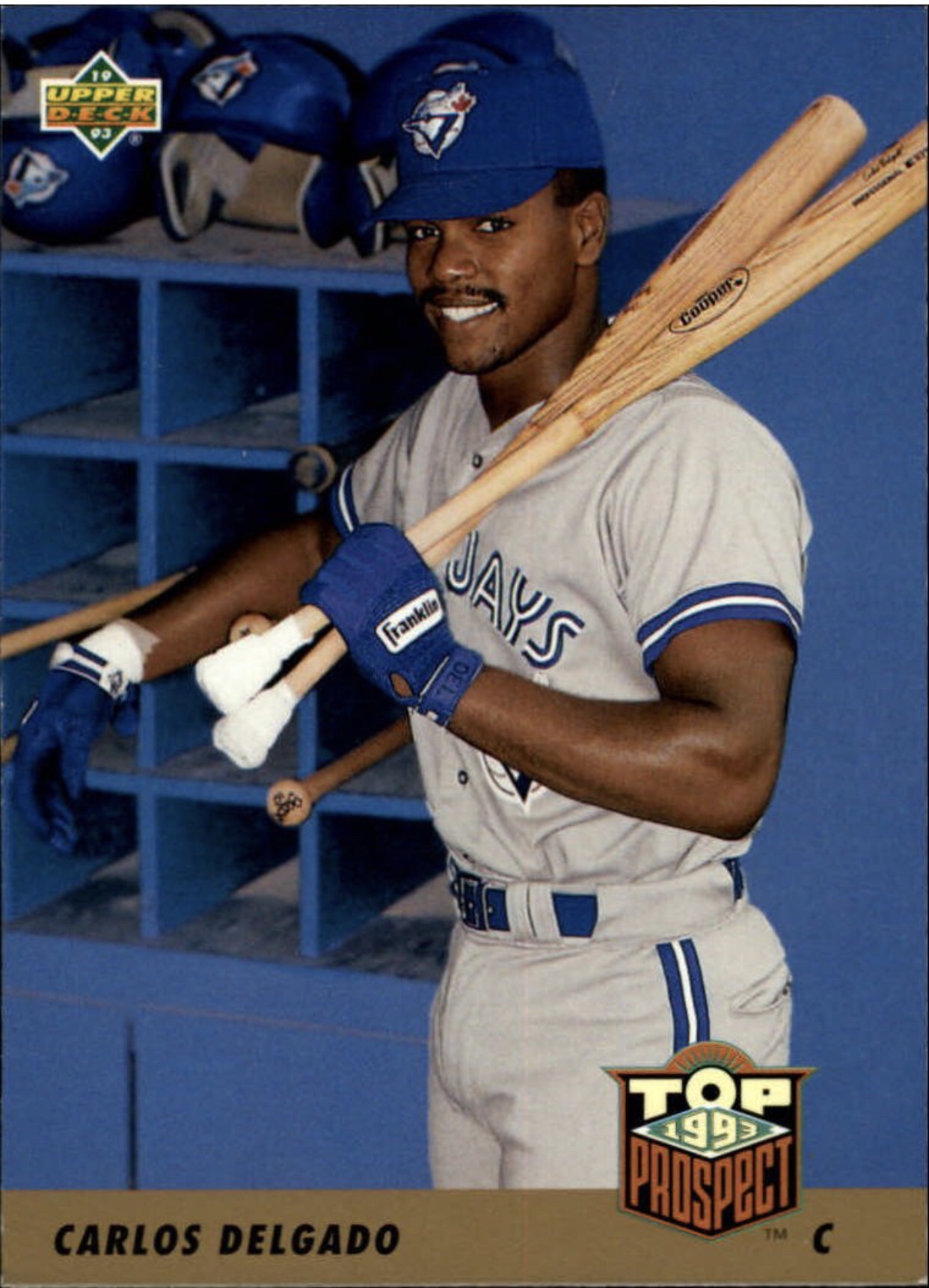
Carlos Delgato. (1993). $60

1993 Upper Deck #425 – Value: $60.00 – Grade 9

Hall of Good: https://youtu.be/toJ9bT5hOX0

Carlos Juan Delgado Hernández (born in Aguadilla, PR on June 25, 1972) is a Puerto Rican former professional baseballplayer. He holds the all-time Major League Baseball home run record among Puerto Rican players, with 473. He is one of only six players in Major League history to hit 30 home runs in ten consecutive seasons, becoming the fourth player to do so. During his twelve years with the Toronto Blue Jays, Delgado set many team records, including home runs (336), RBI (1,058), walks (827), slugging percentage (.556), OPS (.949), runs (889), total bases (2,786), doubles (343), runs created (1,077), extra base hits (690), times on base (2,362), hit by pitch (122), intentional walks (128) and at bats per home run (14.9). Delgado also played for the Florida Marlins and New York Mets. On February 4, 2015, Delgado was elected to the Canadian Baseball Hall of Fame.

Bucky Dent. (1978). $47

1978 Topps 335 Bucky Dent York Yankess
1978 Topps #335 – Value: $47.00 – Grade: 9

Rizzuto interviews Dent (10/2/78) after Yankee winning HR vs Red Sox: https://youtu.be/7MZbvbiU0J8

Russell Earl “Bucky” Dent (born Russell Earl O’Dey; in Savannah, GA on November 25, 1951) is an American former Major League Baseball (MLB) player and manager. He earned two World Series rings as the starting shortstop for the New York Yankees in 1977 and 1978, both over the Los Angeles Dodgers in six games, and he was voted the World Series Most Valuable Player Award in 1978. Dent is most famous for his home run in a tie-breaker game against the Boston Red Sox at Fenway Park at the end of the 1978 regular season. A three-time All-Star, Dent remained the Yankees’ shortstop until 1982, when he was traded to the Texas Rangers in August for outfielder Lee Mazzilli. During his six years with the Yankees, Dent lived in a home in Wyckoff, New Jersey, that he later rented to Don Zimmer. On the Rangers, his uniform number was 7. Dent returned to the Yankees briefly in 1984 (but never played a game) before finishing his career that season with the Kansas City Royals, wearing uniform number 21. He spent his entire 12-year playing career in the American League, with a .247 batting average and 423 RBI.

Tommy John observed that Dent’s throwing arm was not the strongest and that his range was limited. In spite of that, he was extremely reliable on balls he was able to get to. “He knew how to position himself, and he got to balls that were missed by other shortstops with better range,” John said, adding that the player “was kind of taken for granted, until the Yankees unloaded him and discovered what he meant to the infield”.

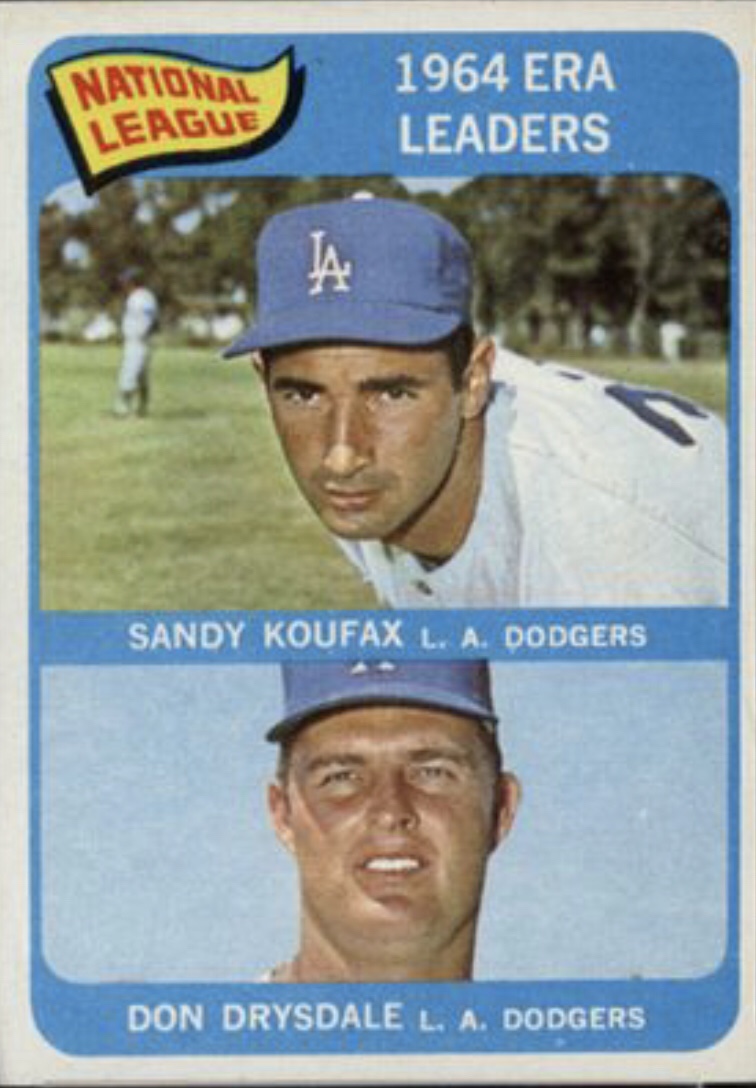
D Drysdale/S Koufax. (‘65) $1,344

1965 Topps #8 – Value $310.00 – Grade 9

Hall of Fame Biography: https://youtu.be/W8cXwLg-Fug

Donald Scott Drysdale (Born: Van Nuys, CA on July 23, 1936 – July 3, 1993) played his entire 14-year career with the Brooklyn/Los Angeles Dodgers (1956-1957, 1958-1969). Big D had a career year in 1962 when he led the league in wins (25) and strikeouts (232) and capturing the NL Cy Young Award, but missing out on the year’s Triple Crown as he came in fifth behind teammate Sandy Koufax in ERA. Drysdale led the National League in games started for four straight seasons (1962-1965), strikeouts three times and hit batsmen five times. Drysdale’s record of 154 hit batsmen remains a modern NL record. Don Drysdale was a nine-time All-Star selection, five-time NL pennant winner and three-time World Series champion (1959, 1963, 1965). Drysdale finished his career with a 209-166 record with 2,486 strikeouts and a 2.95 earned run average. Don was very adept at the plate as well, batting .300 in 1965 adding a National League record tying seven home run tallies. Drysdale retired from playing and found a place in the broadcast booth as well as on the silver screen in Hollywood making several appearances on television shows. Donald Scott Drysdale was elected to the National Baseball Hall of Fame in 1984.

Baseball Documentary: https://youtu.be/UaGBjAmnkPk

Sanford “Sandy” Koufax (Born in Brooklyn, NY on December 30, 1935-) was one of the most dominant pitcher of the 1960s, breaking a 58-year old strikeout record set by Christy Mathewson in 1903, becoming not only the first pitcher to throw four no-hitters (including one perfect game), but also the first to win multiple Cy Young Awards. Sandy, nee Sanford Braun, was born and raised in Brooklyn, New York where he excelled in basketball, but also enjoyed baseball. After captaining his Lafayette High School basketball team, he accepted a scholarship to play at the University of Cincinnati, but he eventually chose to play baseball and signed with the Brooklyn Dodgers after only one year at Cincy. Because the Dodgers signed the hard-throwing left handed to a $14,000 bonus, MLB rules required that he remain on the Major League roster for two years, thereby foregoing his much needed minor league guidance. Sandy would learn the ropes of professional baseball at its highest level. Though he would begin his career at a critical point in the Brooklyn Dodgers history, as they finally achieved the ultimate goal beating the New York Yankees in the World Series for the franchise’s first Major League title, Koufax struggled mightily to find his control and consistency. August 27, 1955 marked Sandy’s first career win, beating the Cincinnati Reds as he struck out 14 batters, but he would finish the year at .500 going 2-2 with 30 Ks and a 3.02 ERA. However, he was still only 19-year old. His struggles would continue for the next five seasons with Koufax going 36-40 with 683 strikeouts and a 4.10 ERA in 174 appearances. Hardly considered much more than mediocre, let alone the making of a Hall of Fame caliber career. The Dodgers were able to return to the World Series 1959 where they dispatched the Chicago White Sox in six games. However, in 1961, on the advice of backup catcher Norm Sherry, Sandy learned to control his fastball by not over-throwing. Sherry took the young hurler aside and told him to just try to throw strikes and not try to throw so hard and success would follow. Koufax stated that during those early years, he “tried to throw every pitch harder than the last one.” But that simple advice turned his career around, and hitters around the league considered his fastball and curveball virtually unhittable. Adding a change-up to the mix soon made Sandy the most dominant pitcher of the 1960s and one of the most dominant in the history of the game. For the first time, in 1961 he led the National League in strikeouts with 269, to more than Christy Mathewson in 1903 and went 18-13 with 15 complete games. He also earned his first of six straight trips to the MLB All-Star Game. A change of venue for the Dodgers, now playing in Los Angeles, playing in the new pitcher-friendly Dodgers Stadium, Koufax was immediately benefitted by the larger park and his ERA plummeting from 4.29 to 1.75. He threw his first of four no-hitters against the expansion New York Mets on June 30, and in the end pitched to a 14-7 record with a league leading 2.54 ERA and 216 strikeouts. In 1963, the reluctant star, Koufax captured his first of three pitching Triple Crowns, going 25-5 with 306 strikeouts, a 1.88 ERA and 11 shutouts – all league leading statistics to earn MLB’s Cy Young Award and Most Valuable Player Award. And, once again, he led the Dodgers to the National League pennant. He would go on to win his second and third Triple Crowns and Cy Youngs in 1965 and 1966, respectively, and he spirited the Boys in Blue to a second World Series appearance in 1965. But, not without controversy. Koufax became a hero to Jews worldwide when he refused to pitch in Game 1 of the 1965 World Series as it fell on Yom Kippur, a religious high holiday. Koufax stood up for his beliefs and the Dodgers fell to the Yankees in Game 1, but Sandy returned to outpitch the World Series record-setting Whitey Ford in Games 3 & 5 to lead the Dodgers to their second MLB title in three years. He threw no-hitters against the San Francisco Giants (5/11/1963), the Philadelphia Phillies (6/4/1964) and a perfect game against the Chicago Cubs on September 9, 1965. Sadly though, injuries and arthritis caught up wth the hard-throwing lefty who was forced to use heat on his elbow before each game and then plunge that elbow into a bucket of ice water after, not to mention the myriad of painkillers. And so, Sandy shocked his teammates, management and the baseball world for that matter when he retired at the age of 30, becoming of the youngest ever to call it quits in the prime of his career in any sport. Koufax’s splendid, seemingly limitless career was cut short due to arthritis limiting him to 12 seasons, but his impact on the game is timeless. Sandy Koufax retired with a record of 165-87 with 2,396 strikeouts and a 2.76 earned run average. Koufax continued to cover baseball as a broadcaster for NBC. Sanford “Sandy” Koufax was elected to the National Baseball Hall of Fame in 1972.

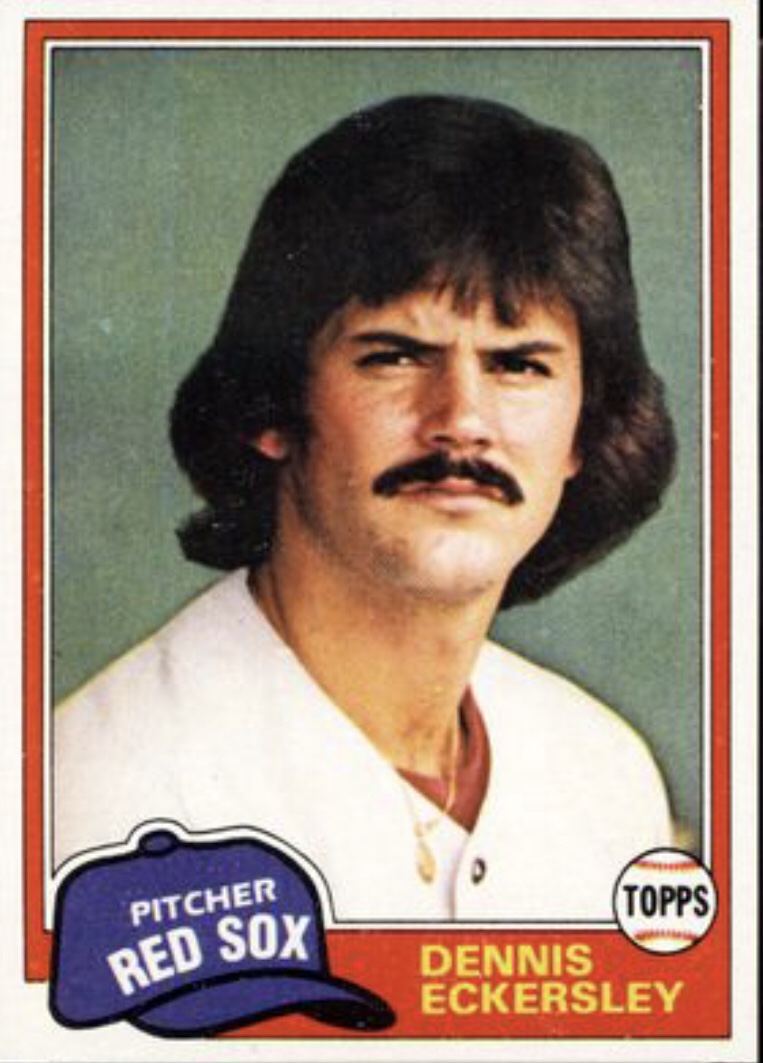
Dennis Eckersley. (1981). $177

1981 Topps #620 – Value: $177.00 – Grade 9

Hall of Fame Biography: https://youtu.be/YZj7Re45fPg

#98 of Top 100 Players

Dennis Lee Eckersley (Born in Oakland, CA on October 3, 1954-) made an excellent transition from starter to closer mid-way through his career and is the only pitcher to amass 100 saves and 100 complete games. Eck began his career with the Cleveland Indians (1975-1977) where he no-hit the California Angels in 1977. Dennis was traded to the Red Sox (1978-1984, 1998) then moved to the Cubs (1984-1986), the A’s (1987-1995) and the Cardinals (1996-1997). In Oakland, legendary manager Tony LaRussa converted Eck into one of the dominant closers in either league. From 1988-1992, Eckersley finished first in saves twice and won the 1992 American League Cy Young and Most Valuable Player Awards after posting 51 saves. The six-time All-Star selection was named the AL Rolaids Relief Man of the Year, given to the top relief pitcher of the year and was a member of the 1989 World Series champion Oakland A’s. During his final ten seasons, Eckersley walked only 86 batters in more than 600 innings. Dennis Eckersley retired with a 197-171 record with 2,401 strikeouts, a 3.50 ERA and 390 saves over his career. Dennis Lee Eckersley was elected to the National Baseball Hall of Fame in 2004.

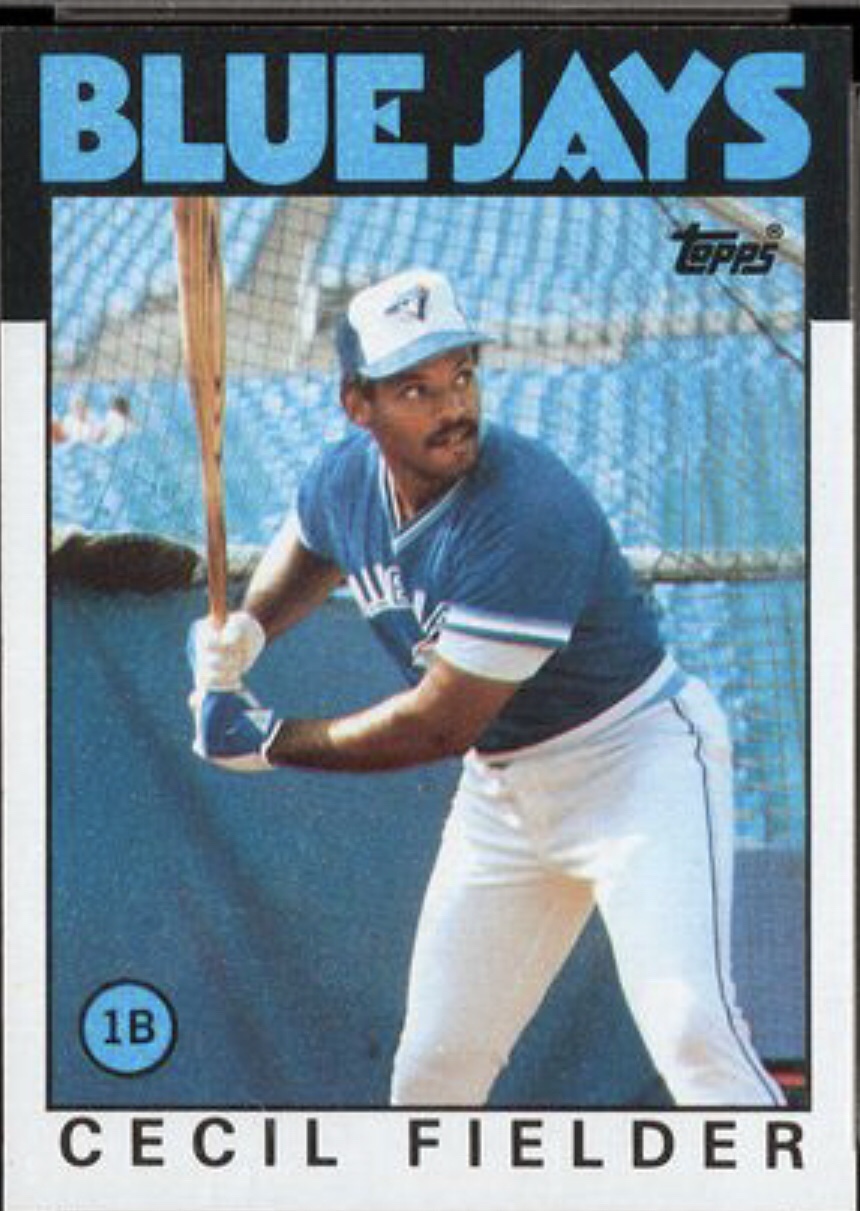
Cecil Fielder. (1986 RC). $186

1986 Topps #386 -Value: $100.00 – Grade 9

Highlights: https://youtu.be/sv06kOR6rp0

Cecil Grant Fielder (Born in Los Angeles, CA on September 21, 1963-) was one of Major League Baseball’s most powerful hitters throughout the 1980s and 1990s, hitting 51 home runs in 1990. He is the father of major leaguer Prince Fielder. The Baltimore Orioles chose Fielder in the 31st round of the 1981 amateur draft, but the future baseman opted not to sign with the team. The Kansas City Royals tapped Fielder in the 4th round of the 1982 amateur draft, trading him to the Toronto Blue Jays the following year. During his Big League years in Toronto (1985-1988), Fielder served as a part-time infielder, prompting his decision to sign with Hanshin Tigers (1989) in Japan. After the Detroit Tigers added Fielder to their roster, Fielder began to exhibit his immense talent, joining the 50 Home Run Club and making all three of his All-Star Game appearances while with the Tigers (1990-1996). Traded to the New York Yankees (1996-1997) midway through the 1996 season, Fielder became a key part to the Bronx Bombers’ World Series championship that season. He finished his playing days with the Anaheim Angels (1998) and Cleveland Indians (1998), retiring with a .255 batting average, 319 home runs, and 1,008 RBIs.