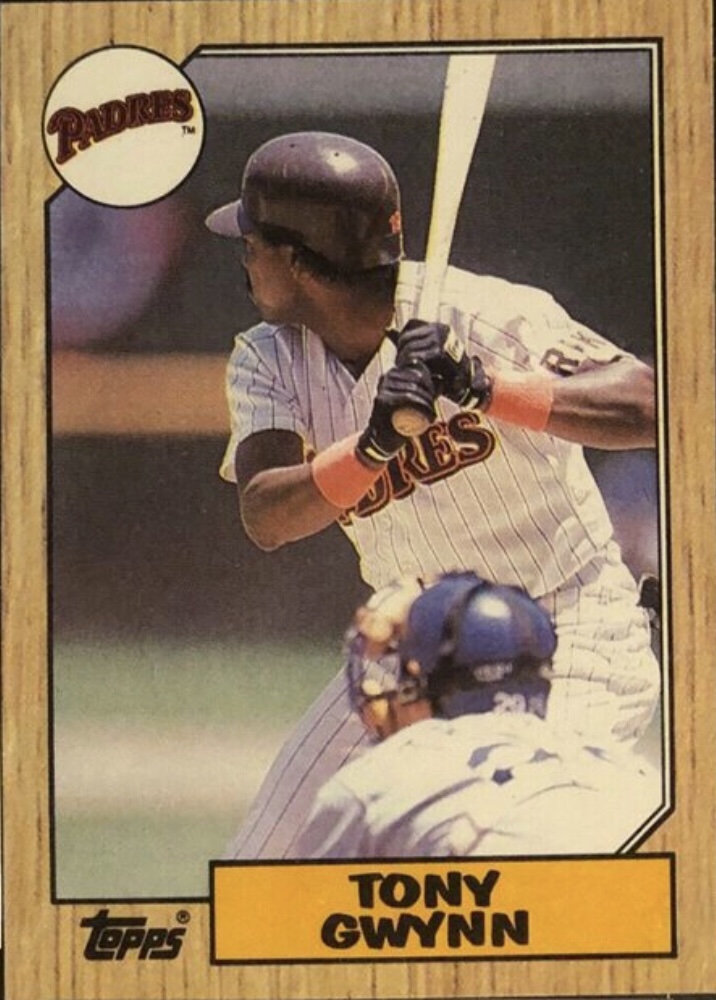
Tony Gwynn Sr. (1987). $116

1987 Topps #530 – Value: $116.00 – Grade: Mint

Mets Celebrate Legacy: https://youtu.be/48epcK4vZQ0

#49 of the Top 100 Players

Anthony Keith Gwynn Sr. (Born in Los Angeles, CA on May 9, 1960 – June 16, 2014), nicknamed “Mr. Padre”, was an American professional baseball right fielder, who played 20 seasons (1982–2001) in Major League Baseball (MLB) for the San Diego Padres. The left-handed hitting Gwynn won eight batting titles in his career, tied for the most in National League (NL) history. He is considered one of the best and most consistent hitters in baseball history. Gwynn had a .338 career batting average, never hitting below .309 in any full season. He was a 15-time All-Star, recognized for his skills both on offense and defense with seven Silver Slugger Awards and five Gold Glove Awards. Gwynn was the rare player in his era that stayed with a single team his entire career, and he played in the only two World Series appearances in San Diego’s franchise history. He was inducted into the Baseball Hall of Fame in 2007, his first year of eligibility. Gwynn attended San Diego State University (SDSU), where he played both college baseball and basketball for the Aztecs. He was an all-conference player in both sports in the Western Athletic Conference (WAC), but was honored as an All-American in baseball. Gwynn was selected by the Padres in the third round of the 1981 MLB draft, as the 58th overall pick. He made his major-league debut the following year, and captured his first batting title in 1984, when San Diego advanced to its first-ever World Series. A poor fielder in college, Gwynn’s work on his defense was rewarded in 1986, when he received his first Gold Glove. The following year, he won the first of three consecutive batting titles. Beginning in 1990, Gwynn endured four straight seasons which ended prematurely due to injuries, particular to his left knee. However, he experienced a resurgence with four straight batting titles starting in 1994, when he batted a career-high .394 in a strike-shortened season. Gwynn played in his second World Series in 1998, before reaching the 3,000-hit milestone the following year. He played two more seasons, hampered by injuries in both, and retired after the 2001 season with 3,141 career hits. A contact hitter, Gwynn excelled at hitting the ball to the opposite field. After meeting Hall of Famer Ted Williams in 1992, Gwynn became more adept at pulling the ball and using the entire field, as well as hitting for more power. He could also run early in his career, when he was a stolen base threat. Widely considered the greatest player in Padres history, Gwynn regularly accepted less money to remain with the small-market team. After he retired from playing, the Padres retired his No. 19 in 2004. Gwynn became the head baseball coach at his alma mater, and also spent time as a baseball analyst. Gwynn died of salivary gland cancer in 2014 at the age of 54.

More Tony Gwynn baseball cards:
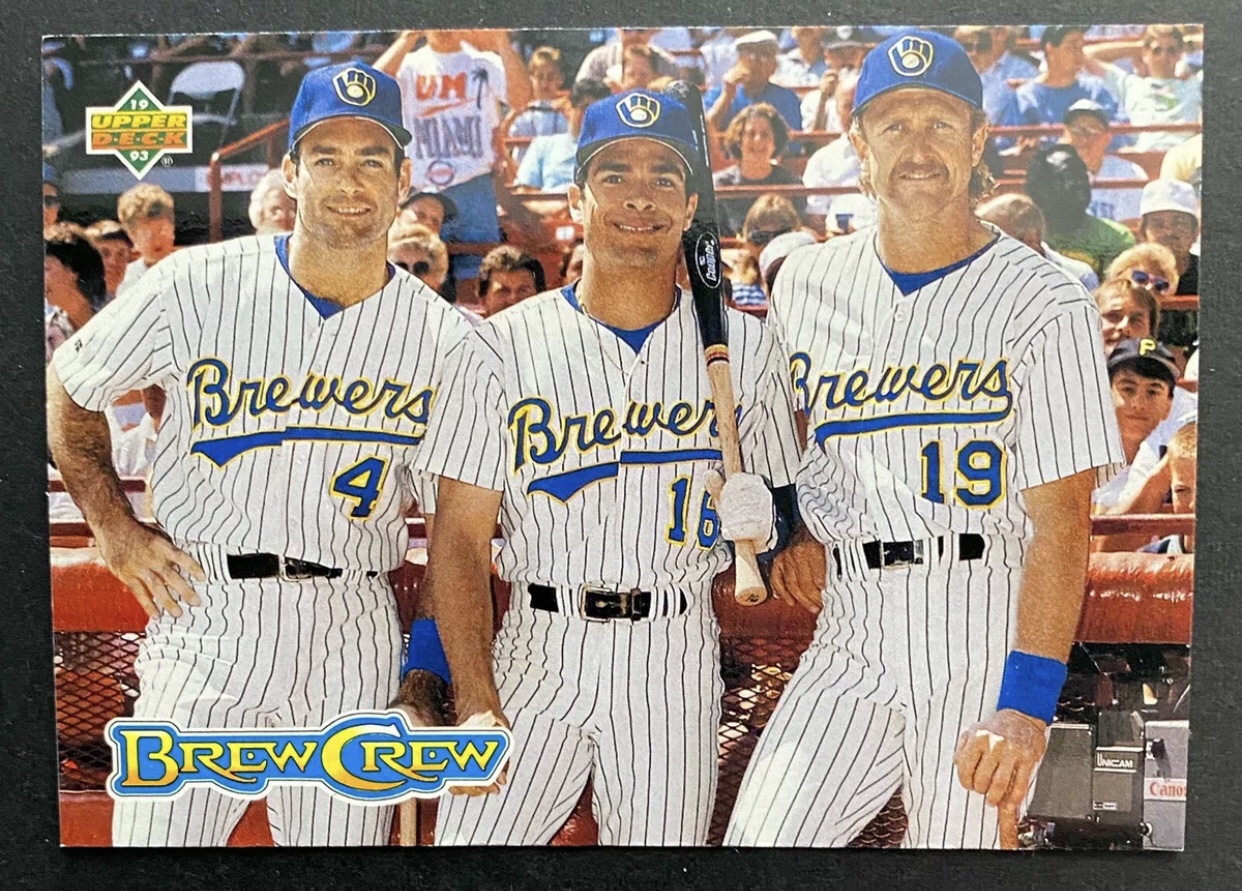
Brew Crew (1992). $12

Paul Molitor, Pat Listash & Robin Yount
1992 Upper Deck #43 – Grade 10 – Value: $12.00

Paul Leo Molitor (born in St. Paul, MN on August 22, 1956), nicknamed Molly” and “The Ignitor”, is an American former Major League Baseball (MLB) player and former manager of the Minnesota Twins, who is in the Baseball Hall of Fame. During his 21-year baseball career, he played for the Milwaukee Brewers (1978–1992), Toronto Blue Jays (1993–1995), and Minnesota Twins (1996–1998). He was known for his exceptional hitting and speed. He made seven All-Star Game appearances, and was the World Series MVP in 1993.

Paul’s Hall of Fame Biography: https://youtu.be/8xJJfwjwb_U

Pat Listach (Born: Natchitochhes, CA) was drafted in the 5th round of the 1988 Major League Baseball Draft by the Milwaukee Brewers. Listach’s best professional season was in 1992, his rookie year. After being called up from the minor leagues by the Brewers in April, Listach became a vital member of a team that won 92 games and contended for the American League playoffs. Listach became the first Brewer to steal 50 or more bases in a single season. His 54 stolen bases in 1992 ranked second in the American League only to the total accrued by Kenny Lofton, another prominent rookie from the Cleveland Indians, during that season. Listach would go on to win the 1992 American League Rookie of the Year award.

Pat Stealing Bases: https://youtu.be/xswRVp7h1mQ

Robin R. Yount (nicknamed,”The Kid”, and “Rockin’ Robin”, born in Danville, IL on September 16, 1955) is an American former professional baseball player. He spent his entire 20-year career in Major League Baseball as a shortstop and center fielder for the Milwaukee Brewers (1974–93). Yount led the American League with 210 hits in 1982. The 1982 AL East race was tied on the final day of the season, with the race coming down to a winner-take-all game between the Brewers and the Baltimore Orioles. With the title on the line, Yount hit home runs in each of his first two at-bats against Orioles starter Jim Palmer. Yount finished with a four-hit game, as the Brewers won 10-2. In addition to his only 200-hit season, he registered career highs with 29 home runs, 114 RBI, and a .331 batting average (.001 behind the league leader, Willie Wilson). Yount finished with a .578 slugging percentage and .957 OPS on his way to gaining 367 total bases – leading the major leagues in all three categories. His slugging percentage was the second highest ever by a shortstop, and his 129 runs set the record for that position. That year, Yount also won his only Gold Glove Award and his first Most Valuable Player Award. His performance garnered 27 of 28 possible first place votes in the 1982 MVP balloting. The year ended with the Brewers making their only World Series appearance. Although Yount became the only player in history to have two 4-hit games in one World Series, Milwaukee lost to the St. Louis Cardinals in seven games. Yount batted .414 in the Series, with one home run and 6 RBI.

A Robin Yount Post Career Interview: https://youtu.be/C86wYTzsHSs

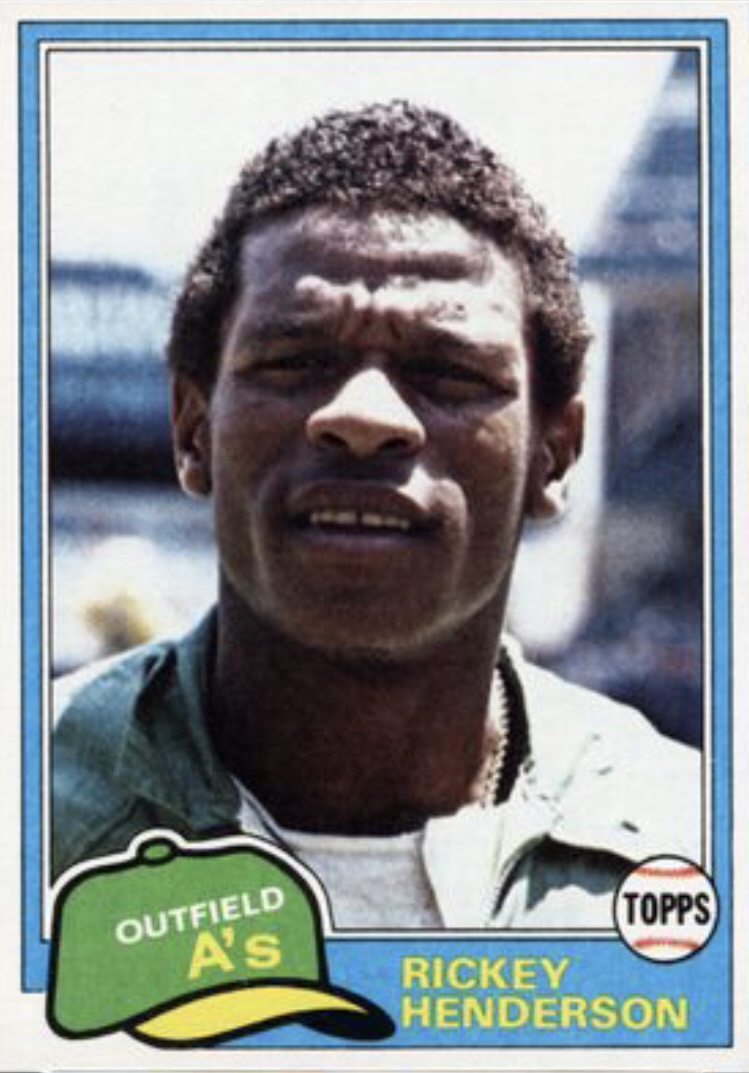
Rickey Henderson. (‘81) $625

1981 Topps #261 – Value: $300.00 – Grade: Mint

Breaks All-Time Stolen Base Record: https://youtu.be/bwQzsMXQ1HE

#51 of the Top 100 Players

Rickey Henley Henderson (Born in Oakland, CA on December 25, 1958-) holds the records for most stolen bases in a career (1,406), most stolen bases in a single season (130), most walks (2,190), most career runs (2,295) and most leadoff home runs (81). The ten-time All-Star selection played 25 seasons for nine teams, primarily with Oakland (1979-1984, 1989-1993, 1994-1995, 1998) and the Yankees (1985-1989). Rickey Henderson led the league twelve times in stolen bases, five times in runs and four times in walks. In 1990, Rickey Henderson was named the American League Most Valuable Player after posting a league leading 119 runs and 58 stolen bases while batting .325 with a league leading on-base percentage of .439 as he helped guide the A’s to a second straight AL pennant. Rickey Henderson was a Gold Glove winner in 1981, won three Silver Slugger Awards and was a member of two World Series champions with Oakland in 1989 and Toronto in 1993. Rickey Henderson’s amazing durability, surprising power and seemingly never-fading speed made him arguably the greatest leadoff batter and certainly the greatest base stealer of all-time. Rickey Henderson retired after compiling 3,055 hits, 2,295 runs, 1,115 RBI 297 home runs and 1,406 stolen bases with a .279 career batting average. Rickey Henley Henderson was elected to the National Baseball Hall of Fame in 2009.

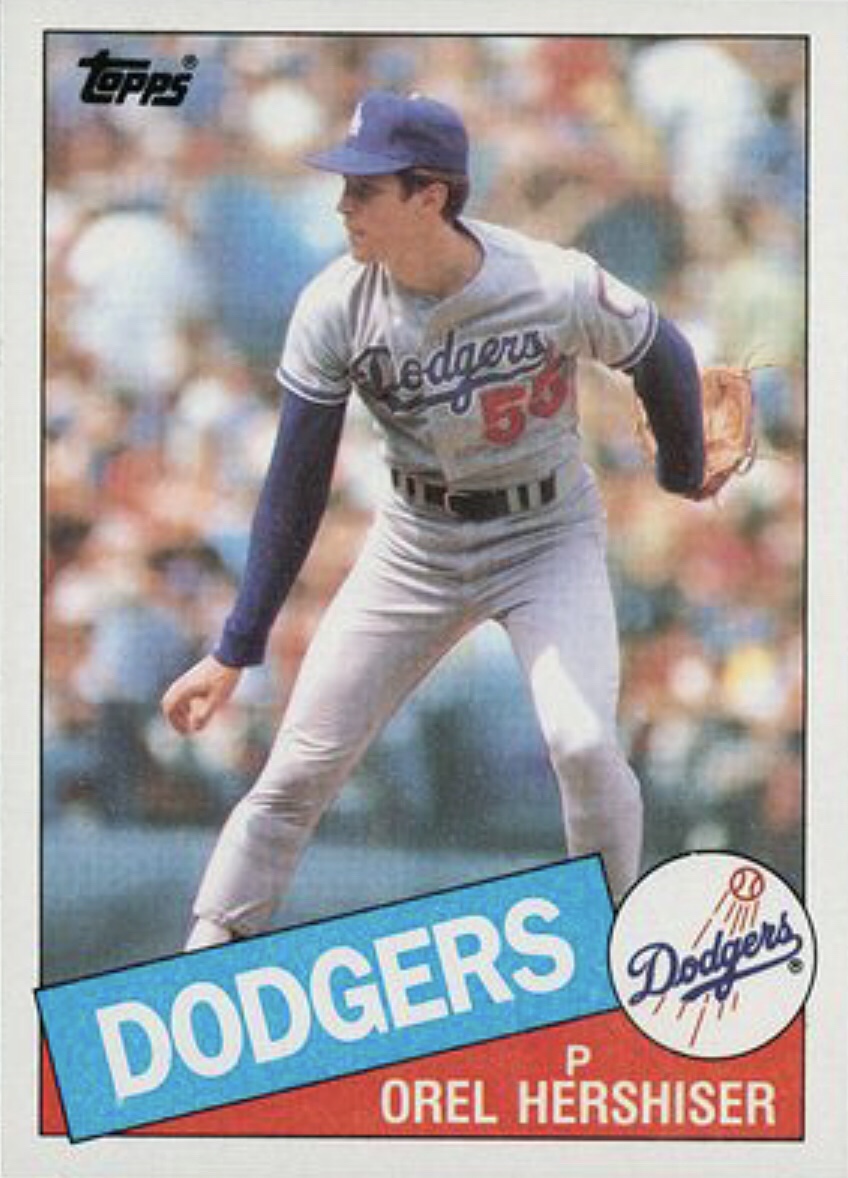
Orel Hershiser. (1985 RC) $153

1985 Topps #493 – Rookie Card
Value: $153.00 – Grade: Mint

Consecutive Scoreless Inning Record (59): https://youtu.be/fMBsI_Uow_Q

Orel Leonard Hershiser IV (Born in Buffalo, NY on September 16, 1958-) was a right-handed pitcher who delivered one of the best single seasons in Major League history in 1988, capturing a Gold Glove and Cy Young Award in 1988, as well as being named the 1988 National League Championship Series MVP and World Series MVP. He is the only player in history to receive the Cy Young and be named the NLCS and World Series MVP in the same season, The Los Angeles Dodgers selected Hershiser in the 17th round of the 1979. He made is big league debut at the end of the 1983 season, becoming a starter in the Dodger rotation in 1984. During a stellar career on the mound, Hershiser’s greatest season was arguably 1988, where he not only garnered a wealth of awards but also let the National League in wins (23), innings (267) and complete games (15), finishing the season with a 59 consecutive scoreless innings. He was also selected to the second of his three All-Star Game rosters. Having spent the bulk of his career with the Dodgers (1983-1994, 2000), Hershiser also played for the Cleveland Indians (1995-1997), San Francisco Giants (1998), and New York Mets (1999). While with the Indians, Hershiser posted a 16-6 record in 1995, helping the team make its first World Series appearance since 1954 and picking up the 1995 ALCS MVP. He retired with a 204-150 record, 3.48 ERA and 2,014 strikeouts.

HR Lead. (‘79 – Aaron/Maris). $140

1979 Topps #413 – Value: $140.00 – Grade: Mint

Vince Scully called Hank’s 715th Home Run: https://youtu.be/QjqYThEVoSQ

Henry Louis Aaron (Born in Mobile, AL on February 5, 1934 – January 22, 2021), nicknamed “Hammer” or “Hammerin’ Hank”, was an American professional baseball right fielder who played 23 seasons in Major League Baseball (MLB), from 1954 through 1976. Widely regarded as one of the greatest baseball players in history, he spent 21 seasons with the Milwaukee/Atlanta Braves in the National League (NL) and two seasons with the Milwaukee Brewers in the American League (AL). His 755 career home runs broke the long-standing MLB record set by Babe Ruth and stood as the most for 33 years; Aaron still holds many other MLB batting records. He hit 24 or more home runs every year from 1955 through 1973 and is one of only two players to hit 30 or more home runs in a season at least fifteen times. In 1999, The Sporting Newsranked Aaron fifth on its list of the “100 Greatest Baseball Players”. In 1982, he was inducted into the National Baseball Hall of Fame in his first year of eligibility. Aaron was born and raised in and around Mobile, Alabama. Aaron had seven siblings, including Tommie Aaron, who played major-league baseball with him. He appeared briefly in the Negro American League and in minor league baseball before starting his major league career. By his final MLB season, Aaron was the last Negro league baseball player on a major league roster. During his time in MLB, and especially during his run for the home run record, Aaron and his family endured extensive racist threats. His experiences fueled his activism during the civil rights movement. Aaron played the vast majority of his MLB games in right field, though he appeared at several other infield and outfield positions. In his last two seasons, he was primarily a designated hitter. Aaron was an NL All-Star for 20 seasons and an AL All-Star for one season, and he holds the record for the most All-Star selections (25), while sharing the record for most All-Star Games played (24) with Willie Maysand Stan Musial. He was a three-time Gold Glovewinner, and in 1957, he won the NL Most Valuable Player (MVP) Award when the Milwaukee Braves won the World Series. Aaron holds the MLB records for the most career runs batted in (RBIs) (2,297), extra base hits (1,477), and total bases (6,856). Aaron is also in the top five for career hits (3,771) and runs (2,174). He is one of only four players to have at least 17 seasons with 150 or more hits. Aaron is in second place in home runs (755) and at-bats (12,364), and in third place in games played (3,298). At the time of his retirement, Aaron held most of the game’s key career power-hitting records.

Breaks season Home Run Record in 1961 (61): https://youtu.be/mPKkRCR61ds

Roger Eugene Maris (Born in Fargo, ND on September 10, 1934 – December 14, 1985) was an American professional baseball right fielder. He is best known for setting a new Major League Baseball (MLB) single-season home run record with 61 home runs in 1961; the record remained unbroken until 1998. Maris played in the minor leagues from 1953 to 1956, and in the major leagues from 1957 to 1968. He reached the major leagues in 1957 as a player for the Cleveland Indians. He was traded to the Kansas City Athletics during the 1958 season, and to the New York Yankees after the 1959 season. Maris finished his playing career as a member of the St. Louis Cardinals in 1967 and 1968. Maris was an American League (AL) All-Star from 1959 through 1962, an AL Most Valuable Player in 1960 and 1961, and an AL Gold Glove Award winner in 1960. Maris appeared in seven World Series; he played for Yankees teams that won the World Series in 1961 and 1962 and for a Cardinals team that won the World Series in 1967. Maris’s home run record was controversial, as the previous single-season home run record (60, set by Babe Ruth in 1927) was set during a period when MLB teams played 154 games per season. Before Maris broke Ruth’s record, the AL baseball season had been extended to 162 games. Maris hit his 61st home run in the last game of the season, which led to questions about the legitimacy of his record. In 1998, Mark McGwire set a new MLB record with 70 home runs; in 2001, Barry Bonds surpassed that mark with 73, though both players have been suspected of using performance-enhancing drugs to do so. Maris continues to hold the American League record for most home runs in a season.

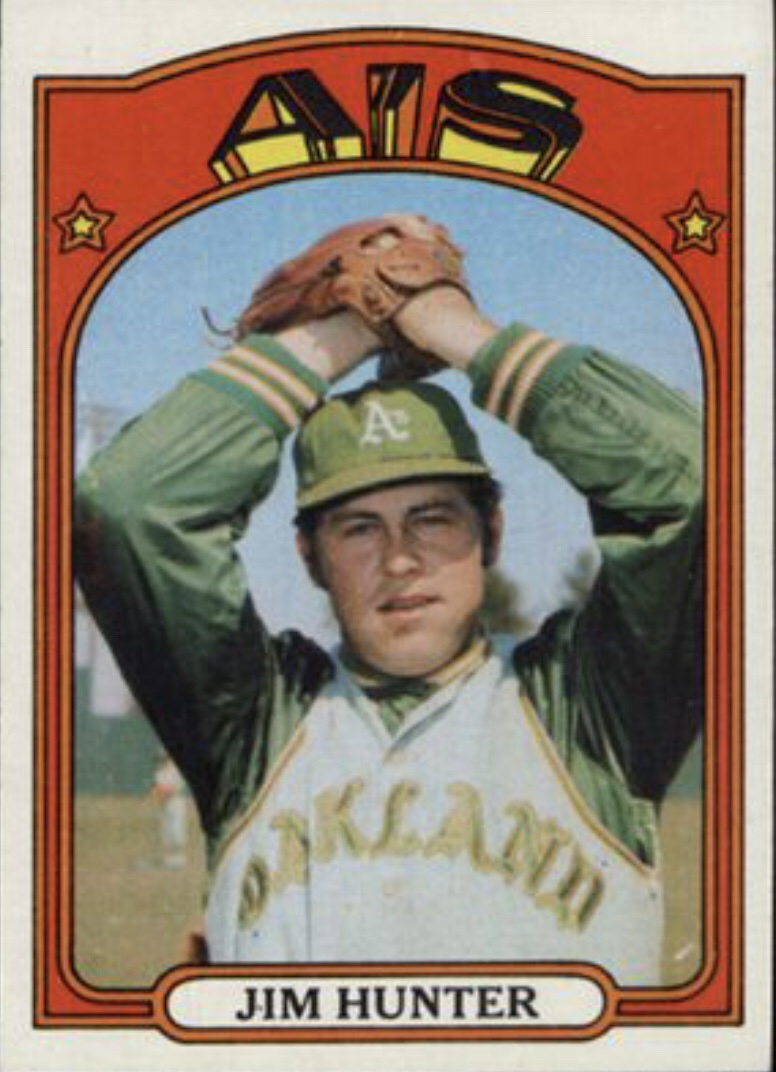
“Catfish” Hunter. (‘72). $1000

1972 Topps #330 – Value: $600 – Grade 10
Best Offer Above $500

Athletics Career Highlights: https://youtu.be/JRRGXGekAXI

James Augustus “Catfish” Hunter (Born in Hertford, NC on April 8, 1946 – September 9, 1999), Cy Young and Christy Mathewson are the only pitchers in history to have won 200 or more game by the age of 31. In 1965, Charles O. Finley, owner of the Kansas City A’s, hung “Catfish” on the young pitcher because he felt Jim needed a flashy nickname. From 1971-1975, Catfish won 21 games or more making him one of the most dominant pitchers in the AL. Hunter played for the Kansas City/Oakland A’s (1965-1967, 1968-1974) and the New York Yankees (1975-1979) where his led the league in wins twice (1974, 1975) and ERA once, when he captured the 1974 American League Cy Young Award. Hunter was a key factor in Oakland and New York’s success, leading them to five World Series championships in 1972, 1973, 1974 and 1977, 1978 respectively. The eight-time All-Star selection posted a record of 224-166 with 2,012 strikeouts and a career 3.26 ERA in 500 games. Arm troubles cut Hunter’s career short at the age of 33, and in 1999 Catfish died of Lou Gehrig’s Disease or ALS. James Augustus “Catfish” Hunter was elected to the National Baseball Hall of Fame in 1987.

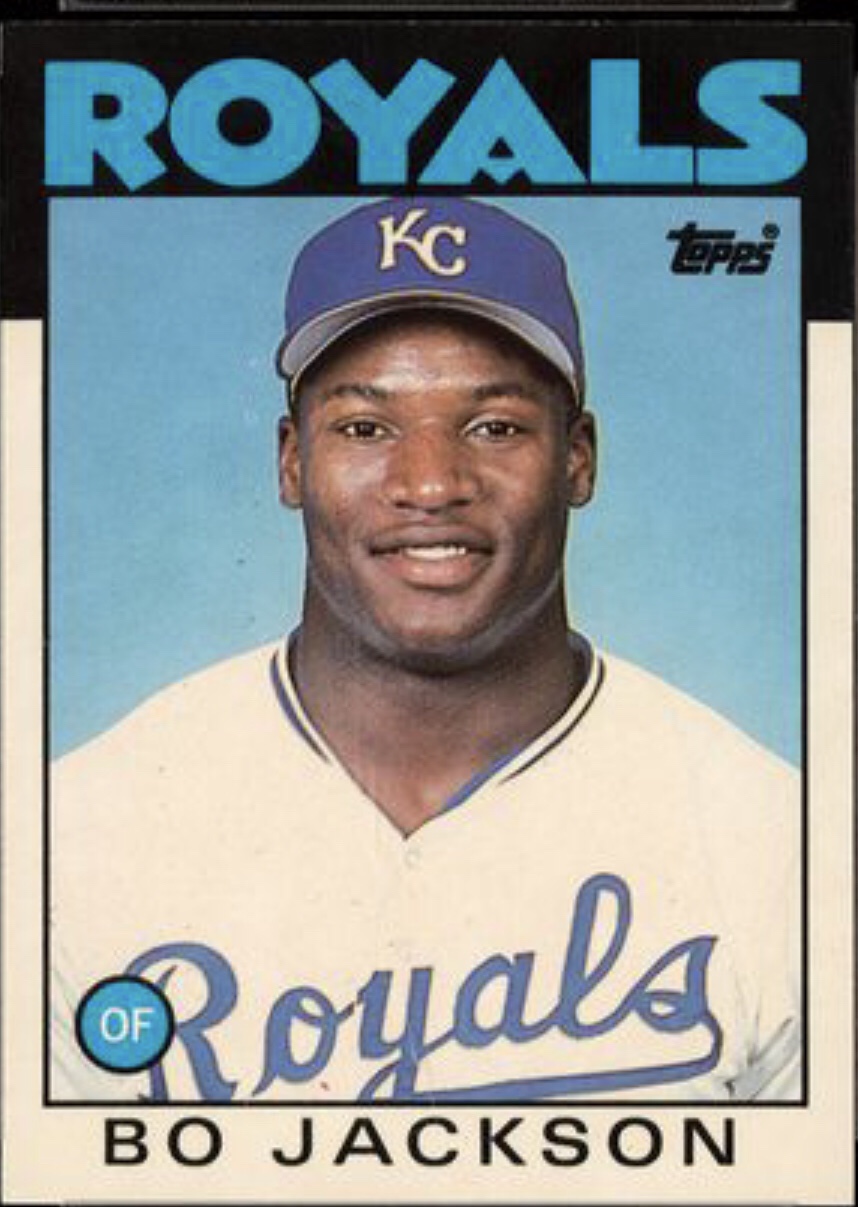
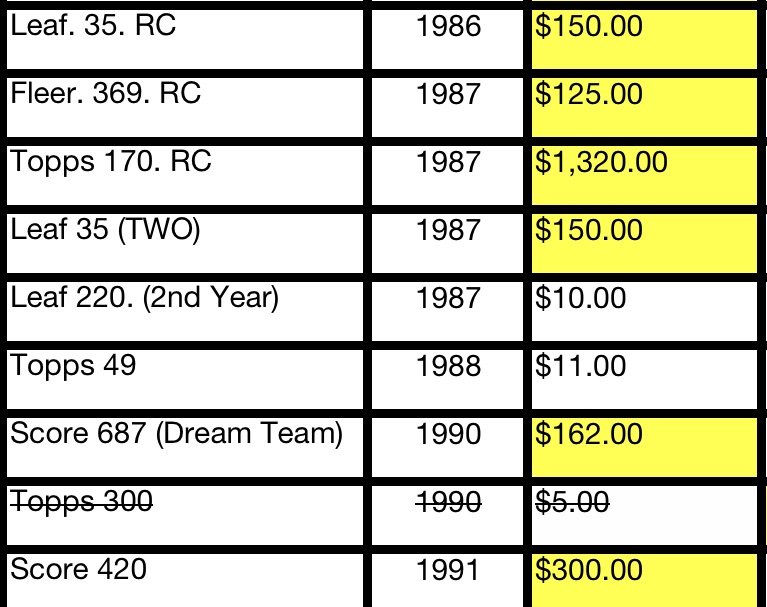
Bo Jackson. (1986 RC) $430

1986 Topps #50T – Rookie Card
Value: $200.00 – Grade: Mint

Most Naturally Gifted Athlete of All Time: https://youtu.be/X5F8yl1ubW0

Vincent Edward “Bo” Jackson (Born in Bessemer, AL on November 30, 1962-) is a Heisman Trophy winner, former Major League Baseball and National Football League player, and the first two-sport All-Star. Jackson played both baseball and football at Auburn University, and edged out University of Iowa quarterback Chuck Long for the 1985 Heisman Trophy. The Tampa Bay Buccaneers took Jackson in the 1st round (1st overall) of the 1986 NFL Draft, but Bo instead joined the Kansas City Royals (1986-1990), who had selected him in the 4th round of the 1986 MLB amateur draft. His best season on the diamond came in 1989, when he was voted to start for the American League All-Star team and earned Most Valuable Player honors. He and Wade Boggs also hit back-to-back home runs, becoming the first duo in All-Star history to lead off their side’s first inning with back-to-back homers. In a 1990 game against the Baltimore Orioles, Jackson performed his now-famous “wall run,” when he caught a ball a few strides away from the wall. As he caught the ball, he noticed the wall and began to run along it, almost parallel to the ground, and came down with the catch. He finished his career with the Chicago White Sox (1991, 1993) and California Angels (1994). In his eight baseball seasons, Jackson had a .250 batting average, hit 141 home runs, and had 415 RBI. Jackson was also a running back for the Los Angeles Raiders (1987-1990), where he rushed for 2,782 yards with 16 touchdowns. A 1990 post season tackle resulted in a hip injury that ended his football career and shortened his baseball career. In 1989 and 1990, Jackson’s name became known beyond just sports fans through the “Bo Knows” Nike advertising campaign to promote a cross-training athletic shoe named in his honor.

Additional Bo Jackson baseball cards:

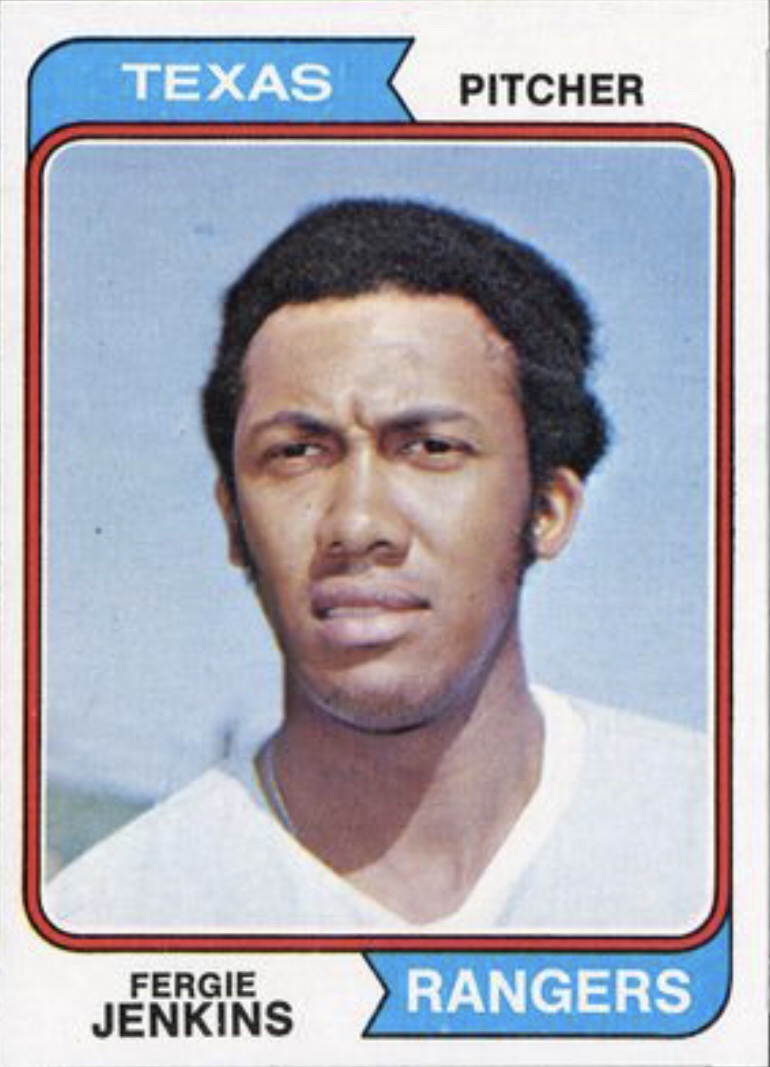
Ferguson Jenkins. (1974). $165

1974 Topps #87 – Value: $100.00 – Grade 9

Hall of Fame Biography: https://youtu.be/GBioKF9ezcI

Ferguson Jenkins (Born in Chatham, Ontario on December 13, 1943-) was the first Chicago Cubs pitcher and first Canadian to win the Cy Young Award. Fergie won 20 games in his first full season with the Chicago Cubs, earning a second place finish for the 1967 National League Cy Young Award voting, and award he would later win in 1971. He was also named the 1971 National League TSN Pitcher of the Year. The 1967 campaign began a stretch of six straight 20-win seasons, and seven out of eight from 1967-1974. Jenkins was a premier pitcher for 19 seasons primarily with the Chicago Cubs (1966-1973, 1982-1983), the Texas Rangers (1974-1975, 1978-1981) and the Boston Red Sox (1976-1977). Though somewhat prone to give up the long ball, leading the league in home runs allowed seven times, he was a workhorse who led the league in complete games four times, games started three times and twice in wins. The three-time All-Star selection is among three pitchers to record 3,000 strikeouts or more while allowing fewer than 1,000 walks in a career. Fergie Jenkins retired with a record of 284-226 with 3,192 strikeouts and a career 3.34 earned run average. Ferguson Jenkins was elected to the National Baseball Hall of Fame in 1991.

Derek Jeter. (1995 RC). $140

1995 Upper Deck #225 – Rookie Card
Value: $100.00 – Grade: Mint

Top Ten Moments: https://youtu.be/2xHpevdVa1U

Derek Sanderson Jeter (born in Pequannock Township, NJ on June 26, 1974) is an American former professional baseball shortstop, businessman, and baseball executive. He has been the chief executive officer (CEO) and part owner of the Miami Marlins of Major League Baseball (MLB) since September 2017. As a player, Jeter spent his entire 20-year MLB career with the New York Yankees. He was elected to the Baseball Hall of Fame in his first year of eligibility in 2020; he received 396 of 397 possible votes (99.75%), the second-highest percentage in MLB history (behind only Mariano Rivera) and the highest by a position player. A five-time World Series champion, Jeter is regarded as one of the primary contributors to the Yankees’ success of the late 1990s and early 2000s for his hitting, base-running, fielding, and leadership. He is the Yankees’ all-time career leader in hits (3,465), doubles (544), games played (2,747), stolen bases (358), times on base (4,716), plate appearances (12,602) and at bats (11,195). His accolades include 14 All-Star selections, five Gold Glove Awards, five Silver Slugger Awards, two Hank Aaron Awards, and a Roberto Clemente Award. Jeter was the 28th player to reach 3,000 hits and finished his career ranked sixth in MLB history in career hits and first among shortstops. In 2017, the Yankees retired his uniform number 2. The Yankees drafted Jeter out of high school in 1992, and he debuted in the major leagues at age 20 in 1995. The following year, he became the Yankees’ starting shortstop, won the Rookie of the Year Award, and helped the team win the 1996 World Series over the Atlanta Braves. Jeter continued to excel during the team’s championship seasons of 1998–2000; he finished third in voting for the American League (AL) Most Valuable Player (MVP) Award in 1998, recorded multiple career-high numbers in 1999, and won both the All-Star Game MVP and World Series MVP Awards in 2000. He consistently placed among the AL leaders in hits and runs scored for most of his career, and served as the Yankees’ team captain from 2003 until his retirement in 2014. Throughout his career, Jeter contributed reliably to the Yankees’ franchise successes. He holds many postseason records, and has a .321 batting average in the World Series. Jeter has earned the nicknames “Captain Clutch” and “Mr. November” due to his outstanding play in the postseason. Jeter was one of the most heavily marketed athletes of his generation and is involved in numerous product endorsements. As a celebrity, his personal life and relationships with other celebrities have drawn the attention of the media.

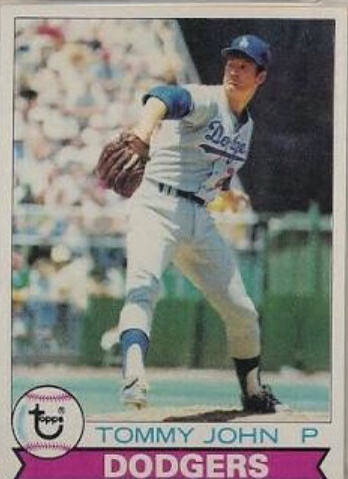
Tommy John. (1979). $53

1979 Topps #255 – Value: $53.00 – Grade: 9

How Tommy John Surgery Got Its Name: https://youtu.be/XH4QFue0lLk

Thomas Edward John Jr. (born in Terre Haute, IN on May 22, 1943), nicknamed “The Bionic Man,” is an American retired professional baseball pitcher who played in Major League Baseball (MLB) for 26 seasons between 1963 and 1989. He played for the Cleveland Indians, Chicago White Sox, Los Angeles Dodgers, New York Yankees, California Angels, and Oakland Athletics. He was a four-time MLB All-Star and has the second-most wins (288) of any pitcher since 1900 not in the Hall of Fame. Known for his longevity, John was the Opening Day starter for both the 1966 Chicago White Sox and the 1989 New York Yankees. At the age of 18, in 1961, John was signed by the Indians, who were impressed with his curveball. After three seasons in the minor leagues for them, he was called up for the first time in 1963. He pitched two seasons for Cleveland before getting traded to the White Sox, with whom he would spend seven seasons. He established himself as a major league starter in 1965 and became Chicago’s Opening Day starter in 1966. In 1968, he finished fifth in the American League (AL) with a 1.98 earned run average (ERA) and was named to his first All-Star team, though he missed the end of the season after he was injured in a fight with Dick McAuliffe. In 1971, pitching coach Johnny Sain tried to have John throw a slider more, but John had his highest ERA since 1964 and was traded to the Dodgers for Dick Allen after the season. He won 11 games in 1972 with the Dodgers, then led the National League (NL) in winning percentage over the next two seasons. In 1974, though, he suffered a potentially career-ending injury when he tore his ulnar collateral ligament (UCL) in a game against the Montreal Expos. Dr. Frank Jobe, the Dodger physician, performed ligament replacement surgery on John later that year. He missed the 1975 season recovering from surgery, but he became the first pitcher to successfully return to baseball following such surgery. Tommy John surgery has since become a common procedure among baseball pitchers, with one out of seven MLB pitchers in 2012 having received it at some point during their careers. John had a 10–10 record his first year back from the surgery. In 1977, John had his first career 20-win season, going 20–7 with a 2.78 ERA as the Dodgers won the NL West and reached the 1977 World Series. He helped the Dodgers return to the World Series in 1978 with a 17–10 record before leaving for the Yankees as a free agent. With the Yankees, John posted 20-win seasons in 1979 and 1980; he was an All-Star in those years as well as in 1978, his final year with the Dodgers. He appeared in three World Series contested between the Dodgers and Yankees, his only World Series appearances, and pitched for the losing team in all three. He was traded to the California Angels in 1982, for whom he made two starts in the AL Championship Series. He remained with the team until 1985, when he was released, though he spent the second half of the season pitching for the Oakland Athletics. Unsigned to begin 1986, it appeared that John’s career might be over, but injuries to Yankee pitchers prompted New York to re-sign him. John won 13 games for the Yankees in 1987, then became the oldest player in baseball in 1988 following Phil Niekro’s retirement. In 1989, he tied Deacon McGuire’s record for most seasons pitched (26, later broken by Nolan Ryan) before retiring. From 1995 through 2009, John was on the Hall of Fame ballot; he never received more than 31.7% of the votes (75% is required for election) but remains eligible to be chosen by the Modern Era Subcommittee of the Veterans Committee. He served as a broadcaster for the Minnesota Twins and the Yankees in the 1990s, then managed the Bridgeport Bluefish from 2007 through the first half of the 2009 season. Since retiring, he has served as a motivational speaker and also founded the “Let’s Do It” Foundation, dedicated to raising awareness about suicides and preventing them.