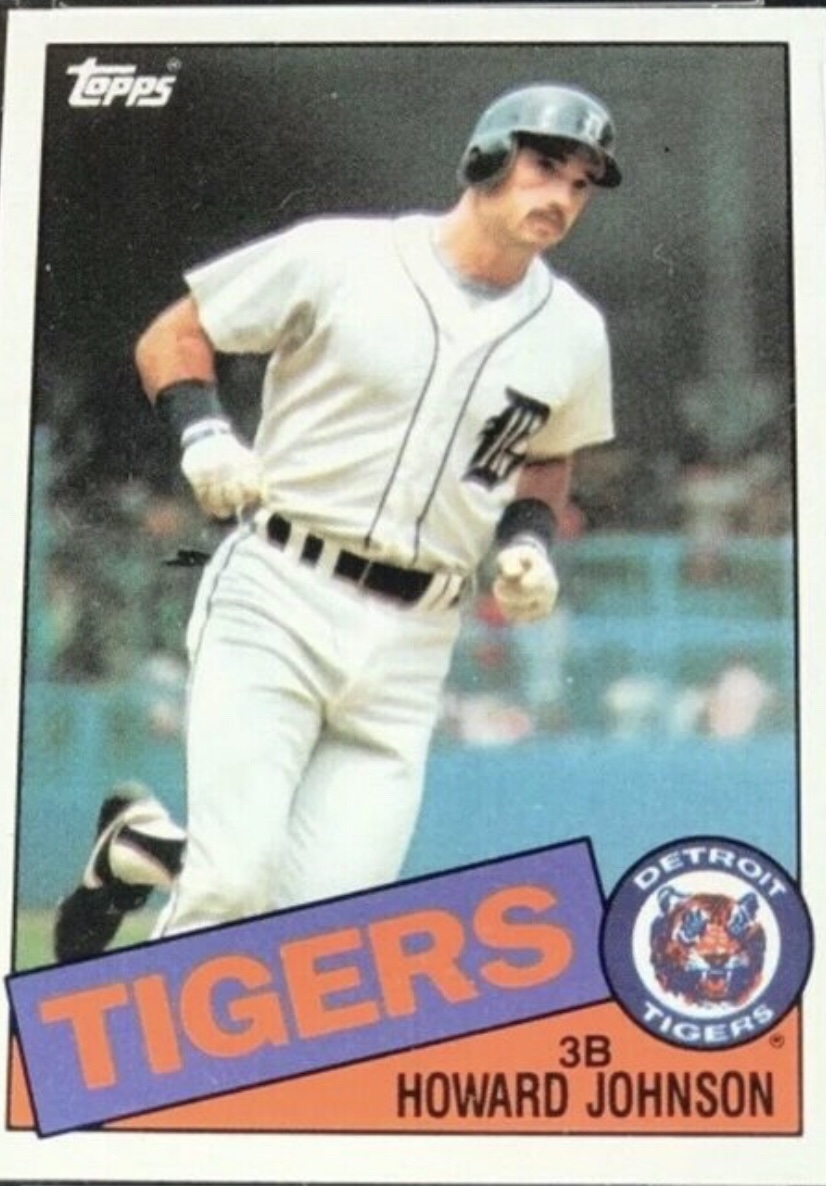
Howard Johnson. (1985). $77

1985 Topps #192 – Value: $77.00 – Grade: 9

1987 Highlights: https://youtu.be/BbxSDXNwDa8

Howard Michael Johnson (born in Clearwater, FL on November 29, 1960), nicknamed HoJo (the nickname of the otherwise unrelated Howard Johnson’s company), is an American former professional baseball third baseman. He played for the Detroit Tigers, New York Mets, Colorado Rockies, and Chicago Cubs of the Major League Baseball (MLB) from 1982 to 1995. He is third on the Mets’ all-time lists for home runs, runs batted in, doubles, and stolen bases. He also played for the Rockland Boulders of the Canadian-American Association of Professional Baseball. On July 13, 2007, he was promoted from his position as the Mets’ first base coach to their hitting coach which he held until the end of the 2010 season. From 2014 to June 2015, he was the hitting coach of the Seattle Mariners after starting 2013 as the batting instructor for the Tacoma Rainiers, the Mariners’ Triple-A affiliate. In the minor leagues, the Tigers soon converted Johnson from a pitcher to an infielder, and in 1981, he hit 22 home runs for the AA Birmingham Barons. He was promoted to Detroit to start 1982, but was hitting only .188 in early May when he was sent back to AAA. He was back in the majors in mid-August and posted fantastic numbers for the rest of the season, including a .405 average in September that raised his final average to .316. He started 1983 with the big club but was sent down again in late May with a .212 averagIn 1984, Johnson was back with the Tigers and was made the left side of a platoon with Tom Brookens. Johnson started fairly well but had a poor second half. He finished the regular season with a .248 batting average, 50 runs batted in (RBI) and 12 homers in 355 at bats. The Tigers led the division for the entire campaign but Johnson sat the bench for the entire 1984 ALCS while Brookens, Marty Castillo and Darrell Evans split time at third. Johnson wound up pinch-hitting only once in the 1984 World Series, reaching on an error by second baseman Alan Wiggins as the Tigers eased through the postseason en route to the world championship. Johnson was traded from the Tigers to the New York Mets for Walt Terrell at the Winter Meetings on December 7, 1984. The move put three players at third base for the Mets but, three days later, they sent Hubie Brooks to the Montreal Expos as part of a trade for catcher Gary Carter. Johnson’s inability to hit well from the right side resulted in him being platooned by the Mets in 1985, this time with Ray Knight. Both started terribly and neither reached .200 until early July. Johnson hit below average all season, while Knight was even worse. The Mets, as they had in 1984, narrowly missed the postseason in 1985. 1986 was the year of the Mets and both Johnson and Knight started very well. The Mets’ problems shifted from third base to shortstop as Rafael Santana struggled to keep his average above .150 most of the season. Johnson was a capable shortstop defensively and picked up extra playing time moving between short and third but his hitting started declining in May. Between his mediocre hitting, continued lack of power, and an injury that wiped out three weeks in June, Johnson played in only 88 games in the regular season. When he returned from the June injury, Johnson went on a home run tear including two in his first game back and, within six weeks, his slugging percentage jumped from .376 to .510. One of Johnson’s home runs occurred in a legendary game on July 22, 1986, against the Cincinnati Reds. When a 10th-inning bench-clearing fight ended, three Mets players were out of the game and they were forced to spend the rest of the game with a pitcher in the outfield and two pitchers in the batting lineup. When one of the pitchers, Jesse Orosco, drew a walk in the 14th inning, Johnson followed with a three-run home run that led to a Mets win. Johnson faded down the stretch and was virtually shut out of the postseason, going 0-for-7 in four games. His only start was Game 2 of the 1986 World Series, when he went 0-for-4 in a crucial Mets loss that put them in an 0–2 hole. His only other at bat in the series was in Game 6, when he struck out in the ninth inning. Nevertheless, at age 25, Johnson already had his second World Series ring. Ray Knight was allowed to become a free agent after the 1986 World Series. Johnson, given sole ownership of the third base position, began a three-month power surge in mid-May. In 10 games, he hit five home runs, including a pair of three-run shots, with 13 RBI. In an 11-game span a month later, he hit another six home runs with 10 RBI. In seven games around the all-star break, he hit another six home runs and seven RBIs, raising his slugging percentage over .520. With his 22nd home run of the season in mid-July, the previously light-hitting Johnson took over the team home run lead from Darryl Strawberrywhile hitting from the seventh spot in the batting order. He ended July with six RBIs in seven games along with a four-hit game, and then started August with a grand slam. In a 13-game span in late July and early August, he had at least one RBI in all but one game and amassed 17 RBIs overall. Three games in mid-August brought another three home runs and seven RBIs, but the power tear was about over for his breakout season. Johnson’s power surge was complemented by a surge in speed. Although he had 31 stolen bases in five previous seasons, on September 11, 1987, Johnson stole his 30th base to join the 30–30 clubfor the first time. Johnson became the first switch-hitter to join the club, and he and Strawberry became the only teammates to achieve 30–30 status in the same season. Another grand slam in September brought Johnson’s home run total to 36, just four shy of his entire career before 1987. Unfortunately for the Mets, as Johnson’s power faded, so did their run at the postseason and the defending champions missed the playoffs. The entire league took notice of Johnson’s unexpected rise in 1987 and he received 42 points in the voting for National League MVP. His home run and RBI totals were second only to Strawberry on the team and his home runs were seventh-best in the entire majors. His right-handed hitting was substantially better than his left-handed hitting with numbers better in almost every category including a batting average 36 points higher and slugging 74 points higher. His 36 home runs overall were the most in National League history by a switch-hitter, breaking Ripper Collins’ 53-year-old record.
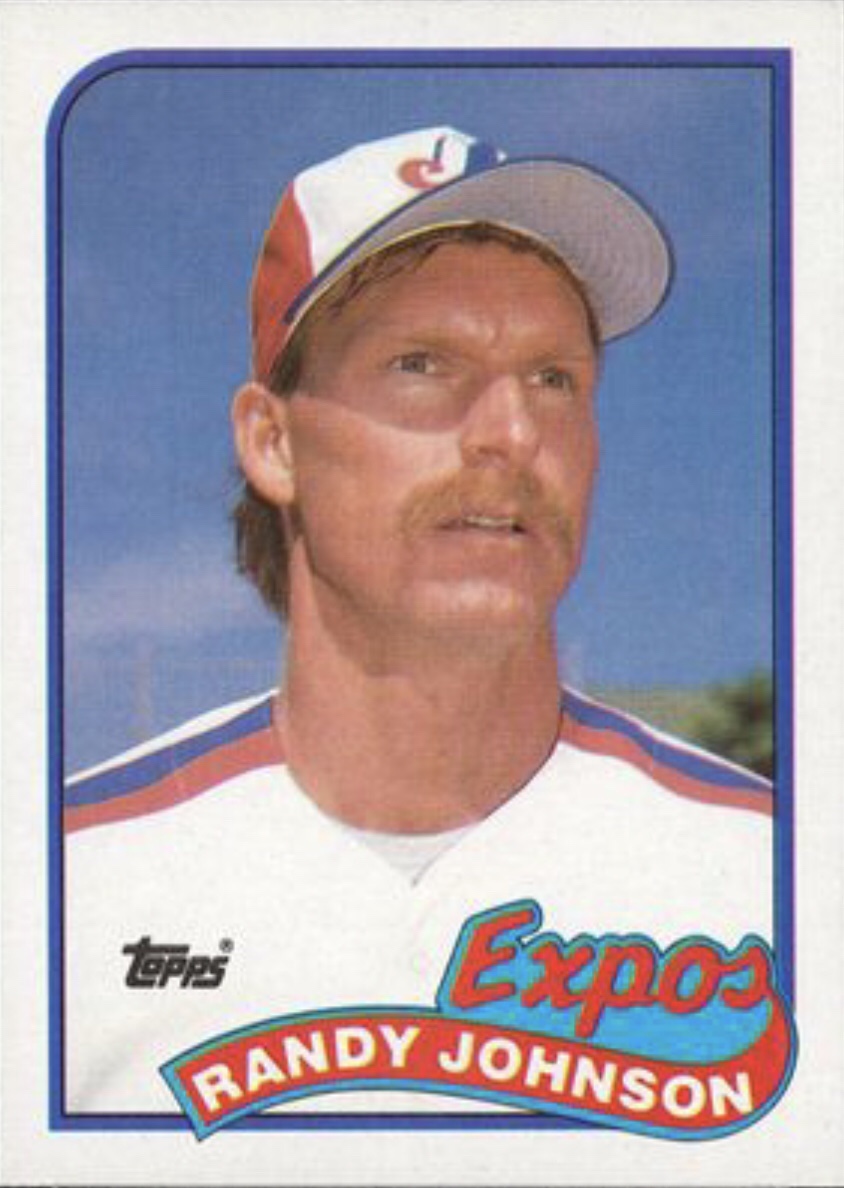
Randy Johnson. (1989 RC). $179

1989 Topps #647 – Rookie Card
Value: $50.00 – Grade: 10

All 27 Outs from his Perfect Game (5/18/2004): https://youtu.be/WlcpDVlsJjg

Randall David “Randy” Johnson (September 10, 1963-) established himself as one of baseball’s most dominant pitchers, playing for six different teams during a 22-year career and capturing five Cy Young Awards. The Montreal Expos drafted Johnson in the second round of the 1985 Major League Baseball Draft. He made his debut with the Expos (1988-1989), Seattle Mariners (1989-1998), Houston Astros (1998), Arizona Diamondbacks (1999-2004, 2007-2008), New York Yankees (2005-2006), and San Francisco Giants (2009). In 1992, Johnson struck out 18 batters in eight innings while throwing 160 pitches – a pitch count that has not been reached in a Major League game since. Nicknamed “The Big Unit,” Johnson was a 10-time All-Star and 2002 Triple Crown winner. Johnson finished his career with a 303-166 record, 3.29 ERA, and 4,875 strikeouts. He ranks first in strikeouts per nine innings pitched among starting pitchers (10.67), second all-time in total strikeouts (4,875; first among left-handed pitchers), third in hit batters (188), and tenth in fewest hits allowed per nine innings pitched (7.24). He pitched two no-hitters (1990, 2004), the second of which was the 17th perfect game in baseball history. Randy Johnson is only the second player in Major League history to win four consecutive Cy Young Awards (1999-2002). Greg Maddux was the first. Randy Johnson was inducted into the National Baseball Hall of Fame in 2015.

Other Randy Johnson cards in my collection:

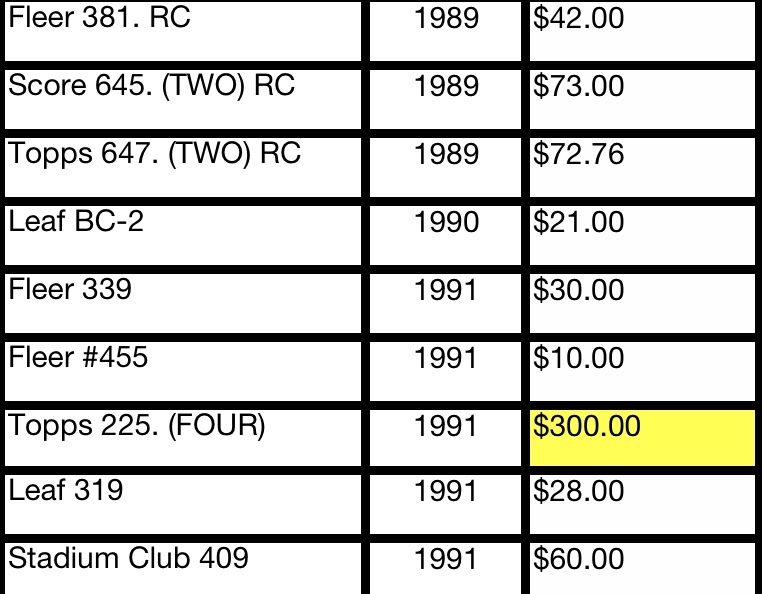
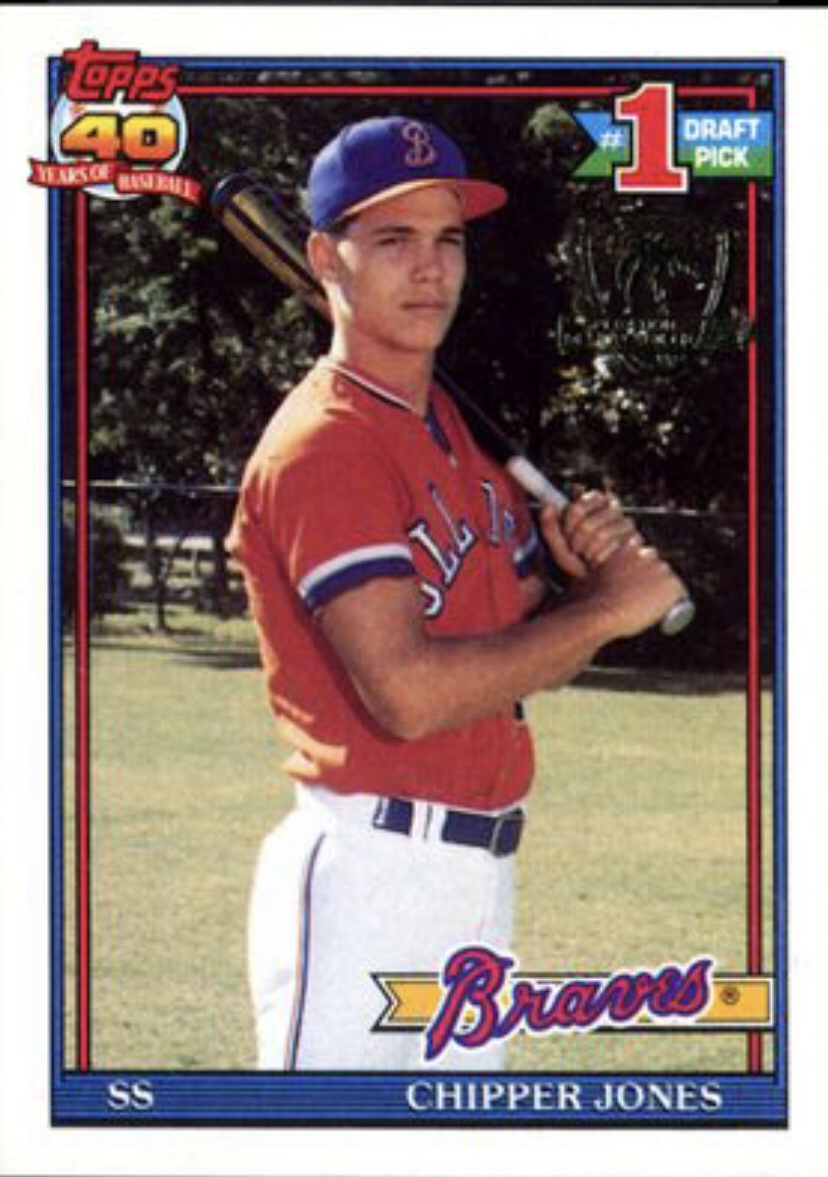
Chipper Jones. (‘91 RC). $90

1991 Topps #333 – Rookie Card
Value: $60.00 – Grade: Mint

Road to Cooperstown: https://youtu.be/RbOJx-fb5hU

Larry Wayne “Chipper” Jones (Born in Pierson, FL on April 24, 1972-) debuted for the Atlanta Braves on a September call-up in 1993, becoming the youngest player in the league at the time, but went on to become the second greatest Brave of all-time behind Hank Aaron. Only Aaron played more games and spent more seasons wearing a Braves uniform. Atlanta took Chipper with the #1 overall pick of the 1990 MLB June Amateur Draft as a shortstop. Jones blew out his ACL during spring training in 1994 forcing him to sit out for the entire 1994 season. In 1995, Chipper, who had played at various positions early on, won the starting job at third base after the departure of All-Star Terry Pendleton. Jones made the most of his new position as he batted .265 with 23 home runs, earning MVP consideration and finishing second in the National League Rookie of the Year race. He also helped the perennial contending Braves over the hump as they defeated the Cleveland Indians in six games. The big, strong switch-hitter had his first .300+ season in his sophomore year and is the only Major League switch-hitter to average .300 or better for his career. The Atlanta Braves utilized Jones as needed as his career progressed; playing left field after the Braves acquired third bagger Vinny Castilla only to return to third two years later. He was a fan favorite, a favorite among teammates and a player’s player displaying not only an exceptional ability at whatever position he fielded, but as an ambassador of the game as well as through his community contributions. Chipper is an eight-time National League All-Star, has won two NL Silver Slugger Awards and in 1999 won the National League’s Most Valuable Player Award. He also took home the Players Choice Award, voted on by his fellow Major Leaguers. Though he has enjoyed better numbers at other times during his career, in the 1999 campaign, Chipper batted .319 with 181 hits including a career-high 45 home runs, scored 116 runs, stole a career-high 25 bases and drove in 110 runs. In 2008, Jones won the batting title as he hit .364 with a .470 slugging percentage. Over the course of his 19-year career in Atlanta, Jones has posted a .957 career fielding percentage with 1,771 putouts, 3,581 assists, 301 double plays and 243 errors in 5,595 chances. Chipper Jones ended his career with a .303 batting average, 2,726 hits including 549 doubles and 468 home runs, has scored 1,619 runs, stolen 150 bases and driven in 1,623 RBI. Chipper Jones was inducted into the Baseball Hall of Fame as a member of the Class of 2018.

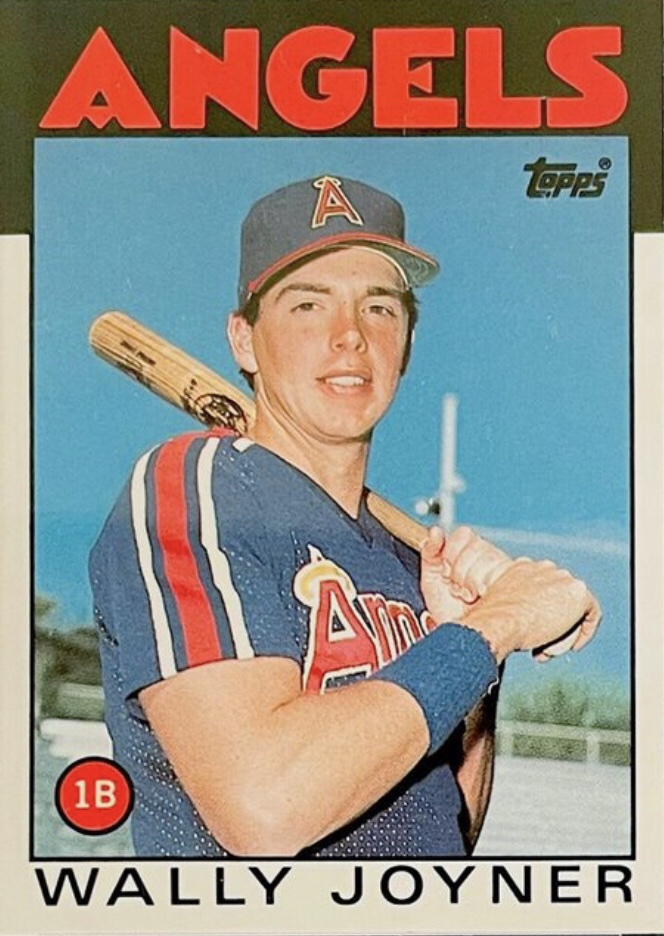
Wally Joyner. (1986 RC). $50

1986 Topps #51T – Rookie Card
Value $50.00 – Grade: 9

A Legend: https://youtu.be/k4QVBhEWTiI

Wallace Keith Joyner (born in Atlanta, GA on June 16, 1962) is an American former professional baseball player. He played for four major league teams during a 16-year career, most notably for the California Angels, for whom he was an All-Star. He was a member of the pennant-winning 1998 San Diego Padres. During his rookie season in MLB with the California Angels, Joyner became a fan favorite and briefly inspired a sensation in which Anaheim Stadium was dubbed “Wally World”. The film National Lampoon’s Vacation had featured a fictional theme park by that name, and the Angels’ proximity to Disneyland may also have helped inspire the moniker. Additionally, ESPN announcer Chris Berman famously called him Wally “Absorbine” Joyner, a nickname that stuck. Joyner was the starting first baseman in the 1986 All-Star Game, becoming the first rookie to be voted into the All-Star Game by the fans. Joyner tied Darryl Strawberry for first place in that year’s Home Run Derby. When the Angels met the New York Yankees in a game in August 1986, a fan threw a knife at Joyner. Joyner was grazed on the left arm by the butt end of the weapon, escaping injury. Joyner broke up two no-hit bids in the ninth during the 1986 season. Against the Texas Rangers on June 16, he foiled Charlie Hough’s bid with a single with one out in the ninth, scoring Jack Howell (who had reached on a three-base error) to tie the game at 1–1. Joyner, whose hit would be the Angels’ only one of the game, eventually scored the winning run on Orlando Mercado’s passed ball for a 2–1 Angels victory. Against the Detroit Tigers on August 20, Joyner broke up Walt Terrell’s bid for a no-hitter by doubling with two out in the ninth; this would also be the Angels only hit in losing to the Tigers 3–0. Joyner and the Angels advanced to the 1986 American League Championship Series, where they came within one strike of reaching the franchise’s first World Series. At the end of the 1986 season, Joyner was the runner-up in the voting for the Rookie of the Year Award, losing to José Canseco. On October 3, 1987, Joyner hit three solo home runs against the Indians in a 12-5 victory on the next to last day of the season. He finished the 1987 season with 34 home runs and 117 RBI, both career highs.

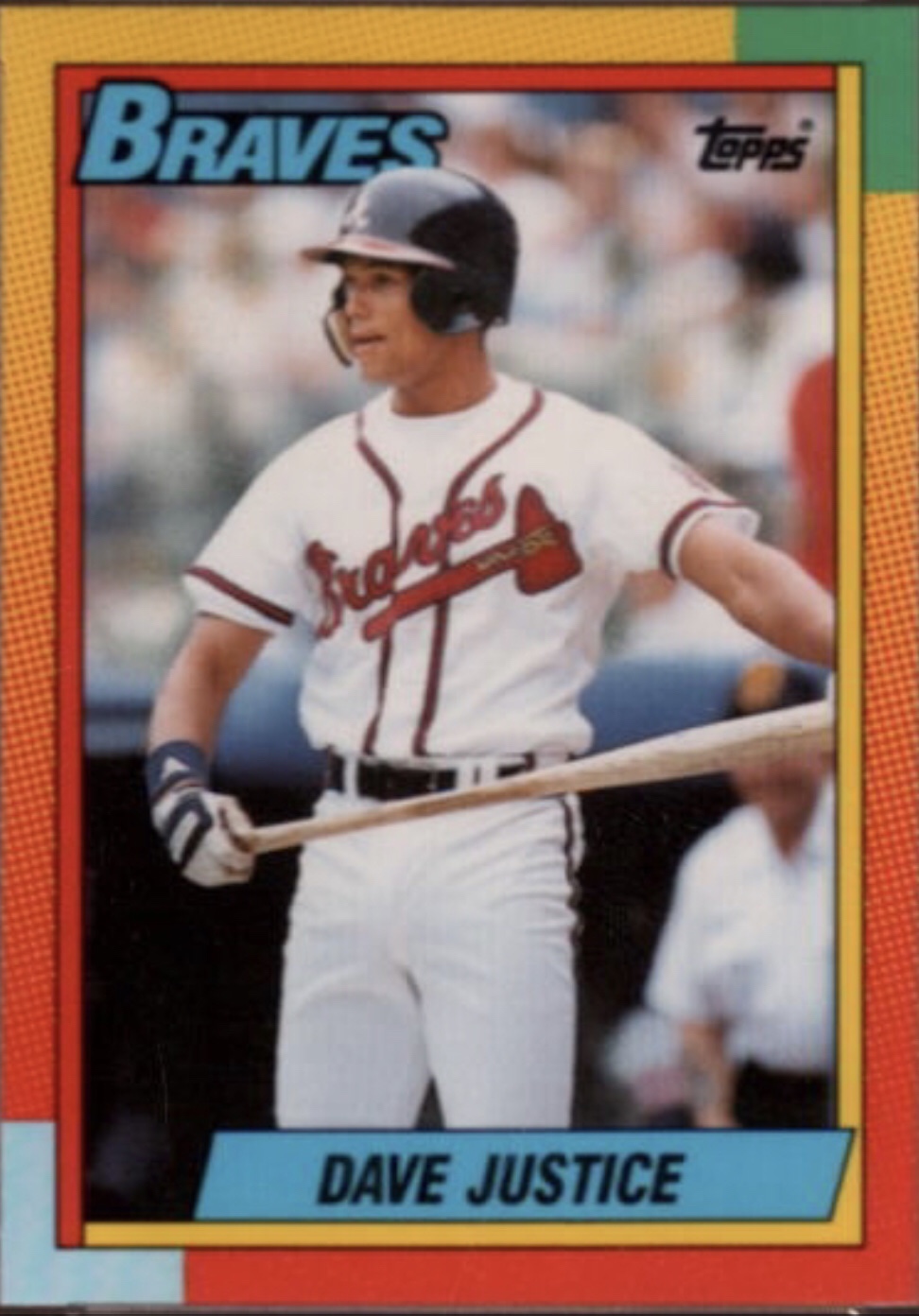
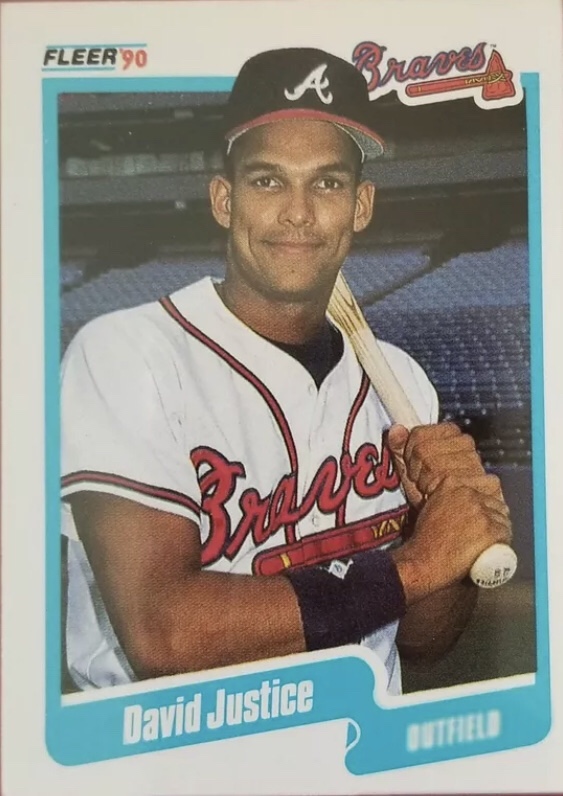
David Justice. (1990 RCs). $1,000

1990 Topps #48T – Rookie Card
Value: $1,000.00 – Grade: Mint
1990 Fleer #586 – Rookie Card
Value: $100.00 – Grade: Mint
Closest Offer to $100.00

MLB Highlights: https://youtu.be/vXF8McaBUJA

David Christopher Justice (born in Cincinnati, OH on April 14, 1966) is an American former professional baseball outfielder and designated hitter in Major League Baseball who played for the Atlanta Braves (1989–1996), Cleveland Indians (1997–2000), New York Yankees (2000–2001), and Oakland Athletics (2002). Justice won the National League Rookie of the Year Award in 1990, and was a three-time MLB All-Star. Justice made his major league debut in May 1989, playing for the Atlanta Braves. The then 23-year-old right fielder earned the starting job after Braves fan favorite Dale Murphy was traded to the Philadelphia Phillies in August 1990. Justice promptly went on an offensive tear during the second half of the season, finishing with 28 home runs, which helped him claim the National League’s Rookie of the Year Award. In 1991, the upstart Braves surged to the top of their division and Justice was leading the National League in runs batted in when he was sidelined by a nagging back injury in June. He finished with 87 runs batted in despite the injury and played in his first World Series. After seeing his production slide slightly in 1992, Justice enjoyed a solid 1993 season. He clubbed 40 home runs and 120 runs batted in (RBIs) with 78 walks, finishing third in MVP voting behind Barry Bonds and Lenny Dykstra. Justice was batting .313 with a .427 on-base percentage and .531 slugging average when the strike ended play in 1994. When baseball returned in 1995, Justice helped his Braves to the World Series against the Cleveland Indians. He drew attention (and boos) when he criticized Atlanta fans for the level of support they were providing the team. However, Justice ended up a hero when his crucial home run in Game 6 provided the only run in a 1–0 game that clinched the championship. In May 1996, a swing and miss in a game against the Pittsburgh Pirates caused a season-ending shoulder separation.

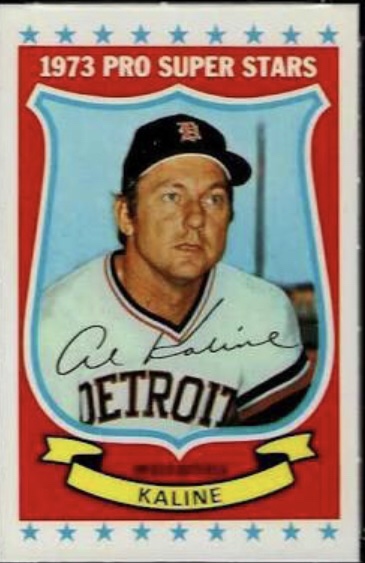
Al Kaline. (1973) $110

1973 Kellogg’s #52 – Value: $110.00 – Grade: 8

A Tribute: https://youtu.be/X1qVG6MGtwA

#76 of the Top 100 Players

Albert William Kaline (born in Baltimore, MD on December 19, 1934 – April 6, 2020), nicknamed “Mr. Tiger”, was an American professional baseball right fielderwho played 22 seasons in Major League Baseball (MLB) for the Detroit Tigers. For most of his career, Kaline played in the outfield, mainly as a right fielder where he won ten Gold Glove Awards and was known for his strong throwing arm. He was selected to 18 All-Star Games, including selections each year between 1955 and 1967. He was elected to the Baseball Hall of Fame in 1980, his first time on the ballot. Kaline bypassed Minor League Baseball and joined the Tigers directly from high school as an 18-year-old “bonus baby” signee, receiving $35,000 ($338,551 in 2020 dollars) to sign with the team. The Detroit scout who had tracked him through high school, Ed Katalinas, said “To me he was the prospect that a scout creates in his mind and then prays that someone will come along to fit the pattern. “He made his major league debut on June 25, 1953 in Philadelphia as a late-inning replacement for outfielder Jim Delsing. Kaline wore number 25 during his rookie campaign, but asked teammate Pat Mullin for his No. 6 after the 1953 season ended. Kaline wore the number for the rest of his major league playing career. In 1955, at age 20, Kaline ended the season with a .340 batting average, becoming the youngest player ever to win the American League (AL) batting title. No 20-year-old major league player had won a batting title since Ty Cobb in 1907. During the 1955 season, Kaline became the 13th man in major league history to hit two home runs in the same inning, became the youngest to hit three home runs in one game, and finished the year with 200 hits, 27 home runs and 102 runs batted in (RBIs). He also finished second to Yogi Berra in the American League’s 1955 Most Valuable Player Awardvoting. He was selected to the Major League Baseball All-Star Game, the first in a string of consecutive All-Star selections that lasted through 1967. Kaline followed in 1956 with a .314 batting average, 27 home runs and a career-high 128 RBIs, finishing third in the AL MVP voting. He led the league in outfield assists with 18 in 1956 and again in 1958 with 23. In 1957, he won the first of what would be ten Gold Glove Awards over the next eleven seasons. Kaline was out for several games in 1958 after he was hit by a pitch. He missed several games in 1959 after he was hit by a thrown ball and sustained a fracture in his cheekbone. Kaline had been knocked out from the blow and initial speculation was that he could miss six weeks of the season. Kaline ended up missing only 18 games, and finished the 1959 season with a .327 batting average and 27 home runs. He also led the AL in slugging percentage (.530) and OPS (.940).

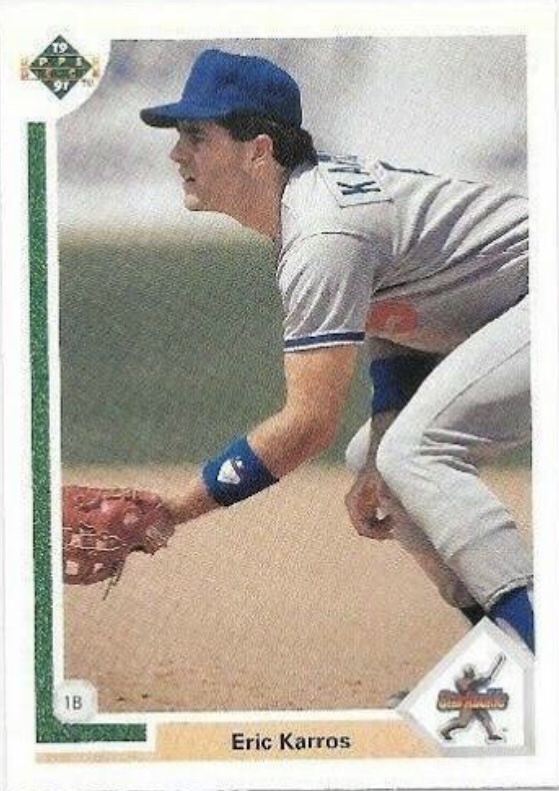
Eric Karros. (1990 RC). $24

1990 Upper Deck #24 – Rookie Card
Value $24.00 – Grade: 9

Life on Tour: https://youtu.be/qM7fTqf7JSA

Eric Peter Karros (born in Hackensack, NJ on November 4, 1967) is an American former professional baseball first baseman. Karros played in Major League Baseball (MLB) from 1991 to 2004 for the Los Angeles Dodgers, Chicago Cubs, and Oakland Athletics. He was the National League Rookie of the Year in 1992 and won a Silver Slugger Award in 1995. Karros was selected by the Los Angeles Dodgers in the sixth round of the 1988 Major League Baseball draft. He made his Major League debut as a pinch runner on September 1, 1991, against the Chicago Cubs. He made his first start, at first base, on September 4, 1991, against the St. Louis Cardinals, when he was 0-for-3 with two strikeouts. Karros recorded his first Major League hit as a pinch hitter in the bottom of the 12th inning against Cincinnati Reds pitcher Milt Hill on September 16, 1991. It was a two-run RBI double to left field, his only hit in 14 batting appearances during the 1991 season. In his first at-bat of the 1992 season, on April 9 against the San Diego Padres, Karros hit a two-run shot to deep left field off of Craig Lefferts for his first career home run. He became a full-time starter for the Dodgers that season, appearing in 149 games and hitting 20 home runs while driving in 88 runs. He was named the 1992 National League Rookie of the Year. Karros put up consistent numbers throughout his career with the Dodgers, with a batting average just under .270 and an average of almost 25 home runs a year. He became the third Dodgers player in history to record 30 home runs and 100 RBI in five different seasons (alongside Duke Snider and Gil Hodges). Karros also remains the only player in Dodgers history to hit two homers in the same inning, accomplishing the feat on August 22, 2000. 1999 was his best statistical year with the Dodgers, when he hit .304 with 34 home runs and 112 RBI. His career 270 home runs as a Los Angeles Dodger are the most since the team moved to Los Angeles, and third in all-time Dodgers history.

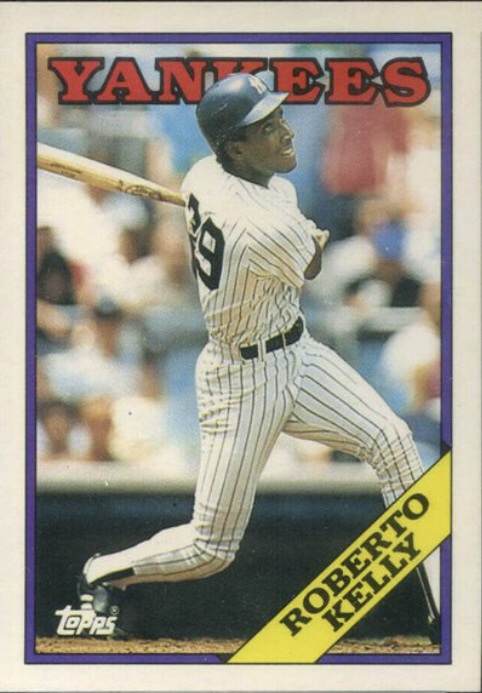
Roberto Kelly. (1988 RC). $95

1988 Topps #56T – Rookie Card
Value: $95.00 – Grade: Mint

Highlights: https://youtu.be/9vXhn1fitSQ

Roberto Conrado “Gray” Kelly (born in Panama City, Panama on October 1, 1964) is a Panamanian former professional baseball outfielder in Major League Baseball. He was signed by the New York Yankees as an amateur free agentin 1982 and went on to play for them (1987–1992 and 2000), the Cincinnati Reds (1993–1994), Atlanta Braves (1994), Montreal Expos (1995), Los Angeles Dodgers (1995), Minnesota Twins (1996–1997), Seattle Mariners (1997) and Texas Rangers (1998–1999). During his playing days in Panama, he was known as La Sombra, Spanish for Shadow. After his playing career, he managed the Giants’ single-A team, the Augusta Green Jackets and later became a coach for the Giants major league team. Kelly was a member of four playoff teams in his career, having helped the Dodgers win the 1995 NL West Division, the Mariners win the 1997 AL West, and the Rangers win the 1998 and 1999 AL Western Division. (Kelly played ten games for the 2000 American League East-winning New York Yankees, but played his final game on April 18, long before the playoffs.). Kelly was named to the 1992 American League All-Star team as well as the 1993 National League All-Star team. Kelly also broke up Toronto Blue Jays pitcher Dave Stieb’s perfect game at SkyDome in 1989 with a 2-out double in the 9th inning. In 14 seasons, he played in 1,337 games and had 4,797 at bats, 687 runs, 1,390 hits, 241 doubles, 30 triples, 124 home runs, 585 RBI, 235 stolen bases, 317 walks, a .290 batting average, a .337 on-base percentage and a .430 slugging percentage. Defensively, he recorded a .985 fielding percentage as an outfielder.

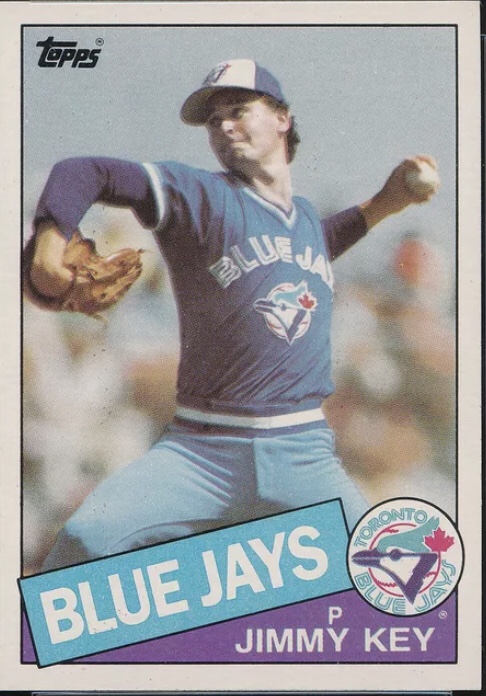
Jimmy Key. (1985). $110

1985 Topps #193 – Rookie Card
Value: $110.00 – Grade: 9

The ASHOF (Alabama Sports Hall of Fame):: https://youtu.be/ZCS2xaaSYoc

James Edward Key (born in Huntsville, AL on April 22, 1961) is a former left-handed starting pitcher in Major League Baseball who played for the Toronto Blue Jays (1984–1992), New York Yankees (1993–1996), and Baltimore Orioles (1997–1998). His best personal years were in 1987, when he posted a 17–8 record with a league-leading 2.76 ERA, and in 1993, when he went 18–6 with a 3.00 ERA and 173 strikeouts. With the Blue Jays, he won the 1992 World Series and with the Yankees, he won the 1996 World Series, both over the Atlanta Braves. Key was drafted by the Toronto Blue Jays in the third round of the 1982 amateur draft. He worked his way up the Blue Jays’ minor league system during 1982 and 1983, putting up respectable numbers with the Florence Blue Jays (South Atlantic League), the Medicine Hat Blue Jays (Pioneer League), the Knoxville Blue Jays (Southern League), and the Syracuse Chiefs (International League) before heading to Toronto. Key made his Major League debut on April 6, 1984, and was utilized in relief situations through his inaugural year, notching 10 saves and a 4.65 ERA. He wore number 27 in his first season and 22 for the duration of his Blue Jays career. Key moved into the starting rotation in 1985 and quickly became a cornerstone in the rotation, leading the Blue Jays to their first postseason appearance that year. In 1987, Key led the major leagues with a 2.76 earned run average and finished second behind Roger Clemens in voting for the American League Cy Young Award. In Game 4 of the 1992 World Series, Key made his final start for the Blue Jays, surrendering one run over 7+2⁄3 innings to earn a 2-1 win and put the Jays up 3 games to 1. He left the game to a tremendous ovation. Key would appear once more in the series, as a reliever in the 10th and 11th innings of the 6th and deciding game, earning another winning decision in the series.

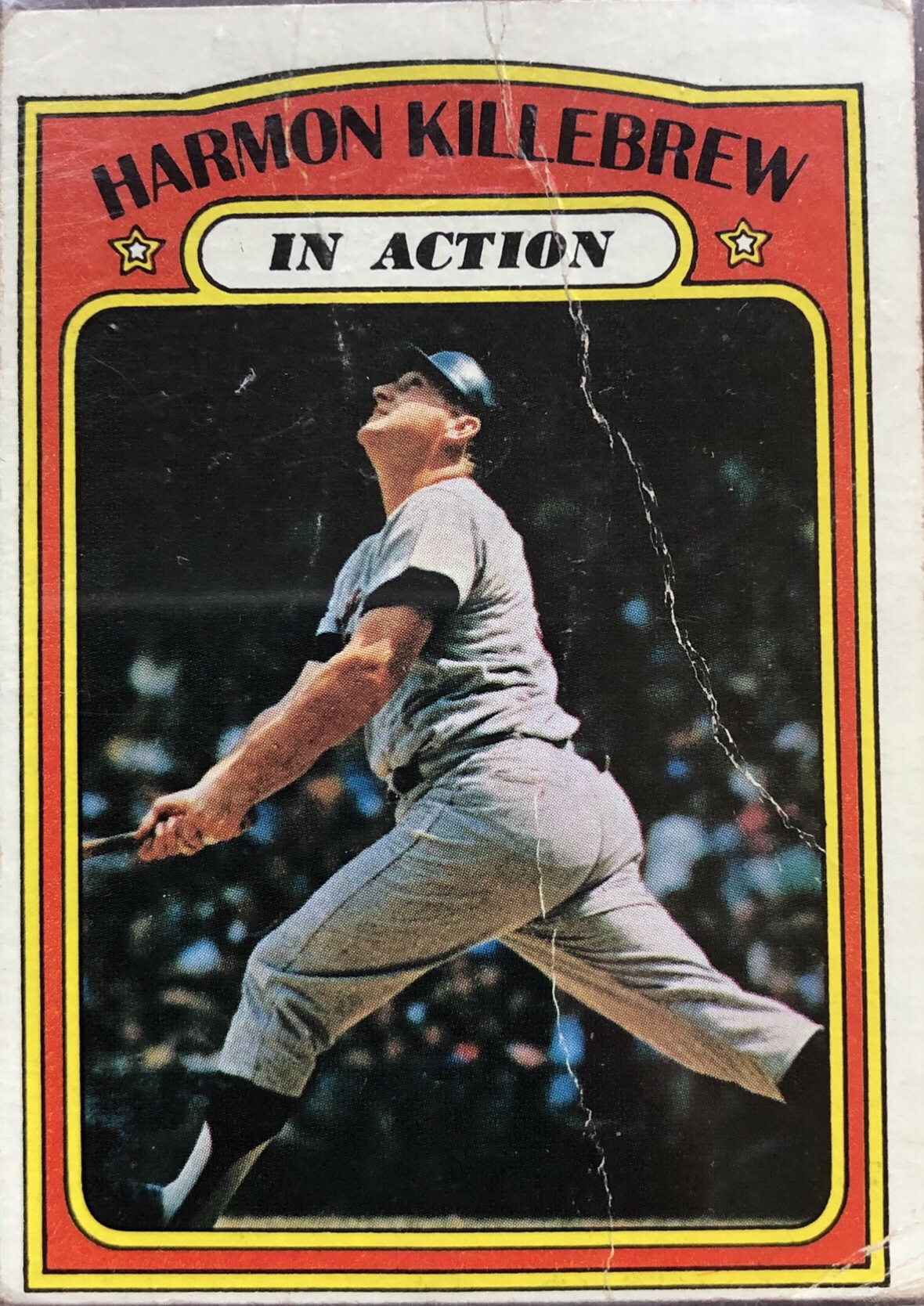
Harmon Killebrew. (1971). $45

1971 Topps #52 – Value: $45.00 – Grade: 4

A Tribute: https://youtu.be/BohnDEVrYoA

#69 of the Top 100 Players

Harmon Clayton Killebrew (Born in Payette, ID on June 29, 1936 – May 17, 2011) blasted a 530 ft. home run into the upper deck of Metropolitan Stadium, reportedly shattering two chairs, which were eventually repainted and never sold again. Signed as a boy wonder, the Washington Senators-turned-Minnesota Twins slugger caused fans, media and player alike to wonder if he might be the player to surpass the almighty Babe Ruth’s records. Killer led the American League six times in home runs, topping the 40-mark eight times. He drove in 100 or more runs nine times during his career and was a fixture among Most Valuable Player voting for eleven years, winning the prestigious award in 1969. Harmon played 22 seasons for the Washington Senators/Minnesota Twins (1954-1960, 1960-1974) and the Kansas City Royals (1975). Killebrew’s gentle nature both on and off the field helped him be a versatile asset to keep in the line-up, playing wherever asked without complaint in order to keep him mighty bat in the game. Harmon Killebrew retired with 573 home runs, 2,086 hits, 1,584 RBI, a .509 career slugging percentage, and a .256 career batting average. Harmon Clayton Killebrew was elected to the National Baseball Hall of Fame in 1984.