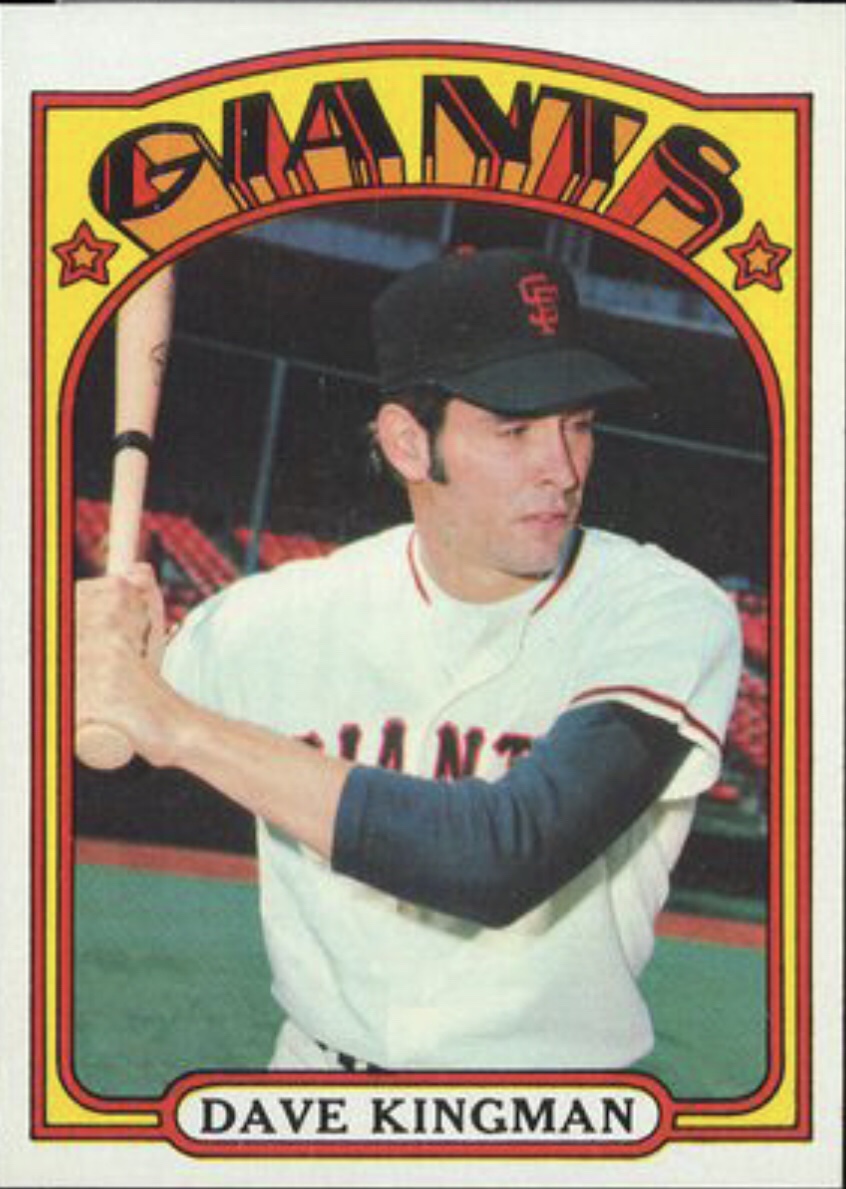
Dave Kingman. (1972). $3100

1972 Topps #147 – Rookie Card
Value: $1500.00 – Grade: 9

A Tribute: https://youtu.be/b-jpnxb2M_M

David Arthur “King Kong” Kingman (Born in Pendleton, OR on December 21, 1948-) was one of Major League’s most dangerous hitters of the 1970s and 1980s, and holds the unenviable distinction of being the first player to hit 400 or more career home runs without gaining election – or even serious consideration for entry – to the Baseball Hall of Fame. The California Angels drafted Kingman out of high school in the 1967 Major League Baseball Draft, and the Baltimore Orioles drafted him in the first round of the 1968 Draft, but he instead opted to play ball at the University of Southern California. The San Francisco Giants picked Kingman in the first round (1st pick) of the 1970 amateur draft. He spent relatively uneventful seasons with the Giants (1071-1974), New York Mets (1975-1977, 1981-1983), San Diego Padres (1977), California Angels (1977), and New York Yankees (1977) before gaining prominence with the Chicago Cubs (1978-1980). His best season came while playing on Chicago’s Northside, batting .288 with 115 RBI and leading the National League with 48 home runs. He finished his career with the Oakland Athletics (1984-1986), being named the 1984 American League Comeback Player of the Year. Having played left field, first base, and served as a designated hitter, Kingman was a two-time National League Home Run Champion and three-time All-Star, retiring with a .236 batting average, 1,210 RBI and 442 career home runs.
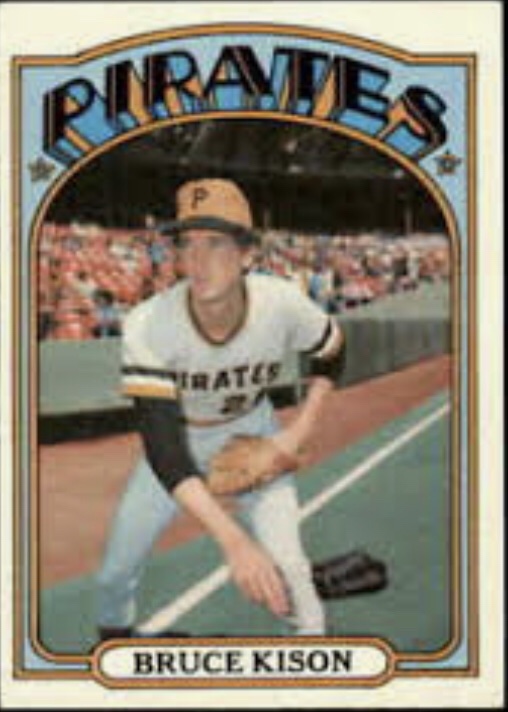
Bruce Kison. (1972 RC). $65

1972 Topps #72 – Rookie Card
Value: $65.00 – Grade: 9

Remembering Bruce Kison: https://youtu.be/6nvz-c60xXc

Bruce Eugene Kison (Born in Pasco, WA on February 18, 1950 – June 2, 2018) was an American professional baseball pitcher, who played in Major League Baseball (MLB) for the Pittsburgh Pirates (1971–79), California Angels (1980–84) and Boston Red Sox (1985). Kison won two World Series championships with the Pirates, both over the Baltimore Orioles, and is perhaps best remembered for throwing 6+1⁄3scoreless innings of relief to win Game 4 of the 1971 World Series. He batted and threw right-handed. Kison grew up in Pasco, Washington, and was drafted by the Pirates in the 14th round of the 1968 Major League Baseball draft. He reached the major leagues in 1971 and relieved Luke Walker in the first inning of Game 4 of the World Series, throwing 6+1⁄3scoreless innings as he enabled the Pirates to come from behind to win the game, and ultimately the Series. Bothered by a sore shoulder the next two years, Kison adjusted his delivery in the 1973–74 offseason, becoming a full-time starter by the middle of 1974. In 1976, he set career highs in wins (14) and earned run average (ERA) (3.08). He had a disappointing 1977 season, partly because of hangnail problems, and in 1978, he was moved back to the bullpen to start the year. He regained his rotation spot halfway through the season, though, and proved an important member of the Pirates’ rotation once again in 1979, winning the season’s final game to send the Pirates to the playoffs. He struggled in his only start of the World Series but won his second World Series ring as the Pirates defeated the Orioles again. A free agent after the 1979 season, he signed a five-year contract with the Angels, but struggled with injuries his first couple of seasons and even tried to give the team back some of his contract money. In 1982, though, he helped the Angels reach the playoffs and won a game for them in the American League Championship Series against the Milwaukee Brewers. A herniated disk suffered in 1983 threatened to end his career, but he returned to the Angels late in 1984 and pitched one final season for the Boston Red Sox in 1985 before retiring. During a 15-year career, Kison compiled 115 wins with 88 losses, 1,073 strikeouts, and a 3.66 ERA. After his playing days were over, he served as a coach for the Kansas City Royals and the Baltimore Orioles, with whom he later served as a scout. He died June 2, 2018, at the age of 68.

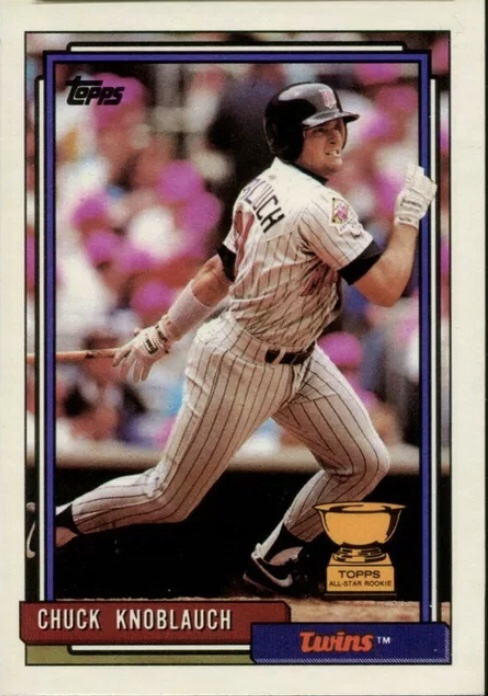
Chuck Knoblauch (‘92 RC) $58

1992 Topps #23 – Rookie Card
Value: $58.00 – Grade: 9

Career Highlights: https://youtu.be/oJvt2wQV4JY

Edward Charles Knoblauch (born in Houston, TX on July 7, 1968) is an American former professional baseball player. He played 12 seasons in Major League Baseball, from 1991 through 2002, for the Minnesota Twins, New York Yankees, and Kansas City Royals. He played mostly as a second baseman before moving to left field for his final two seasons. Knoblauch was drafted by the Minnesota Twins in the first round of the 1989 MLB draft. Knoblauch won the American League Rookie of the Year award and a World Series ring as a member of the 1991 Minnesota Twins. In Game 7 of the World Series, Knoblauch attempted to deceive Lonnie Smith by appearing to start a double play on a Terry Pendleton double (causing Smith to get only to third base when he might have scored for the Atlanta Braves). Smith claimed he lost track of the ball and Knoblauch’s decoy was not a factor. During the 1994–96 seasons, Knoblauch batted .312, .333, and .341, respectively, won the AL Gold Glove Award at second base in 1997, and stole over 40 bases in three consecutive seasons. After the 1997 season, Knoblauch was traded to the Yankees in exchange for four players (including two future All-Stars, Eric Milton and Cristian Guzmán) and US$3 million. Once a popular player in Minnesota, his request to be traded from the Twins resulted in being booed on successive trips to the Metrodome. This included throwing hot dogs, bottles, and golf balls at Knoblauch during a visit to the Metrodome in 2001.

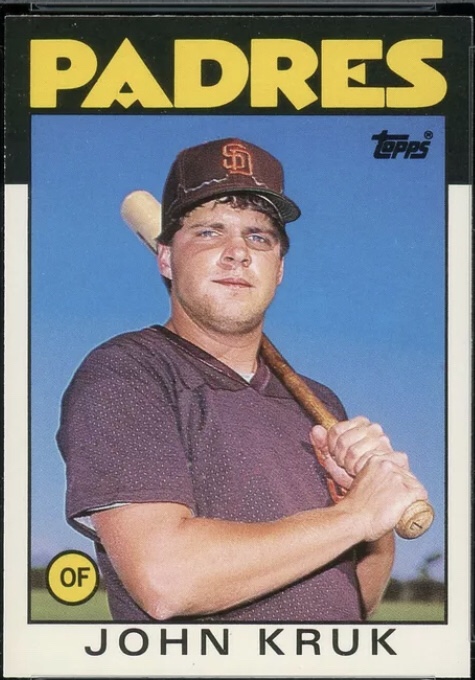
John Kruk. (1986 RC). $175

1986 Topps #56T – Rookie Card
Value: $175.00 – Grade: Mint

Greatest Man Alive: https://youtu.be/2eLU1mWBkeU

John Martin Kruk (born in Keyser, WV on February 9, 1961) is an American former professional baseball first basemanand outfielder. Kruk played in Major League Baseball(MLB) for the San Diego Padres, Philadelphia Phillies, and Chicago White Sox from 1986 through 1995. During his career, he was a three-time MLB All-Star. After retiring as a player, Kruk became a baseball analyst for ESPN. He is now a color commentator for Phillies’ games on NBC Sports Philadelphia. Kruk signed as a #3 Special Draft selection on June 13, 1981 with scout Hank Zacharias. He began his professional career with the San Diego Padres after being drafted in 1981. He played in such outposts as Walla Walla, Reno, Beaumont, and Las Vegas, before making his debut with the Padres in 1986. In this same year he played for the Águilas de Mexicali of the Mexican Pacific League for the 86–87 season. Kruk helped Mexicali win both the League championship and Caribbean Series title. Kruk’s breakout year was 1987 with the Padres. He hit .313 with 20 home runs and 91 RBI, and stole 18 bases, showing surprising speed for someone of his build, although he was caught ten times. He was featured as a backup on the National League All-Star Team in the Nintendo game R.B.I. Baseball. On April 13, 1987, Marvell Wynne, Tony Gwynn, and Kruk became the first players in major league history to open their half of the 1st inning with three consecutive solo home runs in a 13–6 loss to the San Francisco Giants. In October 1987, Kruk rented a house in San Diego with two other men: Roy Plummer, a high school friend, and Vernon (Jay) Hafer, an acquaintance of Plummer’s. They socialized and partied together, with Plummer almost always picking up the check. Unbeknownst to Kruk, who moved out in November to play winter ball in Mexico, Plummer was funding the group’s lifestyle by moonlighting as an armed robber, with Hafer serving as his getaway driver. The FBI informed Kruk of his roommates’ criminal activities during spring training in February 1988, approaching him before batting practice with a photo of Plummer taken during a bank robbery. According to the FBI, Plummer believed that Kruk had turned him in to the police, and Kruk lived in fear of reprisal until Plummer was apprehended on September 19, 1988. Kruk has stated that the ongoing stress from the episode negatively affected his on-field performance that season.

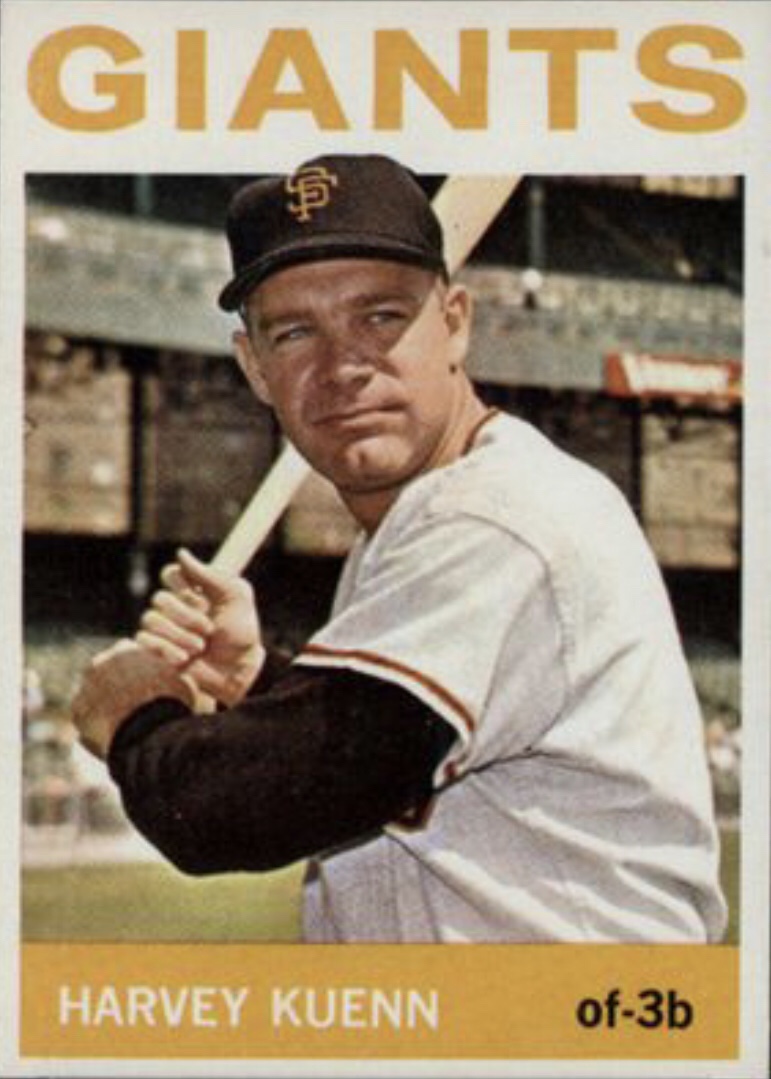
Harvey Kuehn. (1964). $63

1964 Topps #242 – Value: $63.00 – Grade: 7

1953 Rookie of the Year Candidates: https://youtu.be/PCICBGVwynE

Harvey Edward Kuenn (Born in West Allis, WI on December 4, 1930 – February 28, 1988) played only 63 minor league games before being called up by the Detroit Tigers where he tore up the league earning the 1953 American League Rookie of the Year Award. Kuenn enjoyed an extraordinary rookie campaign as he led the American League in plate appearances (731), at-bats (679) and hits (209), setting a rookie record with 167 singles in 155 games. He also earned his first of eight All-Star Game appearances and consideration for the league’s Most Valuable Player Award for his first of nine times. Harvey came up with the Tigers as a shortstop, but eventually moved to the outfield when Billy Martin was acquired from the Kansas City Athletics. Kuenn led the league four times in hits, three times in doubles, twice in at-bats and once in plate appearances and games and won the 1959 batting title with a .353 average. He was often among the league elite in batting as he hit .300 or better nine times in his 15-year career. No slouch in the field, Harvey finished his career with a .966 career fielding percentage with 3,028 putouts, 2,345 assists, 468 double plays and 1919 errors in 5,564 chances. Harvey played 15 years for the Tigers (1952-1959), the Cleveland Indians (1960), the San Francisco Giants (1961-1965), the Chicago Cubs 91965-1966) and the Philadelphia Phillies (1966). He appeared in one World Series losing effort with the Giants who lost to the New York Yankees in 1962. Harvey Kuenn ended his career with a .303 batting average, 2,092 hits including 356 doubles, scored 951 runs and drove in 671 RBI.

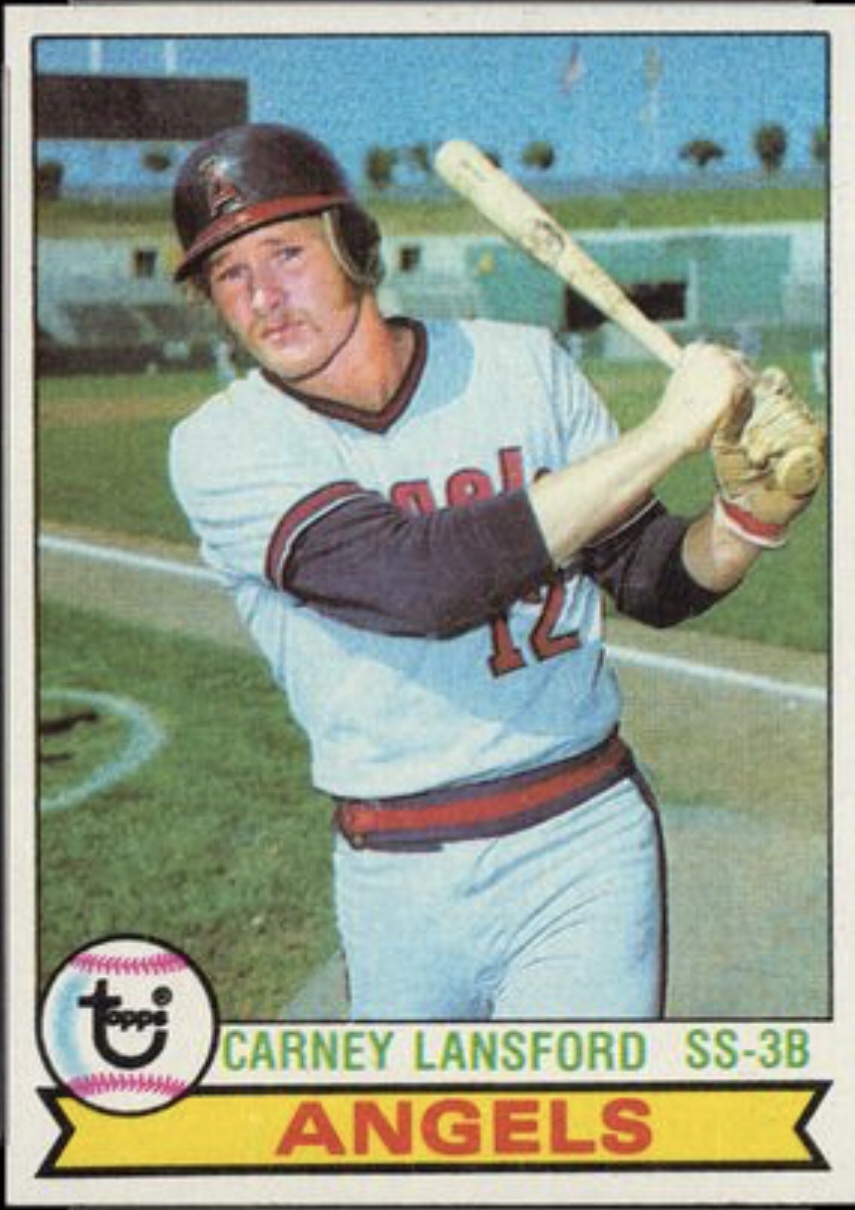
Carney Lansford. (‘79 RC) $15

1979 Topps #212 – Rookie Card
Value: $15.00 – Grade: 9

Origin of the “Bash Brothers” Nickname (1989 World Series): https://youtu.be/c76DKl9vhSs

Carney Ray Lansford (Born in San Jose, CA on February 7, 1957) is a former Major League third baseman who played for three different teams during his 15-year career. The California Angels selected Lansford in the third round of the 1975 amateur draft, and upon his 1978 big league debut, became one of the team’s best rookie players. After just a few seasons with the Angeles (1978-1980), the team traded him to the Boston Red Sox (1981-1982), with Lansford taking the American League batting title in the strike-shortened 1981 season, as well as earning a Silver Slugger Award. The emergence of Wade Boggs in the BoSox organization led to Lansford being sent to the Oakland Athletics (1983-1992), and established himself as their star third baseman during late-1980s and early-1990s reign, including his sole All-Star Game selection (1988). He retired with one World Series ring (1989) in three appearances, a career .290 average, 151 home runs, 224 stolen bases, and 874 RBI.

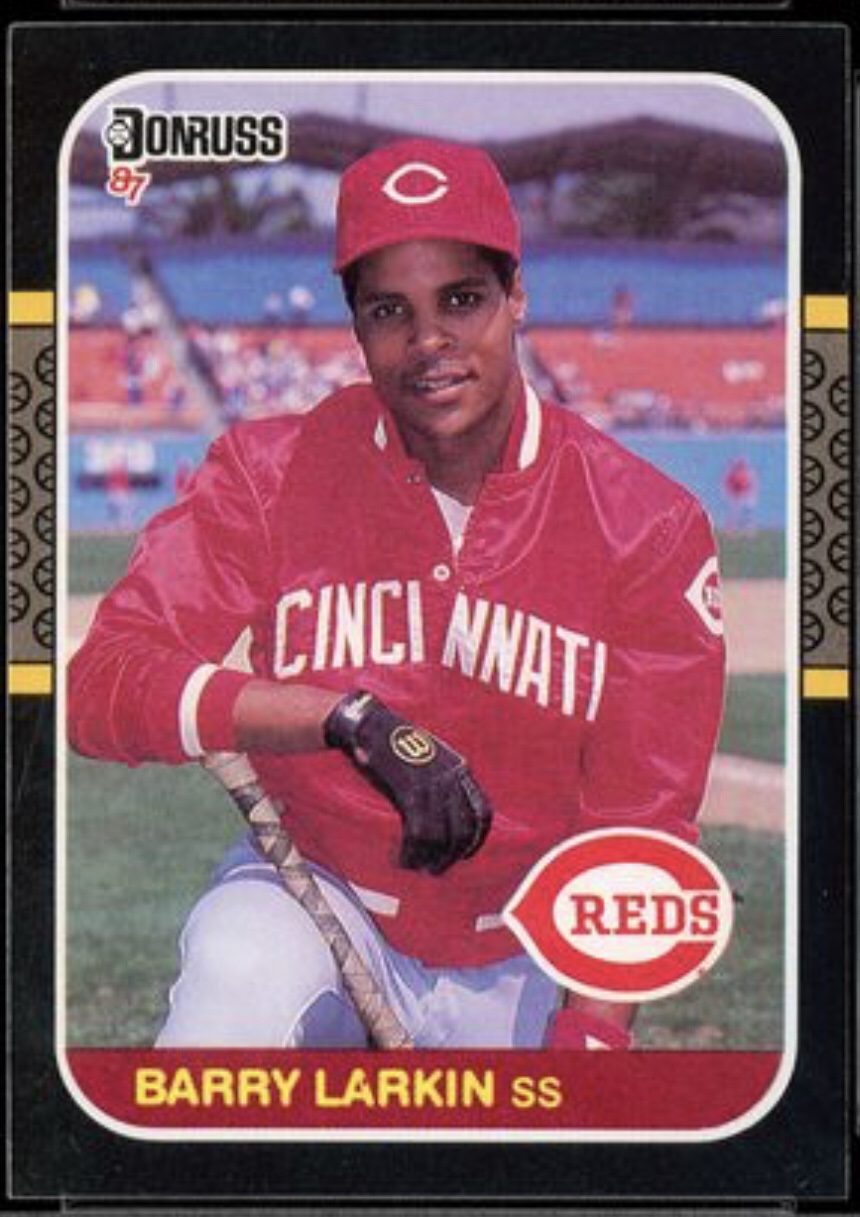
Barry Larkin. (1987 RC). $11

1987 Topps #492 – Rookie Card
Value $11.00 – Grade: 9

Hall of Fame Biography: https://youtu.be/OUI1HWpcQ18

Barry Louise Larkin (Born in Cincinnati, OH on April 28, 1964-) is the first shortstop to hit five home runs in a two game span, was a fixture in the Cincinnati Reds shortstop position throughout the 1990s and 2000s, but was unfortunate in that he played in the National League with Hall of Fame Shortstop Ozzie Smith. Barry attended the University of Michigan and was the starting shortstop of the 1984 United States Olympic Team that captured the silver medal in Los Angeles. The Cincinnati Reds drafted the soon-to-be hometown hero with the fourth pick overall in the 1985 MLB June Amateur Draft. Barry was now on his way to fulfilling his childhood dream of replacing Dave Concepcion as the Reds starting shortstop. Larkin took over the starting spot in his second season and did not relinquish his role until his retirement in 2004, playing with Cincinnati for his entire career (1986-2004). In 1990, the Cincinnati Reds marched to a World Series victory, sweeping the heavily favored Oakland Athletics, as Barry hit .353 with six hits for the Reds. Nine times during his 19-year career, Barry topped the .300-mark at the plate and won the National League Silver Slugger an equal number of times. Barry’s best year came in 1995 as he batted .319 with 158 hits, 15 home runs, 66 RBI and 51 stolen bases as he earned his 7th of 12 All-Star Game selections, his second of three Rawlings Gold Gloves and the National League’s Most Valuable Player Award. He won the 1993 Roberto Clemente Award as the “player who best exemplifies the game of baseball, sportsmanship, community involvement and the individual’s contribution to his team.” Barry was also named the 1994 Lou Gehrig Award winner as one “player who best who best exemplifies his character and integrity both on and off the field.” Barry Larkin wrapped up his career following the 2004 season having amassed 2,340 hits including 441 doubles and 198 home runs, 1,329 runs, 379 stolen bases and 960 RBI while batting .295 over his career. Having taken over as the National League’s top shortstop as Ozzie Smith’s career waned, Barry also posted a .975 career fielding percentage with 3,154 putouts, 5,858 assists, 1,092 double plays and an astounding 235 errors in 9,243 chances while winning five NL Gold Gloves. Barry Larkin was inducted into the National Baseball Hall of Fame in 2012

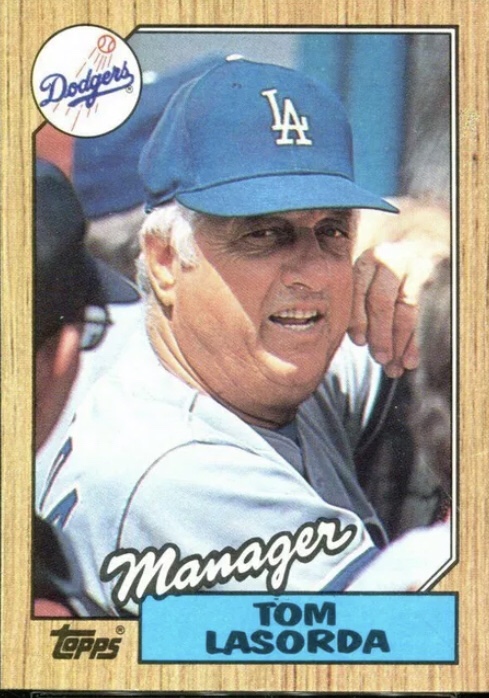
Tom Lasorda. (1987). $99

1987 Topps #493 – Value: : $99.00 – Grade: 9

Hall of Fame Induction Speech: https://youtu.be/gJdOuA36H1Y

Thomas Charles Lasorda (Born in Norristown, PA on September 22, 1927 – January 7, 2021) was an American professional baseball pitcher and manager. He managed the Los Angeles Dodgers of Major League Baseball (MLB) from 1976 through 1996. He was inducted into the National Baseball Hall of Fame as a manager in 1997.

Lasorda graduated from Norristown High School in Norristown, Pennsylvania, in 1944. He signed with the Philadelphia Phillies as an undrafted free agent in 1945 and began his professional career that season with the Concord Weavers of the Class D North Carolina State League. He missed the 1946 and 1947 seasons because of a stint in the United States Army. He served on active duty from October 1945 until spring 1947. Lasorda returned to baseball in 1948 with the Schenectady Blue Jays of the Canadian–American League. On May 31, 1948, he struck out 25 Amsterdam Rugmakers in a 15-inning game, setting a professional record, and drove in the winning run with a single. He played with Schenectady from 1948 through 1950.Lasorda then played for Almendares of the Cuban League in Havana, Cuba in 1950–52 and again in 1958–60, compiling a 16-13 record in four seasons, including 8-3 with a 1.89 ERA in 1958-59. Lasorda also pitched for Marianao, a league rival of Almendares also in the Havana area.

Lasorda became the Los Angeles Dodgers manager September 29, 1976, upon Alston’s retirement. When asked by broadcaster Vin Scully if he felt any pressure replacing Alston, Lasorda responded, “No, Vin, I’m worried about the guy who’s gonna replace me. That’s the guy who’s gonna have it tough.” He managed the final four games of the 1976 season. Lasorda compiled a 1,599–1,439 record as Dodgers manager, won two World Series championships (1981 and 1988), four National League pennants, and eight divisiontitles in his 20-year career as the Dodgers manager. His 16 wins in 30 NLCS games were the most of any manager at the time of his retirement. His 61 postseason games ranks fourth all-time behind Bobby Cox, Casey Stengel (all of whose games took place during the World Series in baseball’s pre-LCS days), and Joe Torre. He also managed in four All-Star games. Lasorda managed nine players who won the NL Rookie of the Year Award. The winners came in two strings of consecutive players. From 1979 to 1982, he managed Rick Sutcliffe, Steve Howe, Fernando Valenzuela, and Steve Sax. From 1992 to 1995, he managed Eric Karros, Mike Piazza, Raúl Mondesí, and Hideo Nomo. Before retiring during the 1996 season, he had also managed that year’s eventual winner, Todd Hollandsworth. Lasorda’s final game was a 4–3 victory over the Houston Astros, at Dodger Stadium, on June 23, 1996. The following day, he drove himself to the hospital complaining of abdominal pain, and in fact was having a heart attack. He officially retired on July 29, 1996. His 1,599 career wins rank 22nd all-time.

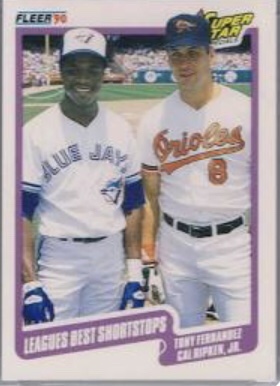
League’s Best (SS) (1990). $40

1990 Fleer #634 – Value: $40.00 – Grade: Mint

Montage: https://youtu.be/Ow0yswiOnrk

Calvin Edwin Ripken Jr. (born in Havre de Grace, MD on August 24, 1960), nicknamed “The Iron Man”, is an American former baseball shortstop and third baseman who played 21 seasons in Major League Baseball (MLB) for the Baltimore Orioles(1981–2001). One of his position’s most offensively productive players, Ripken compiled 3,184 hits, 431 home runs, and 1,695 runs batted in during his career, and he won two Gold Glove Awards for his defense. He was a 19-time All-Star and was twice named American League (AL) Most Valuable Player (MVP). Ripken holds the record for consecutive games played, 2,632, surpassing Lou Gehrig’s streak of 2,130 that had stood for 56 years and that many deemed unbreakable. In 2007, he was elected to the National Baseball Hall of Fame in his first year of eligibility with 98.53% of votes, the sixth-highest election percentage ever.

Memories of Tony’s Baseball: https://youtu.be/PcriUj6y8B0

Octavio Antonio Fernández Castro (Born in San Pedro de Macoris, DR on June 30, 1962 – February 16, 2020), better known as Tony Fernández, was a Dominican shortstop in Major League Baseball (MLB) who played for seven teams from 1983 to 2001, most notably the Toronto Blue Jays. A five-time All-Star, Fernández was known for his defensive skills, winning four consecutive Gold Glove Awards(1986–1989). He batted over .300 four times, led the major leagues with 17 triples in 1990, collected 30 doubles six times and 20 stolen bases seven times. He also led American League shortstops in assists three times, and in putouts and fielding average twice each. After moving to the National League in a blockbuster trade following the 1990 season, he returned to the Blue Jays in a mid-season trade in 1993, and played a major role in helping the club repeat as World Series champions, batting .333 with nine runs batted in during the series.

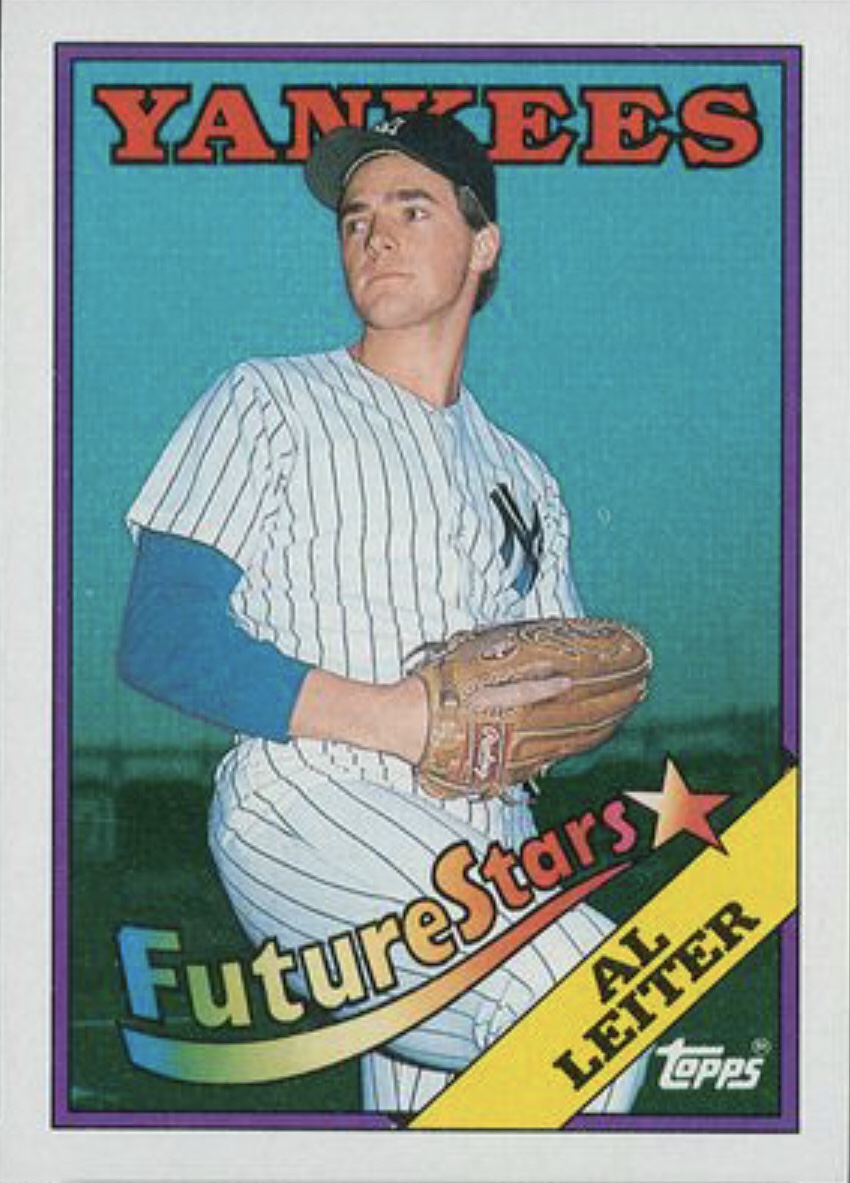
Al Leiter. (1988 RC). $24

1988 Topps #18 – Rookie Card
Value: $24.00 – Grade: Mint

Analyzing the Evolution of Pitching: https://youtu.be/_BlucbtoljM

Alois Terrance “Al” Leiter (Born in Toms River, NJ on October 23, 1965-) is a former left-handed Major League Baseball pitcher best remembered for his no-hitter on May 11, 1996 – the first no-hitter in Florida Marlins history. The New York Yankees took Leiter in the 2nd round of the 1984 amateur draft, debuting for the Bronx Bombers late in the 1987 season and recording a win in his first big league appearance. Nagging blisters on Leiter’s pitching hand during his first stint in New York (1987-1989) led the Yankees to trade him to the Toronto Blue Jays (1989-1995), where the lefty continued to be troubled by injuries and recovery from Tommy John surgery. Traded to the Marlins (1996-1997, 2005), Leiter pitched the first no-hitter in that team’s history in a game against the Colorado Rockies, and made his first of two All-Star Game appearances (1996, 2000). As a member of the New York Mets (1998-2004), Leiter made baseball history on April 30, 2002, as the first pitcher to defeat all 30 Major League teams during his career. He ended his career in 2005 following brief returns to both the Marlins and Yankees, retiring with a 162-132 record, a 3.80 ERA, and 1,974 strikeouts.